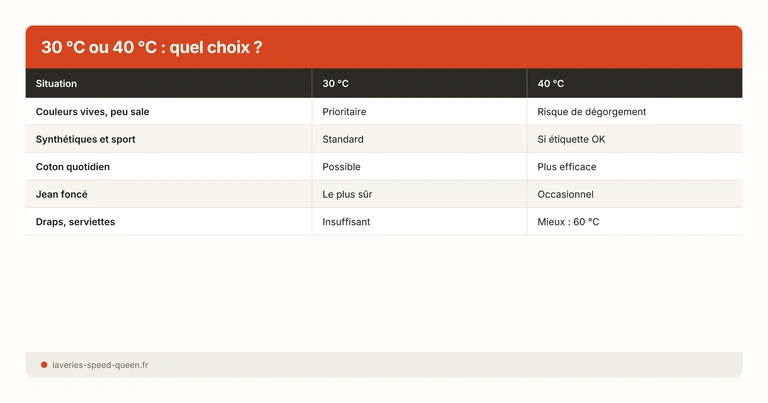
In short: 30 °C is the right reflex for colours, synthetics and lightly soiled everyday laundry. 40 °C becomes more relevant when cotton still comes out loaded with sebum, odour or light soil. The real mistake is not choosing 30 or 40 °C, but using the same setting for all fabrics without checking the label or the actual soil level.
At a glance
30 °C — colours, synthetics, prints, lightly soiled laundry.
40 °C — dirtier everyday cotton, persistent light odour, sebum.
60 °C — bedding, towels, tea towels and targeted hygiene if the label allows.
The right criterion — fibre + soil level + hygiene need, not just habit.
Quick answer: should you wash at 30 or 40 °C?
Most everyday clothes wash well at 30 °C when they are lightly to moderately soiled. Go to 40 °C when the fabric retains more sebum, odour or soil, without going as far as cases requiring 60 °C for hygiene.
The question “30 or 40” comes up often because these two settings cover most daily needs. In practice, it is not an abstract duel between savings and cleanliness: it is a trade-off between three very concrete things.
- the fabric’s tolerance to heat;
- the actual soil level;
- the hygiene need, which is not the same for a t-shirt worn for a day and a pillowcase.
| Situation | 30 °C | 40 °C | Useful note |
|---|---|---|---|
| Bright colours, lightly soiled laundry | ✅ Priority | ⚠️ Not always useful | 30 °C limits colour bleeding and visual wear |
| Synthetics and sportswear | ✅ Most common | ⚠️ Only if the label allows | Excessive heat damages elastane |
| Moderately soiled everyday cotton | ✅ Possible | ✅ Often more effective | 40 °C gives more margin on sebum and odours |
| Jeans and dark denim | ✅ Safest | ⚠️ Occasional cases | Opt for 30 °C to preserve colour |
| Sheets, towels, tea towels | ❌ Often insufficient | ⚠️ Intermediate | The real issue often shifts to 60 °C |
What really changes going from 30 to 40 °C
Going from 30 to 40 °C does not turn a poor wash into a full disinfection. However, that extra step often helps with sebum, light perspiration, modest odours and everyday cotton.
Competitors visible on this query often sum up the topic as “30 for ecology, 40 for better cleaning”. That is too vague. What really matters is the nature of the stains.
30 °C protects colours better
This is the most logical setting for lightly soiled garments, dark fabrics and heat-sensitive fibres. It reduces the risk of unnecessary colour bleeding and shrinkage.
40 °C helps with sebum
On a cotton t-shirt worn all day, pyjamas, majority-cotton leggings or regular underwear, 40 °C gives more margin than 30 °C without unnecessarily going to 60 °C.
Detergent matters as much as the number
The right load size, accurate dosing and a detergent suited to the temperature often make more difference than automatically switching from 30 to 40 °C.
The classic trap of the \u201c30 or 40?\u201d question
Many people hesitate between 30 and 40 °C when the real answer depends first on the fabric. A technical garment that smells strong should not necessarily go to 40 °C, and a white sheet should not be limited to 30 °C just “to save energy”. If you are unsure about the tub symbol first, start with the care labels guide.
Comparison chart: 30 °C vs 40 °C vs 60 °C by fabric
To decide quickly, here is the recommended temperature for each common fabric type, with the reasoning behind it.
| Fabric | 30 °C | 40 °C | 60 °C | Main reason |
|---|---|---|---|---|
| Coloured cotton t-shirt | ✅ | ✅ | — | 30 °C if lightly soiled, 40 °C if loaded with perspiration |
| Jeans / denim | ✅ | ⚠️ | — | 30 °C preserves indigo and limits shrinkage |
| Sportswear (polyester) | ✅ | — | — | Heat damages elastane and membranes |
| White cotton shirt | ⚠️ | ✅ | ✅ | 40 °C daily, 60 °C for whitening |
| Cotton underwear | — | ✅ | ✅ | 40 °C routine, 60 °C for enhanced hygiene |
| White cotton sheets | — | ⚠️ | ✅ | 60 °C eliminates dust mites and accumulated sebum |
| Bath towels | — | — | ✅ | 60 °C needed against mould and bacteria |
| Kitchen tea towels | — | — | ✅ | Food contact: strict hygiene |
| Wool / cashmere jumper | ✅ | — | — | 30 °C max or dedicated wool programme |
| Viscose dress / blouse | ✅ | — | — | Viscose shrinks and deforms with heat |
| Cotton pyjamas | ✅ | ✅ | — | 40 °C if worn several nights (prolonged skin contact) |
| Baby clothes | — | ⚠️ | ✅ | 60 °C for heavily soiled items (bibs, bodysuits) |
Key: ✅ = recommended, ⚠️ = possible depending on label and soil level, — = not recommended or unnecessary. This chart is a starting point; always check each garment’s care label.
When 30 °C is the best choice
Choose 30 °C whenever your priority is to preserve the fabric rather than tackle heavy soiling.
Dark and bright colours
Black, navy, red, prints: 30 °C limits colour bleeding and loss of vibrancy better than 40 °C.
Synthetics and delicate blends
Polyester, elastane, sportswear, technical blouses: 30 °C is often more consistent with the fibre and the label.
Lightly soiled laundry
A shirt worn briefly, a top without stains, a lightly worn pair of jeans or a simply refreshed garment wash well at 30 °C.
Items prone to shrinkage
Dark denim, prints, items with elastane or a fitted cut: 30 °C reduces the risk of shrinkage and visual wear.
If your question is mainly about the actual cold range and the difference between 20, 30 and the “cold” button, also read our dedicated cold wash guide. For large volumes or fabrics that need more space, check out our laundromats with machines suited to every need.
When 40 °C makes more sense
Go to 40 °C when 30 °C leaves a slightly too narrow cleaning margin, but the fabric does not warrant 60 °C.
| Type of laundry | Why 40 °C helps | Point of caution |
|---|---|---|
| Everyday cotton t-shirts and tops | More margin on perspiration, sebum and light odour | Check the colour and label |
| Regular underwear | More solid setting than 30 °C when well worn | 60 °C is reserved for targeted hygiene cases |
| Cotton pyjamas and indoor wear | Prolonged skin contact loads the fabric more | Do not exceed if the garment contains a lot of elastane |
| Moderately soiled coloured cotton | 40 °C is often the best everyday compromise | Avoid for very fragile colours |
The right use of 40 °C
40 °C is not the “universal default setting”. It is mainly the right intermediate step when you are dealing with everyday laundry, but with a bit more soil, sebum or odour than a simple 30 °C cycle.
When the question should no longer be “30 or 40?”
As soon as the topic becomes bedding, towels, tea towels, some heavily soiled baby items or allergy-related hygiene, the real question shifts to 60 °C.
Competing pages often mix all three topics on the same page. That is precisely what makes the answer vague. Here, the separation is deliberate:
30 °C= preserve and maintain light everyday items;40 °C= boost everyday cleaning;60 °C= target more demanding hygiene on the right fabrics.
If you are in that third category, continue with washing at 60 °C: which clothes and when to avoid it?.
Practical cases to avoid mistakes
Raw or dark jeans
30 °C, turned inside out, with a drum that is not overloaded. 40 °C is only occasional if the jeans are genuinely dirty and the label allows it.
Lightly soiled white cotton t-shirt
30 °C can suffice if simply worn. If the collar is greasy or the odour lingers, 40 °C becomes more appropriate.
Synthetic sportswear
Stay at 30 °C without fabric softener. Going to 40 °C is not the priority move on technical fibres.
Pillowcases and sheets
Do not think of them like a t-shirt. Bedding has a different hygiene concern. See how often to wash sheets and our anti dust mite protocol.
Energy consumption: the real impact on your bill
Washing temperature is the primary energy lever for a washing machine. Heating the water accounts for 80 to 90 % of the energy consumed during a cycle.
ADEME estimates that a 30 °C cycle uses about 0.4 kWh, compared with 0.6 kWh at 40 °C and 1.0 kWh at 60 °C. In other words, washing at 30 °C uses about 40 % less energy than a 60 °C cycle, and 30 % less than a 40 °C cycle. Over a year with one wash per week, the difference represents about EUR 15 to 25 on the electricity bill between a systematic 60 °C habit and a reasoned 30 °C approach.
To put these numbers in perspective: an average French household does about 5 cycles per week (260 cycles/year according to ADEME). If all those cycles switch from 40 °C to 30 °C, the annual saving is about 52 kWh, or EUR 13 at the 2026 regulated rate (~EUR 0.25/kWh). This is not spectacular at an individual level — but nationally, with 25 million equipped households, systematically lowering by 10 °C represents the equivalent of a small power plant’s annual output.
| Temperature | Consumption / cycle | Cost / cycle (at EUR 0.25/kWh) | Annual cost (52 cycles) | Saving vs 60 °C |
|---|---|---|---|---|
| 30 °C | ~0.4 kWh | ~EUR 0.10 | ~EUR 5 | -60 % |
| 40 °C | ~0.6 kWh | ~EUR 0.15 | ~EUR 8 | -40 % |
| 60 °C | ~1.0 kWh | ~EUR 0.25 | ~EUR 13 | Reference |
These figures are for domestic machines. In a professional laundromat, machines are optimised for energy efficiency with more powerful heating elements, but the logic remains the same: less heat = less energy.
Beyond the financial saving (modest at household level), the concern is also garment lifespan. Every cycle at a higher temperature accelerates fibre wear, colour fading and fabric shrinkage. Washing at 30 °C when it is sufficient is at once an economic, ecological and wardrobe-preserving choice.
The right reflex: reserve 60 °C for fabrics that genuinely need it (sheets, towels, tea towels, hygiene laundry). For everything else, choose between 30 and 40 °C based on actual soil level — that is where the real everyday lever lies.
At the laundromat: which programme to choose
At a Speed Queen laundromat, machines offer several pre-configured programmes that match this article’s recommendations. The “colours” programme runs at 30 °C — perfect for coloured garments and synthetics. The “cotton” programme runs at 40 °C — suited to dirtier everyday laundry. The “whites” programme goes up to 60 °C for sheets, towels and tea towels.
The advantage at a laundromat is that detergent is dosed automatically according to the chosen programme. You do not need to adjust the dosage based on the temperature — it is calibrated. A 30 °C cycle uses the same dosage as a 40 °C cycle, but the agitation time differs slightly to compensate for the lower temperature.
If you are hesitating between two machines (for example a 9 kg at 30 °C and a 9 kg at 40 °C), sort your laundry into two loads rather than putting everything into a single compromise programme. Two machines in parallel at the right temperature is faster and more effective than one machine at the wrong setting.
Common mistakes
- Using 40 °C out of habit — when 30 °C is enough for most lightly soiled coloured laundry.
- Staying at 30 °C despite a persistent odour — the right intermediate step is often 40 °C, not necessarily 60 °C.
- Thinking 40 °C = enhanced hygiene — for sheets, towels and allergies, the logic often changes.
- Ignoring the label — a comfort 40 °C on a delicate garment can cost more than a rewash.
- Confusing fabric with soil — a dirty technical garment is not treated like everyday white cotton.
Methodology and sources
This article deliberately isolates the decision between 30 °C or 40 °C, because competitors often answer with generalities. The goal here is more operational: decide between the two most common everyday settings, then redirect to 60 °C only when the intent shifts to targeted hygiene.
- ADEME, Entretien du linge : 10 conseils sante et environnement, published 20 November 2025, accessed 15 March 2026
- Clevercare / GINETEX, More eco-temperature tips, published 6 September 2023, accessed 15 March 2026
- GINETEX, Les symboles d’entretien textile, accessed 15 March 2026
Sources and references
- ADEME - Entretien du linge : 10 conseils sante et environnement (lien externe)
- Clevercare - More eco-temperature tips (lien externe)
- GINETEX - Symboles d’entretien textile (lien externe)
- Full washing temperature guide
- Cold wash: what temperature to choose?
As an Amazon Partner, we earn a small commission on purchases made via the affiliate links in this article — at no extra cost to you. This helps us maintain this site and produce free guides.
If you want the full version by fabric, head to our complete washing temperature chart. And if your hesitation is mainly about hygiene needs for sheets, towels or baby laundry, continue with our precise 60 °C guide .