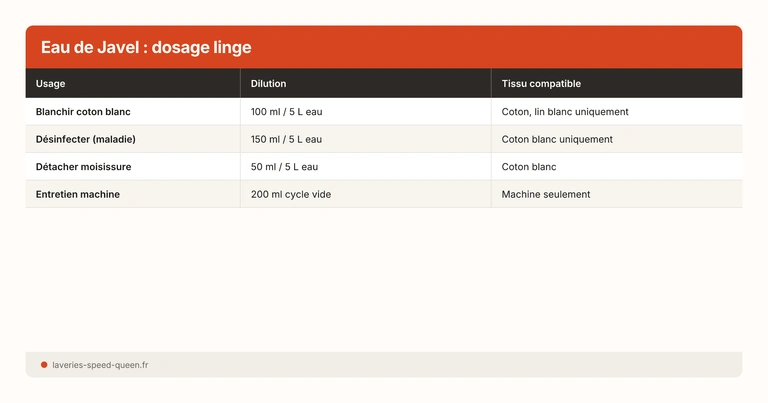
In short: bleach is a powerful disinfectant and whitener, but it should only be used on white cotton or white linen. On colours, it discolours. On synthetics, it yellows. On elastane, it breaks the fibres. Dosage: 1 glass (100 ml) per 5 litres of cold water, 30 min soak max. The alternatives ( sodium percarbonate, Sanytol) are more versatile and less aggressive. At the laundromat: no bleach in shared machines.
At a glance
White cotton and white linen only — bleach destroys colours and attacks synthetics.
Never pure, always diluted — 100 ml per 5 L of cold water. Concentrated bleach burns fibres.
30 minutes max soaking — beyond that, fibres weaken without additional benefit.
Never bleach + vinegar — the mixture produces toxic chlorine gas.
Percarbonate = universal alternative — whitens and disinfects without the risks of bleach.
No bleach at the laundromat — residues contaminate the next cycle.
How bleach works
To understand when to use bleach and when to avoid it, you need to understand its chemical mechanism.
Sodium hypochlorite: a powerful oxidiser
Household bleach is an aqueous solution of sodium hypochlorite (NaClO), generally at 2.6% active chlorine (current European standard). On contact with organic matter (stain, bacterium, textile fibre), hypochlorite releases active chlorine that oxidises molecules. This oxidation:
- Destroys pigments — coloured molecules are broken by oxidation, losing their colour (whitening)
- Destroys micro-organisms — the cell membranes of bacteria, viruses and fungi are oxidised and rupture (disinfection)
- Weakens fibres — cellulose chains (cotton, linen) are partially oxidised, reducing the mechanical strength of the fabric
This triple action makes bleach both highly effective and potentially destructive. It all comes down to dosage, exposure time and textile compatibility.
Temperature and bleach
Bleach is used with cold water (15-20 °C). Heat accelerates the decomposition of sodium hypochlorite — above 40 °C, bleach rapidly loses effectiveness and produces more chlorine gas (an irritant). This is why manufacturers recommend pouring bleach into the designated tray (which injects it during the cold rinse) and not into the detergent tray (which sends it during the hot wash phase).
When to use bleach on laundry
Bleach has its place in a limited number of very specific situations.
1. Whitening yellowed white cotton
White cotton laundry (sheets, tea towels, towels, white t-shirts) yellows over time from the accumulation of detergent residues, sebum and limescale. Bleach oxidises these residues and restores the original whiteness.
Protocol:
- Soaking: 100 ml of bleach in 5 L of cold water, 30 minutes
- Or in the machine: 100 ml in the bleach tray, cotton cycle at 40 °C
See also our complete guide: whiten yellowed laundry.
2. Disinfecting after a contagious illness
After flu, gastroenteritis or an infectious episode, the patient’s sheets, towels and pyjamas need disinfection. If these textiles are white cotton, bleach is the most powerful disinfectant — it destroys all pathogens, including the most resistant viruses (norovirus).
Protocol: 100 ml in the bleach tray, cotton cycle at 60 °C.
3. Treating mould stains on whites
Mould stains on white cotton (sheets stored damp, forgotten tea towels) respond well to bleach. Oxidation destroys mould spores and bleaches residual stains.
Protocol: localised soaking (bleach diluted 1:50 on the stain) for 15 minutes, then normal wash.
The golden rule of bleach
Before using bleach on a textile, ask yourself three questions: (1) Is it cotton or linen? (2) Is it white? (3) Does the label show a non-crossed-out triangle? If the answer is “yes” to all three, bleach is possible. Otherwise, use sodium percarbonate.
When to avoid bleach: the 5 prohibitions
- Coloured laundry — bleach destroys dye pigments. Irreversible discolouration: white spots, halos, faded colours. No dosage is safe on colours.
- Synthetics (polyester, nylon, acrylic) — bleach does not whiten these fibres. On white polyester, it causes irreversible yellowing (chemical reaction between chlorine and optical brighteners in polyester).
- Elastane (Lycra, Spandex) — chlorine breaks elastic fibres. The garment loses its stretch, becomes misshapen and does not recover. Underwear, swimwear and sportswear almost always contain elastane.
- Wool and silk — bleach dissolves keratin (protein in animal fibres). Even a short soak can destroy a wool jumper or a silk dress. Irreversible damage.
- At the laundromat — chlorine residues in the drum, seals and water circuit risk discolouring the next user's coloured laundry. It is disrespectful to other users.
The synthetic trap: yellowing
Many people think bleach whitens anything white. This is false. White polyester contains optical brighteners (additives that absorb UV and reflect blue light, creating the illusion of whiteness). Chlorine from bleach destroys these brighteners, and polyester turns an irreversible yellow. This is the opposite of the desired effect.
If your white t-shirt is polyester or a cotton/polyester blend, use sodium percarbonate instead of bleach. Percarbonate whitens through active oxygen, not chlorine, and does not destroy optical brighteners.
The elastane case: silent destruction
Elastane (marketed as Lycra or Spandex) is present in small amounts (2-5%) in many garments: stretch jeans, underwear, socks, fitted t-shirts, sportswear. Chlorine from bleach breaks the polyurethane bonds in elastane fibres.
The garment does not show immediate visible damage — but after a few bleach washes, it loses its stretch, sags at the knees, elbows and waist. This degradation is progressive and irreversible.
Dosage: never too much, never pure
Correct bleach dosage is critical. Too little: ineffective. Too much: fibre destruction.
| Use | Dosage (2.6% bleach) | Method | Max duration |
|---|---|---|---|
| Whitening by soaking | 100 ml per 5 L cold water | Basin | 30 min |
| Whitening in machine | 100 ml in the bleach tray | Designated tray | Full cycle |
| Disinfection in machine | 50-100 ml in the bleach tray | Designated tray | Full cycle |
| Localised stain | 1 capful in 1 L cold water | Sponge on stain | 15 min |
Absolute rules:
- Never pure bleach on laundry — it burns fibres instantly
- Always cold water — heat decomposes bleach and releases chlorine gas
- Never in the detergent tray — bleach would be sent during the hot wash phase
- Never at the same time as detergent — some surfactants react with chlorine
Alternatives to bleach
For the vast majority of laundry whitening and disinfection situations, safer and more versatile alternatives exist.
Sodium percarbonate
Whitening and disinfecting agent using active oxygen. Active from 40 °C. Works on all fabrics (cotton, synthetic, colourfast). Gentle on fibres. 2 tbsp in the drum. The number-one alternative to bleach. Guide: percarbonate and laundry.
Sanytol textile
Chlorine-free antibacterial disinfectant. Active from 20 °C. Poured into the softener tray (acts during the final rinse). Compatible with all textiles and all colours. Ideal for disinfection at low temperature.
White vinegar
Mild antibacterial, anti-limescale, natural softener. Less powerful than bleach or percarbonate for disinfection, but useful for everyday maintenance. 200 ml in the softener tray. Never mix with bleach. Guide: vinegar and laundry.
Sunlight
UV-B rays from the sun naturally whiten damp white cotton (photo-bleaching). Hang white laundry in the sun — after 4-6 hours of exposure, whitening is visible. Free, ecological and risk-free for fibres.
Percarbonate vs bleach: the comparison
Sodium percarbonate is the most direct alternative to bleach for whitening and disinfection. Here is an objective comparison.
| Criterion | Bleach | Sodium percarbonate |
|---|---|---|
| Active agent | Chlorine (hypochlorite) | Active oxygen (peroxide) |
| Compatible fabrics | White cotton/linen only | All (cotton, synthetic, colours) |
| Temperature | Cold water | 40 °C minimum |
| Whitening power | Very high | High |
| Disinfecting power | Maximum (destroys everything) | High (bacteria, fungi) |
| Impact on fibres | Weakens over time | Gentle, regular use possible |
| Environmental impact | Polluting (chlorine discharge) | Biodegradable (breaks down into water, oxygen, soda) |
| Use in laundromat | Not recommended | Allowed |
Percarbonate is less powerful than bleach on the most stubborn stains (deep mould, dried blood stains on whites), but it works on all textiles, all colours, and with every wash without risk to fibres. For most households, percarbonate is a better replacement for bleach.
Bleach at the laundromat: why to avoid it
No bleach in shared machines
At a laundromat, machines are used by dozens of people every day. Pouring bleach into a shared machine is irresponsible: chlorine residues in the drum, seals and pipes can discolour the next customer’s coloured laundry. Even a rinse cycle does not guarantee total chlorine removal.
If you need to whiten or disinfect laundry at the laundromat, use sodium percarbonate (in the drum, with a programme at 40 °C minimum). It is effective, safe for subsequent users, and perfectly compatible with professional machines.
Health and bleach: precautions
Bleach is a chemical classified as an irritant. A few essential precautions:
- Ventilate the room during use — chlorine vapours irritate the respiratory tract
- Wear gloves for soaking — bleach irritates and dries out skin
- Never mix bleach + vinegar — toxic chlorine gas
- Never mix bleach + ammonia — toxic chloramine gas
- Keep children and pets away during soaking
- Rinse laundry thoroughly after treatment — chlorine residues irritate sensitive skin
For people suffering from eczema or sensitive skin, bleach should be avoided even on white laundry. Detergent residues and chlorine are known skin irritants.
En tant que Partenaire Amazon, nous percevons une petite commission sur les achats effectués via les liens partenaires de cet article — sans surcoût pour vous. Cela nous aide à maintenir ce site et à produire des guides gratuits.
Our laundromats in Blagnac, Croix-Daurade and Montaudran have professional machines with 60 °C programmes and dosing trays. To whiten or disinfect at the laundromat, use sodium percarbonate directly in the drum — effective, safe and respectful of other users. Payment CB sans contact ou espèces. See our prices.