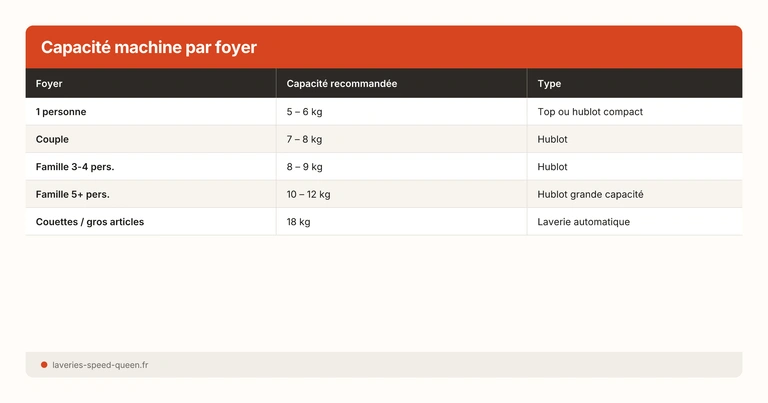
Choosing a washing machine means balancing capacity, energy efficiency, features and budget. For a couple: 7-9 kg, class A-B, front loader, 1200 rpm, budget EUR 500-700. For a family: 10-12 kg, same criteria, budget EUR 600-900. And for bulky items (duvets, curtains, blankets) your machine cannot handle: a professional laundromat with 9-18 kg machines is the perfect complement to a domestic machine.
At a glance
Capacity by household -- single 5-7 kg, couple 7-9 kg, family 10-12 kg. Count 3-4 kg of laundry per person/week.
Front loader for most -- larger capacity, better wash, stackable with dryer. Top loader if space is tight.
Class A or B -- 30-40% energy saving compared to class C. Pays for itself in 5-10 years.
1200-1400 rpm spin -- reduces drying time by 30-45 min. Beyond 1400, marginal gains.
Budget EUR 500-700 -- mid-range offers the best value for durability (10-15 years).
Capacity: the number one criterion
Washing machine capacity is expressed in kilograms of dry laundry. It is the most important criterion because it determines how many loads you will do per week — and therefore your water, energy and time consumption.
How much laundry your household produces
An adult produces on average 3 to 4 kg of dirty laundry per week (daily clothing, underwear, socks, pyjamas). A child produces 2 to 3 kg. Add sheets (weekly wash recommended, ~3 kg for a double bed), towels (1-2 kg per person/week) and kitchen towels (0.5-1 kg/week).
To understand your laundry weight properly, see our laundry weight guide and our article on dry vs wet laundry weight.
| Household size | Laundry per week | Recommended capacity | Loads per week |
|---|---|---|---|
| 1 person | 5-7 kg | 5-7 kg | 1-2 |
| Couple | 10-14 kg | 7-9 kg | 2-3 |
| Family of 3 | 14-18 kg | 9-10 kg | 2-3 |
| Family of 4-5 | 18-25 kg | 10-12 kg | 2-4 |
| Family of 6+ | 25+ kg | 12 kg + laundromat | 3-5 |
Do not oversize
An oversized machine consumes more water and energy each cycle — even at half load. The “half load” setting adjusts water by 20-30%, not 50%. A 12 kg machine half-full uses notably more than a fully loaded 7 kg machine. Choose the capacity that lets you run full loads most of the time.
Bulky items: the domestic machine limit
The tricky case: duvets, blankets, curtains and other bulky items. A double duvet needs an 18 kg machine (180-litre drum) to wash properly. No domestic machine reaches that capacity.
Even for a single duvet or child’s duvet, a 9 kg machine is the minimum for effective washing and rinsing. This is why many families combine a domestic machine of 8-10 kg for everyday laundry and a laundromat for bulky items — it is the most rational solution.
Front loader vs top loader
The front loader
The most common format in Europe (80% of sales). The door opens on the front.
Front loader advantages
Capacities up to 12 kg and above. Better wash (laundry falls and re-falls into water by gravity). Stackable with a dryer. Top usable as a work surface. Quieter during spin. More water-efficient.
Front loader disadvantages
Minimum 60 cm wide. Needs space in front for the door to open. Requires bending to load and unload. Heavier (70-90 kg). Door seal requires maintenance (mould risk).
The top loader
The lid opens from the top. Preferred format in small spaces.
Top loader advantages
Only 40-45 cm wide (15-20 cm gain). No need for space in front. Upright loading, ergonomic. Lighter (55-65 kg). No door seal to maintain.
Top loader disadvantages
Capacity limited to 6-8 kg. Cannot stack a dryer on top. Top not usable as a work surface. Fewer programmes and features. Slightly less effective wash (no gravity effect).
Our recommendation: if space allows (60 cm width + door opening space), choose a front loader. The capacity difference (up to 12 kg vs 8 kg max) and wash quality justify the larger footprint. The top loader remains an excellent choice for studios, narrow bathrooms and people with back problems (no bending).
Energy class: how to read it
The EU energy label (2021+)
Since March 2021, the EU has revised the energy label. The old A+++ to D scale has been replaced by a scale from A to G, clearer and more demanding. The current class A roughly corresponds to the old A+++ — most machines dropped 2-3 levels on the new scale.
The difference between class A and class C represents approximately EUR 10-15 per year — or EUR 100-150 over 10 years. If the extra purchase cost of class A is below EUR 150, the choice is economically rational. Above that, class B offers the best value.
For a complete guide on washing energy consumption, see our article on washing machine water and electricity consumption.
Spin speed: an underrated criterion
Spin is the rapid drum rotation at the end of the cycle that extracts water from laundry by centrifugal force. Speed is expressed in revolutions per minute (rpm).
The faster the spin, the drier the laundry comes out, and the less time and energy is needed to dry it — whether in a dryer or on a line.
Budget: how much to invest
Price ranges in 2026
| Range | Price | Typical capacity | Energy class | Estimated lifespan |
|---|---|---|---|---|
| Entry-level | EUR 300-400 | 7-8 kg | C-D | 5-8 years |
| Mid-range | EUR 500-700 | 8-10 kg | A-B | 10-15 years |
| High-end | EUR 800-1200 | 10-12 kg | A | 15-20 years |
Total cost of ownership
The purchase price is only part of the cost. Over 10 years, a washing machine also costs water, electricity, detergent and maintenance. Learn more about consumption per cycle.
The 10-year calculation
Mid-range machine at EUR 600, lifespan 12 years. Depreciation: EUR 50/year. Water + electricity: EUR 40-60/year (220 cycles, class B). Detergent: EUR 50-80/year. Maintenance (descaling, seal cleaning): EUR 10-20/year. Total: EUR 150-210/year, or EUR 1.30-1.80 per load.
The laundromat alternative: when the domestic machine is not enough
Even with an excellent washing machine, some items simply do not fit in the drum — or fit but are not washed properly.
What a domestic machine cannot do
- Double duvets: need a 180-litre drum (18 kg machine). The largest domestic machine offers 80-90 litres.
- Thick blankets: fleece throws, weighted blankets — volume and weight exceed domestic capacities.
- Bulky curtains: thick living room curtains need a spacious drum.
- Professional laundry: Airbnb concierge services, restaurants, tradespeople — volumes require 18 kg machines.
Machine + laundromat complementarity
The most rational solution for a family: a domestic machine of 8-10 kg for everyday laundry (4-5 loads per week) and a laundromat visit 1-2 times per month for duvets, blankets, curtains and other bulky items. The laundromat wash cost (EUR 4-10 per item) is negligible compared to the price of a new duvet or dry cleaning.
Compare the advantages of each option in our article laundromat vs home machine and laundromat vs dry cleaner.
- Do not force a duvet into a machine that is too small -- a compressed duvet is not washed properly, rinsing is incomplete (detergent residue in the filling), and you risk overloading the motor and pump.
- Watch wet laundry weight -- a 2 kg dry duvet weighs 5-6 kg wet. The drum, shock absorbers and motor handle this extra weight, but not indefinitely. Respect maximum capacity.
As an Amazon Partner, we earn a small commission on purchases made via the affiliate links in this article — at no extra cost to you. This helps us maintain this site and produce free guides.
Do not want to invest in a washing machine, or need to supplement your domestic machine for bulky items? Our laundromats in Blagnac, Croix-Daurade and Montaudran have machines from 9 to 18 kg and professional dryers, with detergent included. No investment, no maintenance, no breakdowns. Payment CB sans contact ou espèces. Check our prices.
Sources and references
- Washing machine water and electricity consumption
- Laundry weight in the machine
- Washing machine programmes explained
- Laundromat vs home machine
- How to wash a duvet
- How to clean your washing machine
- Saving water and energy when washing
- Washing machine weight
- European Commission — Energy labelling of appliances (lien externe)