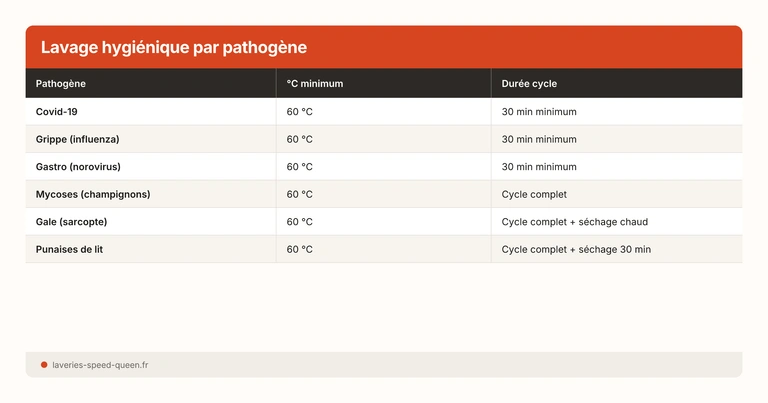
In a nutshell: a sick person’s laundry (flu, stomach bug, Covid) should be washed at 60 °C minimum, in a separate load, with your regular detergent (no special disinfectant required at this temperature). Never shake dirty laundry (infectious aerosols). Dry completely, clean the machine afterward, and maintain these measures up to 48 hours after symptoms end.
At a glance
60 °C minimum, standard program — no eco program, which may not reach the actual temperature.
Separate load — don't mix the sick person's laundry with the rest of the family's.
Don't shake dirty laundry — shaking disperses viruses and bacteria into the air (aerosols).
Regular detergent + 60 °C = sufficient — no bleach or special disinfectant required.
Immediate full drying — in the dryer preferably, for the extra heat.
48 hours after symptoms end — continue the protocol for 2 days after recovery.
Why a sick person’s laundry needs a specific protocol
When a family member is affected by a contagious illness (flu, stomach bug, Covid-19), their laundry — sheets, towels, pajamas, underwear, handkerchiefs — is potentially contaminated by pathogenic viruses and bacteria.
Textile contamination pathways
Pathogens end up on laundry through three main routes:
- Respiratory secretions — coughing, sneezing, breathing. Flu and Covid viruses settle on pillows, sheets and pajamas with every nighttime cough.
- Digestive secretions — vomiting, diarrhea. Norovirus (stomach bug) is massively shed in stool and vomit. The patient’s sheets, pajamas and bath towels are contaminated.
- Sweat and skin contact — fever causes heavy sweating. Skin bacteria proliferate in the warm, humid environment of a feverish patient’s sheets.
How long do pathogens survive on textiles?
Survival time varies by pathogen and conditions (temperature, humidity):
| Pathogen | Illness | Survival on textile | Elimination temperature |
|---|---|---|---|
| Influenza A/B | Flu | 8 to 12 hours | 56 °C (30 min) |
| SARS-CoV-2 | Covid-19 | 24 to 72 hours | 56 °C (30 min) |
| Norovirus | Stomach bug | Up to 12 days | 60 °C (30 min) |
| Rotavirus | Stomach bug (children) | Up to 10 days | 60 °C (30 min) |
| E. coli | Digestive infection | Several days | 60 °C (15 min) |
Norovirus is the most resistant: it survives up to 12 days on a dry textile, withstands 40 °C washing and requires 60 °C for 30 minutes to be destroyed. This is why 60 °C is the recommended minimum threshold, regardless of the type of illness.
The complete protocol, step by step
Step 1 — Handle laundry without shaking
NEVER shake a sick person's laundry
Shaking a sheet, pillowcase or contaminated pajamas releases thousands of microorganisms into the air as aerosols (microdroplets). These aerosols remain suspended for several minutes and can be inhaled by anyone in the room. This is one of the most underestimated transmission mechanisms.
The right approach:
- Pick up the linen by the edges, calmly
- Fold it onto itself to enclose the contaminated surface inside
- Transport it directly to the machine without setting it on other surfaces
- If possible, wear disposable gloves during handling
- Wash your hands with soap for 30 seconds after handling
Step 2 — Wash in a separate machine at 60 °C
The sick person’s laundry must be washed alone, without mixing with other family members’ laundry.
Settings:
- Program: standard cotton (not eco)
- Temperature: 60 °C minimum
- Detergent: your regular detergent, normal dosage
- Spin: normal speed (1000-1200 rpm)
- Optional: add 2 tablespoons of [sodium percarbonate](/blog/percarbonate↗-de-soude-linge/) to the drum to boost the disinfecting action
Why regular detergent is enough at 60 °C
Detergent surfactants destroy the lipid envelope of enveloped viruses (flu, Covid) — the same mechanism as soap on hands. At 60 °C, heat denatures viral and bacterial proteins. The drum’s mechanical action dislodges pathogens from fibers and rinsing flushes them away. These three combined actions (chemical + thermal + mechanical) are enough to make laundry hygienically safe.
Step 3 — Dry completely and immediately
Don’t leave wet laundry in the drum after the cycle. Pathogens that may have survived the wash (very low probability at 60 °C) could multiply in the drum’s humid environment.
- Dryer (preferred): dryer heat (70-80 °C) adds an extra disinfection layer. A full 30-40 minute cycle finishes off any residual microorganisms.
- Air drying: if you don’t have a dryer, hang laundry in a ventilated area, away from living spaces. Don’t hang it in the sick person’s bedroom (possible recontamination from respiratory secretions).
Step 4 — Clean the machine after the cycle
After washing contaminated laundry, clean the machine to remove potential residue:
- Wipe the door seal with a cloth soaked in white vinegar — this is where residue accumulates most
- Wipe the visible drum and the detergent drawer
- Run an empty cycle at 90 °C if possible — heat sterilizes the water circuit and drum
- Leave the door open after cleaning to ventilate the drum
By illness: the specifics
All contagious illnesses share the same basic protocol (60 °C, separate load, don’t shake). Here are the specifics for each.
Flu (Influenza)
The flu virus is an enveloped virus (surrounded by a lipid membrane) transmitted primarily through the respiratory route. It’s relatively fragile: it survives 8-12 hours on a dry textile and is destroyed at 56 °C in 30 minutes.
Most contaminated textiles: pillowcases (face contact), pajamas (feverish sweating), cloth handkerchiefs (nasal secretions), bath towels.
Flu protocol: 60 °C is more than sufficient. The virus is easily destroyed by detergent + heat. Change sheets every 2 days during the illness (feverish sweating saturates sheets quickly).
Stomach bug (norovirus, rotavirus)
Viral gastroenteritis is caused mainly by norovirus (adults) and rotavirus (children). These viruses are non-enveloped (no lipid membrane), making them much more resistant than the flu virus.
Norovirus is the most demanding pathogen for textile washing:
- It survives up to 12 days on a dry textile
- It withstands 40 °C washing
- It requires 60 °C for 30 minutes to be destroyed
- It’s shed in stool for 48 hours after recovery
Most contaminated textiles: sheets (sweat, digestive contact), bath towels, underwear, pajamas, and especially any textile soiled by vomit or diarrhea.
- Treat vomit and diarrhea immediately — remove solid residue with paper towels, rinse with cold water (not hot — hot water sets proteins), then machine wash at 60 °C.
- Wear disposable gloves — norovirus transmits very easily through direct contact with contaminated matter.
- Clean surfaces — if vomit has touched the floor, walls or furniture, clean with diluted bleach (norovirus resists most other disinfectants).
- 48 hours after recovery — continue separate washing at 60 °C for 2 days after vomiting and diarrhea end. The virus is still being shed.
Covid-19 (SARS-CoV-2)
SARS-CoV-2 is a relatively fragile enveloped virus on surfaces. It survives 24-72 hours on a textile (New England Journal of Medicine study, 2020) but is easily destroyed by detergent and heat.
Most contaminated textiles: cloth masks, pillowcases, sheets, handkerchiefs, bath towels, pajamas.
Covid protocol: 60 °C with regular detergent is sufficient. The virus is destroyed by detergent surfactants (its lipid envelope is vulnerable to soap) and by heat. WHO and CDC recommendations confirm that washing at 60 °C with regular detergent is enough.
What’s necessary and what isn’t
Necessary
60 °C standard program, separate load, don't shake laundry, immediate full drying, regular detergent at normal dosage, wash hands after handling, 48-hour protocol after recovery.
Not necessary
Bleach (except on white cotton handkerchiefs), special textile disinfectant (detergent + 60 °C is enough), double wash, 90 °C program (60 °C is sufficient for all these pathogens), throwing laundry away (it's recoverable after washing).
Recommended (bonus)
Sodium percarbonate in the drum (2 tbsp), dryer after washing, empty 90 °C cycle after contaminated load, disposable gloves for handling, dedicated bag for the sick person's dirty laundry.
Laundry involved
Sheets, pillowcases, duvet if soiled, bath/hand towels, pajamas, underwear, cloth handkerchiefs, cloth masks, any textile in direct contact with the patient or their secretions.
The question of textiles that can’t handle 60 °C
Some of the sick person’s textiles (silk pajamas, wool blanket, satin sheet) can’t handle 60 °C. Two solutions:
Solution 1 — Sodium percarbonate at 40 °C
Sodium percarbonate releases active oxygen (hydrogen peroxide) from 40 °C. This active oxygen destroys bacteria and most viruses through cell membrane oxidation. Add 2 tablespoons to the drum with a 40 °C cycle. This is the best alternative when 60 °C isn’t possible.
Solution 2 — Sanytol textile at 20 °C
Sanytol textile disinfectant contains didecyldimethylammonium chloride, a biocide active from 20 °C. It’s poured into the softener compartment and works during the final rinse. This is the solution for the most delicate textiles (silk, wool, viscose) that can’t handle heat or percarbonate.
Full guide: how to disinfect your laundry.
Duration of measures: the 48-hour rule
The specific washing protocol (60 °C, separate load) must be maintained until 48 hours after the last symptoms end.
Why 48 hours after apparent recovery?
- Norovirus: shed in stool for 48-72 hours after vomiting and diarrhea end
- Rotavirus: shed for up to 10 days after recovery in children (hence the importance of hand washing)
- Flu: the virus can be shed for 24-48 hours after fever drops
- Covid-19: viral particles can be detected for 5-10 days after symptom onset (but viral load decreases rapidly)
The 48-hour rule is a practical compromise between health safety and domestic reality. After this period, the risk of contamination through laundry becomes negligible.
Sick person’s laundry at the laundromat
It’s perfectly possible to wash a sick person’s laundry at a self-service laundromat, as long as you follow the protocol.
Laundromat advantages
- Professional machines reliably reach 60 °C (no eco mode cheating on temperature)
- Large drums allow effective tumbling of the laundry
- Professional dryers reach high temperatures (80 °C) that reinforce disinfection
- If your home machine is too small for a duvet or large-format sheets, the laundromat is the solution
Hygienic responsibility
Respect for other users
Washing contaminated laundry at a laundromat is your right, but hygienic responsibility is yours. Transport laundry in a sealed bag (not an open basket). Don’t place dirty laundry on folding tables. Run the cycle at 60 °C and use the dryer. Don’t leave residue in the machine. Wash your hands after handling.
After the illness: the deep clean
Once the illness is over and the 48-hour period has passed, a thorough cleaning of the sick person’s bedroom textiles is recommended:
- Wash all sheets (sheets, pillowcases, duvet cover) at 60 °C
- Wash the duvet if it was in direct contact with the patient — at the laundromat if needed (washing a duvet)
- Wash the pillows — in the dryer afterward to eliminate internal moisture (washing a pillow)
- Air the bedroom for several hours (windows wide open)
- Clean surfaces (bedside table, door handles, light switches) with a disinfectant
- Wash the mattress protector at 60 °C
Misconceptions to correct
”You need bleach to disinfect a sick person’s laundry”
False in most cases. The combination of detergent + 60 °C is sufficient to destroy common viruses and bacteria. Bleach is only useful on white cotton and brings an additional risk of discoloration. Sodium percarbonate is an effective and risk-free complement if you want to boost the action.
”You need to wash at 90 °C”
Not necessary. 60 °C for 30 minutes destroys all the pathogens mentioned in this article (flu, stomach bug, Covid). 90 °C is reserved for sterilization (destroying bacterial spores), which isn’t required for common illnesses. Moreover, 90 °C damages many textiles (shrinking, discoloration).
”A sick person’s laundry should be thrown away”
False. Proper washing at 60 °C makes laundry perfectly hygienic and reusable. There’s no reason to throw away sheets, towels or pajamas after an illness — that’s unnecessary waste.
”The eco program at 60 °C is sufficient”
Risky. Eco programs may not maintain the displayed temperature throughout the cycle. For disinfection, use the standard cotton program (not eco) which guarantees that the 60 °C temperature is reached and maintained during the full wash phase.
As an Amazon Partner, we earn a small commission on purchases made via the affiliate links in this article — at no extra cost to you. This helps us maintain this site and produce free guides.
Our laundromats at Blagnac, Croix-Daurade and Montaudran have professional machines with reliable 60 °C programs and high-temperature dryers. Ideal for washing sheets, duvets and household linen after an illness episode. Payment CB sans contact ou espèces. Check our pricing.
Sources and references
- How to disinfect your laundry
- Washing at 60 °C: which clothes and textiles?
- Washing at 90 °C: when to use it?
- Sodium percarbonate: usage guide
- Washing kitchen towels
- Wash temperatures: complete guide
- New England Journal of Medicine (2020) — SARS-CoV-2 surface survival
- WHO — recommendations on laundry washing in infectious contexts
- CDC — guidelines for disinfection and sterilization in healthcare facilities
- INRS — biological risks in domestic settings