A poorly maintained dryer uses 20-40 % more energy, takes longer to dry laundry, and poses a fire risk. The essential steps: clean the lint filter after every cycle (10 seconds), the condenser every month (5 minutes), empty the water tank after every cycle, clean seals every 2-3 months. At the laundromat: maintenance is handled by the operator — you have nothing to do.
At a glance
Lint filter: after EVERY cycle -- the most important step. 10 seconds, no excuse.
Condenser: every month -- rinse under running water. Lint and limescale reduce airflow.
Water tank: after every cycle -- otherwise a safety stop mid-way through the next cycle.
Seals and drum: every 2-3 months -- lint in the seals, residue in the drum.
Ventilation: every 6 months -- duct not kinked, rear grille clear, space behind the machine.
Why dryer maintenance is critical
The dryer is one of the most maintenance-demanding appliances in a household — and one of the most neglected. With every cycle, textiles shed microscopic fibres (lint) that accumulate in the filter, condenser, ducts and seals. This build-up has three direct consequences.
1. Performance drops. A clogged filter reduces airflow by 30-50 %. Hot air no longer circulates freely in the drum — laundry takes 20-40 % longer to dry. A 60-minute cycle becomes an 80-100-minute cycle.
2. Energy consumption rises. The dryer compensates for lost airflow by heating longer. On an appliance that already uses 2-4 kWh per cycle (one of the most energy-intensive household appliances), a 20-40 % overconsumption means 0.5-1.5 kWh wasted per cycle. Over 150 annual cycles, that is 75-225 kWh wasted. See our article on saving energy while doing laundry for other levers.
3. Fire risk increases. Lint is a highly flammable material (dry, light fibres). When it accumulates beyond the filter — in exhaust ducts, around the heating element or in the chassis — it can ignite from the heat. Fire services estimate that dryers are responsible for several hundred domestic fires per year in France.
The lint filter: after every cycle
Why it is step number one
The lint filter (or lint trap) is the first barrier against fibre build-up in the dryer’s internal circuits. It captures 80-90 % of lint shed during drying. The remaining 10-20 % passes through the mesh and accumulates in the condenser, ducts and chassis — this is unavoidable.
A clean filter ensures maximum airflow in the drum. A clogged filter forces the fan to draw air through a compacted layer of fibres — flow drops, pressure rises, the fan motor works harder, heat does not circulate. Result: long cycles, damp laundry, overconsumption.
How to clean the filter
Cleaning the filter is the simplest maintenance step of any household appliance.
- Open the filter flap. Depending on your model, it is located in the door opening (most common), on the machine top, or at the back of the drum.
- Remove the filter — it slides or clips out.
- Peel off the lint by hand. It forms a felt-like layer that comes off in one piece.
- Replace the filter.
Duration: 10 seconds. It is a reflex to develop — like turning off the light when leaving a room.
When to rinse the filter
The filter mesh gradually clogs with microscopic residue (softener, dust, limescale) that manual lint removal cannot eliminate. Every 2-3 months, rinse the filter under hot water with a little dish soap. Scrub the mesh with an old toothbrush to dislodge embedded residue. Dry before replacing.
- Never run a cycle without the filter -- lint will go directly into the condenser, ducts and fan. The damage may require costly technical intervention.
- Do not replace the filter with a non-original one -- dimensions and mesh fineness must match the model. A filter that is too fine reduces airflow; too coarse, it lets lint through.
The condenser: monthly cleaning
The role of the condenser
The condenser is the component that turns moisture from hot air into liquid water. Hot, humid air from the drum passes through the condenser, where it is cooled — the moisture condenses into water, which is collected in the tank. The dry air is then reheated and sent back to the drum.
The condenser consists of tightly spaced metal fins (like a radiator) between which air flows. Lint that passes through the filter sticks between these fins, gradually reducing the heat exchange surface and airflow. Limescale from condensation water adds to the clogging.
How to clean the condenser
Locate and remove the condenser
The condenser is generally accessible via a panel at the bottom of the front (condenser dryer) or bottom right (heat pump dryer). Open the panel, unclip the condenser and pull it toward you. Consult your model's manual if you cannot find it.
Rinse under running water
Place the condenser under the tap and direct the water stream between the fins. Water will dislodge lint and limescale. If deposits are stubborn, soak for 15 minutes in a hot water + white vinegar mix before rinsing.
Dry and replace
Let the condenser air dry for 15-20 minutes (or wipe with a cloth). Replace and verify it is properly clipped in. A poorly positioned condenser creates air leaks that reduce drying efficiency.
Self-cleaning condenser
Some high-end dryers (Bosch, Siemens, Miele) feature a self-cleaning condenser: an automatic rinsing system that cleans the fins with condensation water after every cycle. This significantly reduces maintenance — but it does not eliminate lint filter cleaning, which remains mandatory after every cycle.
The water collection tank: empty regularly
How it works
Water extracted from the laundry by the condensation process is collected in a collection tank at the top of the machine (removable drawer). This tank fills with every cycle — approximately 1-2 litres of water per standard load, more for very wet laundry.
Why empty it
If the tank is full, the dryer stops automatically (safety feature) — a “tank full” light comes on and the cycle is interrupted. The laundry stays damp and you must empty the tank, then restart the cycle. This is frustrating and wastes energy (the machine must reheat the drum at each restart).
Permanent solution: most dryers have a drain hose at the back. Connect this hose to a siphon or drain outlet (like a washing machine) — the water drains automatically and the tank stays empty. No more manual emptying. Consult your model’s manual for installation.
Condensation water: can it be reused?
Dryer water is demineralised water (low in limescale) but contaminated with textile microfibres, detergent and softener residues. It can be used for ironing (if filtered) or for watering hardy plants, but it is not drinkable and not suitable for fragile plants.
Seals and drum: bimonthly cleaning
The door seal
The rubber seal around the dryer door accumulates lint and damp residue with every cycle. This build-up can prevent the door from sealing tightly — hot air leaks, drying is less effective, and moisture escapes into the room.
Cleaning: wipe along the seal with a damp cloth every 2-3 months. Pay attention to the rubber folds where lint accumulates. If mould traces appear, scrub with a cloth dampened with white vinegar↗.
The drum
The dryer drum is usually stainless steel and does not need regular cleaning. However, softener residue (if you use softener for washing) can deposit on the walls, creating a sticky film that traps lint.
Cleaning: wipe the inside of the drum with a damp cloth every 2-3 months. If sticky residue persists, use a cloth dampened with white vinegar.
The humidity sensor
The humidity sensor (2 metal bars inside the drum, near the door) measures the laundry’s moisture level to stop the cycle at the right time. When coated with limescale and softener residue, it gives inaccurate readings.
- Fouled sensor + conductive residue = the dryer “thinks” the laundry is dry too early -> laundry still damp at end of cycle. This is the main reason laundry comes out damp from the dryer.
- Fouled sensor + insulating residue = the dryer does not detect moisture -> excessively long cycles.
Cleaning: rub the bars with a cloth dampened with white vinegar every 2-3 months. Wipe dry with a clean cloth.
Ventilation: six-monthly check
Vented dryers
Vented dryers expel hot, humid air outdoors via a flexible duct (10-15 cm diameter tube) passing through a wall or window. This duct is a critical maintenance point.
- Check the duct is not kinked, crushed or twisted (each bend reduces airflow by 10-15 %).
- Clean the inside of the duct with a flexible brush or vacuum. Lint accumulates at bends and junctions.
- Check the outdoor exit is not blocked (bird nest, leaves, compacted lint).
The exhaust duct: fire risk zone
The exhaust duct is the most dangerous zone in terms of fire risk. Lint accumulates out of sight, in a duct where hot air (60-70 °C) circulates. If the duct is too long (over 3 metres), has too many bends, or is made of non-fireproof material (flexible plastic), the risk increases significantly. Use a rigid or semi-rigid aluminium duct, as short and straight as possible.
Condenser / heat pump dryers
These models have no exhaust duct — air circulates in a closed loop. But they need good ambient ventilation: residual heat is expelled through the machine’s rear grille.
- Rear clearance: maintain 10-15 cm between the machine and the wall.
- Rear grille: vacuum the dust and lint that accumulate on the grille every 6 months.
- Ventilated room: the dryer generates heat (especially classic condenser models). If the room is closed and small (utility room, cupboard), the temperature rises and the machine overheats — it stops on safety or runs in degraded mode.
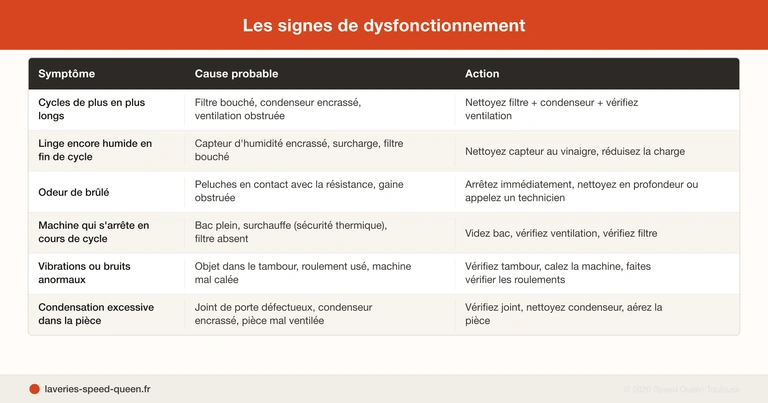
Warning signs of malfunction
A malfunctioning dryer gives clear signs. Learn to recognise them.
| Symptom | Probable cause | Action |
|---|---|---|
| Increasingly long cycles | Clogged filter, fouled condenser, obstructed ventilation | Clean filter + condenser + check ventilation |
| Laundry still damp at end of cycle | Fouled humidity sensor, overload, clogged filter | Clean sensor with vinegar, reduce load |
| Burning smell | Lint in contact with heating element, blocked duct | Stop immediately, deep clean or call a technician |
| Machine stops mid-cycle | Full tank, overheating (thermal safety), missing filter | Empty tank, check ventilation, check filter |
| Unusual vibrations or noises | Object in drum, worn bearing, unlevelled machine | Check drum, level the machine, have bearings checked |
| Excessive condensation in the room | Faulty door seal, fouled condenser, poorly ventilated room | Check seal, clean condenser, ventilate room |
- Burning smell = stop immediately -- a burning smell during dryer operation is an emergency sign. Stop the machine, unplug it, check the filter and exhaust duct. If the smell persists after cleaning, call a technician before reusing the machine.
- Never override the thermal safety -- if your dryer stops on safety (overheating), do not restart immediately. Let it cool for 30 minutes, check filter and ventilation, then restart. Repeated safety stops signal a maintenance or ventilation problem.
Maintenance schedule summary
| Component | Frequency | Duration | Difficulty |
|---|---|---|---|
| Lint filter | After every cycle | 10 seconds | None |
| Water collection tank | After every cycle | 15 seconds | None |
| Condenser (rinse) | Monthly | 5-10 minutes | Easy |
| Lint filter (rinse with water + soap) | Every 2-3 months | 3-5 minutes | Easy |
| Door seal and drum | Every 2-3 months | 5 minutes | Easy |
| Humidity sensor | Every 2-3 months | 2 minutes | Easy |
| Ventilation / exhaust duct | Every 6 months | 10-15 minutes | Medium |
| Rear grille (dust vacuuming) | Every 6 months | 5 minutes | Easy |
Condenser vs heat pump dryer: maintenance compared
Classic condenser
Electric heating element warms the air. High consumption (3-5 kWh/cycle). Standard maintenance: filter, condenser, tank. Heating element lifespan: 8-12 years. The condenser clogs faster because air circulates at higher temperature.
Heat pump
Heat recovery system (like a reversed fridge). Reduced consumption (1.5-2.5 kWh/cycle). Same basic maintenance + additional filter on some models. Condenser clogs less quickly. Some models have a self-cleaning condenser. Compressor lifespan: 10-15 years.
Whatever the dryer type, lint filter after every cycle remains the universal and most important step. The maintenance difference between the two technologies is marginal — the real difference is energy consumption.
At the laundromat: zero maintenance for you
At a self-service laundromat, dryer maintenance is entirely handled by the operator. This is one of the most concrete advantages of the laundromat compared to drying at home.
What the operator does
- Filters: cleaned daily by the technical team (and often after each maintenance visit).
- Exhaust ducts: checked and cleaned regularly.
- Machines inspected: Speed Queen professional dryers are designed for intensive use (15-20 cycles/day). They are inspected on a preventive maintenance schedule.
- Wear parts: bearings, belts, heating elements are replaced before they fail — predictive maintenance.
Performance advantage
Professional dryers at the laundromat are more powerful and larger than domestic models. The large-capacity drum allows laundry to tumble freely — drying is faster and more even. A laundromat drying cycle takes 30-45 minutes for a standard load, versus 60-90 minutes on a domestic model. See our drying guide to understand the differences between home and professional drying.
Cost comparison: home drying vs laundromat
A domestic heat pump dryer costs EUR 600-900 to buy, uses EUR 40-80 of electricity per year and requires regular maintenance (time + products). Amortised over 10 years: EUR 100-170/year total. At the laundromat, drying costs EUR 1.50 per 10-minute block — around EUR 4.50-6 per drying session. For 1-2 sessions per week, that is EUR 250-600/year. The home dryer is more economical for regular use, but the laundromat is unbeatable for zero maintenance and zero breakdowns.
As an Amazon Partner, we receive a small commission on purchases made via affiliate links in this article — at no extra cost to you. This helps us maintain this site and produce free guides.
Don’t want to maintain a dryer? Our laundromats in Blagnac, Croix-Daurade and Montaudran have high-capacity professional dryers, maintained daily. Load your laundry, select the time, collect your dry laundry. Zero maintenance, zero breakdowns. Payment CB sans contact ou espèces. See our prices.
Sources and references
- Laundry drying guide
- Why laundry comes out damp from the dryer
- Saving energy while doing laundry
- White vinegar for laundry
- Indoor laundry drying without humidity
- Outdoor clothesline drying
- Service-Public.fr — Neighbourhood nuisance (lien externe)
- SDIS — Domestic fire prevention related to dryers (lien externe)