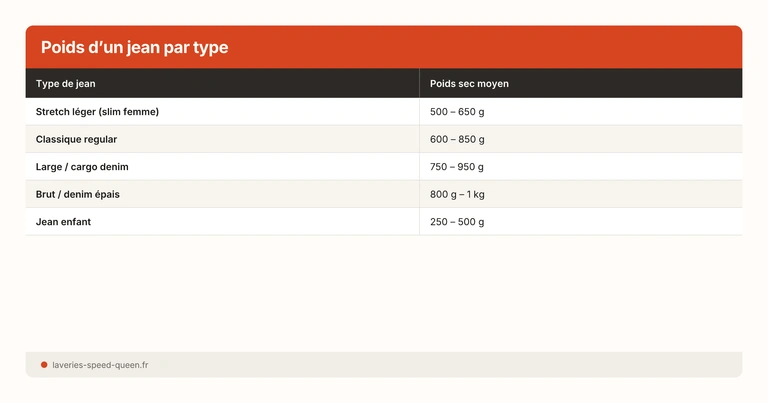
In short: an adult pair of jeans most often weighs between 500 and 1,000 g dry depending on the cut, size and denim thickness. For a 9 kg machine, the safe benchmark is about 6 standard pairs if the load is almost entirely denim. The right reflex is not just to look at kilos: you also need to leave enough volume in the drum.
At a glance
Lightweight stretch jeans — about 500 to 650 g.
Classic jeans — about 600 to 850 g.
Raw or thick jeans — up to 900 g to 1 kg.
9 kg machine — stick to about 6 standard adult pairs in practice; a 7th pair is already pushing the limit.
How much do jeans actually weigh?
For an adult, the useful benchmark is simple: count 0.5 to 1 kg per dry pair depending on the fabric and cut. Below that, you are usually looking at a lightweight or children’s model. Above that, you are generally dealing with thick denim, a large size or a wide-leg cut loaded with fabric.
| Type of jeans | Average dry weight | Useful benchmark |
|---|---|---|
| Lightweight stretch jeans | 500 to 650 g | Women’s, slim cut, thin fabric |
| Classic regular jeans | 600 to 850 g | The most common case |
| Skinny jeans | 450 to 600 g | Close-fitting cut, less fabric, often stretch |
| Boyfriend jeans | 600 to 800 g | Relaxed fit, weight varies depending on the denim |
| Bootcut jeans | 650 to 850 g | Flared at the bottom, extra fabric at the legs |
| Wide-leg / denim cargo | 750 to 950 g | More fabric, more volume |
| Raw / thick denim jeans | 800 g to 1 kg | Dense fabric, takes longer to dry |
| Children’s jeans | 250 to 500 g | Highly variable depending on age |
Why jeans can vary by 400 g from one model to another
Denim weight
Lightweight denim dries faster and weighs less than dense raw denim. At the same size, the difference is far from negligible.
The cut
Slim jeans use less fabric than wide-leg, flare or cargo jeans. The fuller the cut, the more the weight increases.
The size
The same model in a small and a large size does not weigh the same. The extra fabric adds up quickly across a full load.
The finishing
Thick pockets, linings, rivets, reinforced waistbands or heavy topstitching add a few dozen grams per pair.
Why some brands use “oz” instead of grams
In the denim world, the fabric weight is often expressed in ounces (oz). This is not the weight of the finished pair of jeans, but a measure of fabric density. The heavier the denim, the more likely the finished pair is to be thick, stiff and slow to dry.
The point not to confuse
A 14 oz denim does not mean the finished pair of jeans weighs 14 oz. The ounce primarily describes the fabric. The actual weight of the jeans then depends on the size, the area of fabric used, the cut, the pockets, the rivets, the linings and the level of finishing.
| Denim benchmark | Practical reading | Impact on the finished jeans |
|---|---|---|
| 10 to 11 oz | Lightweight denim | Jeans often softer and closer to 500-650 g |
| 12 to 13 oz | Standard denim | The majority of everyday jeans, around 600-850 g |
| 14 oz and above | Dense / raw denim | Stiffer jeans, often 800 g to 1 kg and sometimes more |
This benchmark does not replace the actual garment weight, but it helps to understand why two pairs of jeans of the same size can behave very differently in the wash.
Real variability: what causes jeans weight to fluctuate
| Factor | Typical effect | Why it matters |
|---|---|---|
| Size | Small vs large: often a visible difference | More fabric, therefore more weight and more volume in the drum |
| Cut | Slim < regular < baggy | A fuller cut uses more fabric than a fitted pair |
| Stretch or raw | Lightweight stretch vs dense denim | Raw or selvedge denim is often stiffer and heavier |
| Construction | Pockets, rivets, linings, seams | Details cause the final weight to vary for the same cut |
How many jeans in a 9 kg, 11 kg or 18 kg machine?
The stated capacity is a maximum for dry laundry, not a packing guideline. With denim, always keep a margin: the fabric absorbs a lot of water, becomes heavy during rinsing, and above all quickly takes up a lot of space in the drum.
| Machine capacity | Safe benchmark | What actually limits you |
|---|---|---|
| 5 kg | 4 to 5 pairs | Volume fills up very quickly with thick denim |
| 7 kg | 5 to 6 pairs | A uniform load is fine, but don’t pack it |
| 9 kg | 6 pairs | A 7th pair is already pushing the volume limit |
| 11 kg | 7 to 8 pairs | Good choice for a large batch of standard denim without compacting |
| 18 kg | 10 to 12 pairs | Large capacity, but denim remains a dense load — don’t fill it to the brim if you want real room for tumbling |
Safe benchmarks based on practical filling logic, not the absolute physical maximum. Here, drum volume becomes the limiting factor before theoretical weight as soon as the denim is thick, raw or wide-leg; with a 9 kg machine, the 7th pair is already a limit zone.
What does a load of jeans look like compared to other laundry?
A standard pair of jeans weighs roughly the same as 4 to 5 lightweight t-shirts or 1 large thick bath towel. But it also takes up more space than a stack of easily compressible t-shirts, which explains why a drum can seem still “manageable” in kilos while already being too dense to tumble properly.
| 1 standard pair of jeans ≈ | Practical benchmark |
|---|---|
| 4 to 5 t-shirts | Useful for visualising a mixed load |
| 2 to 3 lightweight shirts | Depending on fabric and size |
| 1 large bath towel | Similar volume and weight in the drum |
The right reflex for denim
If you’re mainly washing thick jeans, don’t try to reach the theoretical maximum capacity. Denim needs space to move, rinse properly and spin without tangling. For a broader benchmark on mixed loads, see our complete laundry weight chart.
When weight alone isn’t enough to choose the right machine
Two 6 kg loads can behave very differently in the wash. A load of t-shirts spreads easily in the drum; a load of heavy jeans creates a compact mass that is less breathable and much slower to dry.
You therefore need to consider three things together:
- the total dry weight;
- the volume occupied in the drum;
- the drying time afterwards.
If you combine several pairs of jeans with towels, sweatshirts or thick workwear, treat it like a dense load. In that case, it is better to go for a slightly higher capacity than to re-wash or run an extra drying cycle.
Dry jeans, wet jeans: why the mistake costs you at wash time
The capacity stated by the machine is always given for dry laundry. Once soaked, denim absorbs a lot of water: it becomes much heavier, packs down more and more easily creates an imbalance during spinning if the starting load was already too dense.
This point matters especially in three cases:
- a load made almost entirely of jeans;
- raw or very thick denim;
- a mix of jeans + towels + sweatshirts.
In other words: even if the load “fits” in kilos on paper, it can become difficult to rinse, spin and dry if everything is dense denim.
Quick method to estimate your load without a scale
Count 0.75 kg per standard pair when you don't know the exact cut.
Subtract 100 to 200 g if the jeans are very thin or stretch.
Add 100 to 200 g if they are raw, wide-leg or very thick.
Keep a real volume margin if the entire load is denim.
Check the free space with the hand test before starting the cycle.
Estimating the weight of your load without a scale
If you don’t have a kitchen scale to hand, several concrete benchmarks let you estimate your load with an acceptable margin of error.
The outstretched arm test. Hold your pile of jeans at arm’s length for 10 seconds. If your arm tires noticeably, you probably have more than 4 kg in hand. A standard pair of jeans (700 g) held at arm’s length feels “light” on its own, but fatigue sets in quickly from the third pair onwards. Beyond 5 pairs held at arm’s length, most people feel clear fatigue — a good benchmark for about 3.5 kg.
The water pack comparison. A pack of 6 x 1.5 L bottles weighs 9 kg. If your pile of jeans feels “about the same as a water pack”, you are around the capacity of a 9 kg machine. If it feels noticeably lighter than a pack, you are probably under 6 kg — the 9 kg machine is comfortable.
The hand-in-the-drum test. Once the jeans are loaded into the machine, slide your hand flat between the laundry and the top of the drum. If your hand passes easily and there is space left, the load is fine. If your hand is squeezed or can’t get through, remove one item. This test is for volume, not weight — but with denim, it is often the volume that maxes out first.
The equivalent counting method. Count 0.75 kg per standard pair of jeans, 0.15 kg per t-shirt, 0.5 kg per bath towel. By mentally adding these benchmarks, you get an estimate within ±15% of the actual weight — enough to choose the right machine.
If you want to check at home without guessing
The most reliable method is to weigh an actual dry pair of jeans on a household scale, then use that benchmark for the rest of the batch. A single real measurement is worth more than an overly precise theoretical figure.
Simple method:
- weigh 1 dry pair of jeans you wear often;
- note its type: stretch, regular, raw, baggy;
- use this measurement as a benchmark for similar jeans;
- keep a margin if you mix them with towels, sweatshirts or thick denim.
The most common mistakes
- Thinking only in kilos — an overpacked drum washes and rinses poorly.
- Mixing heavy jeans with delicate fabrics — the friction and spin become more aggressive.
- Forgetting to turn jeans inside out — the colour fades faster.
- Underestimating drying time — a batch of thick jeans often takes longer than a lighter but bulkier load.
Washing a batch of jeans at a laundromat
When you have 6-8 pairs of jeans to wash at once — back from holiday, change of season, or simply catching up — a laundromat becomes worthwhile. An 18 kg machine comfortably handles 10-12 standard adult pairs with room for tumbling. In a 7 kg home machine, you would need 2 separate cycles.
A few precautions specific to denim at a laundromat: turn all jeans inside out before loading, close all zips to avoid snags, and choose a 30 °C cycle. If you are mixing dark and light jeans, separate them to avoid dye transfer — 9 kg machines are ideal for a uniform batch of 6 dark pairs.
Drying denim in a professional dryer is quick (20-25 minutes) and gives a supple result. If you prefer to preserve the colour as much as possible, remove the jeans slightly damp and finish drying them on a line at home.
Methodology and sources
The weight benchmarks given here are practical estimates for dry laundry, established from the most common denim cuts and real-world use in front of a machine. The useful figure is never absolute: size, stretch, fabric thickness and finishing can cause the weight of the same type of jeans to vary.
- Clevercare / GINETEX, Jeans, the iconic garment of your wardrobe!, accessed 15 March 2026
- Le Gaulois Jeans, Comprendre le poids des tissus de jeans, published 19 October 2023, accessed 15 March 2026
- Internal site reference: Laundry weight: chart by garment, updated 28 February 2026
As an Amazon Associate, we earn a small commission on purchases made via the affiliate links in this article — at no extra cost to you. This helps us maintain this site and produce free guides.
Do you often load the machine by guesswork? Start with our complete laundry weight chart, then use the laundry calculator to estimate your load. If you’re still unsure about denim temperature, also check our washing temperature guide and our first time at a laundromat guide.