In short: Drying clothes indoors releases about 2 litres of water per load into the ambient air. This moisture promotes condensation, mould and dust mites. The WHO recommends a humidity level between 40 and 60 % — indoor drying without ventilation can push it to 70-80 %. Solutions exist: ventilate, space out laundry, use a dehumidifier, or tumble dry.
Signs you might recognise
If you notice morning condensation and black spots, humidity from indoor drying often exceeds 60 % for extended periods.
Before talking about science, a simple test. If you regularly dry your laundry indoors, you have probably noticed one or more of these signs:
Condensation on windows
Droplets form on the inside of the glass, especially on winter mornings. Water runs down the frames and pools at the bottom of the window. This is the most visible sign of excessive indoor humidity.
Black spots on the ceiling or in corners
Dark spots appear in corners, behind furniture, around windows or on the bathroom ceiling. These are mould colonies — most often Cladosporium or Aspergillus — that grow on cold, damp surfaces.
Laundry that smells musty
Even when clean, laundry dried on a rack develops an unpleasant smell. This is not a detergent problem — it is a drying speed problem. When fabric stays damp too long, bacteria multiply and produce foul-smelling compounds (see our laundry odour guide).
Blistering paint and buckling wallpaper
Moisture seeps into porous materials. Paint blisters, wallpaper peels in places, wood frames swell. This is gradual damage, often blamed on an "insulation problem" when the source is actually indoors.
If you recognise two or more of these signs, indoor drying is probably a major cause. Here is what the research says.
What science measures
Field measurements estimate that one wash load dried indoors releases about 2 litres of water into the home’s air.
2 litres of water per wash load
In 2012, the Mackintosh Environmental Architecture Research Unit (Glasgow School of Art) published the results of a three-year study, funded by the Engineering and Physical Sciences Research Council (EPSRC), on drying practices in 100 homes in Glasgow.
The findings are precise:
Porteous, Sharpe, Menon et al. (2012)
A standard wash load dried on a rack releases about 2 litres of water into the indoor air. Passive drying accounts for one third of total moisture in a home during winter. Of the 100 households studied, 87 % dried indoors during the cold season, and 75 % had humidity levels high enough to support dust mite growth.
Source: “Domestic laundering – environmental audit in Glasgow with emphasis on passive indoor drying and air quality”, Mackintosh Environmental Architecture Research Unit, Glasgow School of Art, EPSRC.For a family doing 5 to 6 loads per week, this amounts to 10 to 12 litres of water released into the home each week — the equivalent of a full bucket.
What humidity makes grow
Indoor humidity does not disappear on its own. It condenses on cold surfaces (windows, exterior walls, ceiling corners) and creates a favourable environment for two types of organisms:
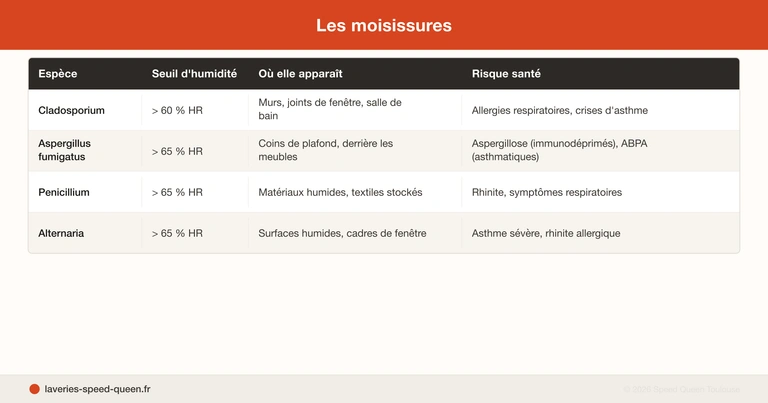
Mould
| Species | Humidity threshold | Where it appears | Health risk |
|---|---|---|---|
| Cladosporium | > 60 % RH | Walls, window seals, bathroom | Respiratory allergies, asthma attacks |
| Aspergillus fumigatus | > 65 % RH | Ceiling corners, behind furniture | Aspergillosis (immunocompromised), ABPA (asthmatics) |
| Penicillium | > 65 % RH | Damp materials, stored textiles | Rhinitis, respiratory symptoms |
| Alternaria | > 65 % RH | Damp surfaces, window frames | Severe asthma, allergic rhinitis |
The Glasgow study detected Aspergillus spores in 25 % of the sampled homes — a mould that can cause lung infections in immunocompromised individuals.
Dust mites
House dust mites (Dermatophagoides farinae) are directly dependent on ambient humidity. Arlian, Neal and Vyszenski-Moher (Wright State University, 1999) showed that the critical threshold is 50 % relative humidity:
- Below 50 % RH maintained for ≥ 22 h/day: the dust mite population declines
- Above 50 %: dust mites reproduce and proliferate
- 4 to 8 hours per day at 75 % RH is enough to sustain a viable population
Source: Arlian LG et al., “Reducing relative humidity to control the house dust mite Dermatophagoides farinae”, J Allergy Clin Immunol, 1999, 104(4):852-856, PMID 10518832.
A home where laundry dries daily easily exceeds 60-70 % relative humidity for several hours — well above the proliferation threshold.
What the World Health Organization says
The WHO framework targets 40-60 % indoor humidity; above that, respiratory risks and mould proliferation increase significantly.
In 2009, the WHO published its first recommendations on indoor air quality related to dampness and mould (WHO Guidelines for Indoor Air Quality: Dampness and Mould). The report, written by 36 international experts, concludes:
WHO, 2009
Occupants of damp or mouldy homes have up to 75 % higher risk of respiratory symptoms and asthma. The report establishes a sufficient link between indoor dampness and allergic rhinitis, respiratory infections, bronchitis and asthma exacerbation.
Source: WHO Guidelines for Indoor Air Quality: Dampness and Mould, WHO Regional Office for Europe, 2009, ISBN 978-92-890-4168-3.These findings are reinforced by the meta-analysis of Fisk, Lei-Gomez and Mendell (Lawrence Berkeley National Laboratory, 2007), published in Indoor Air: the odds ratios for respiratory effects linked to dampness and mould range from 1.32 to 2.10 — meaning a 32 to 110 % increased risk depending on the condition.
Source: Fisk WJ et al., “Meta-analyses of the associations of respiratory health effects with dampness and mold in homes”, Indoor Air, 2007, 17(4):284-296, PMID 17661925.
Why laundry dries poorly (and smells bad)
The critical threshold is temporal: beyond 4-5 hours of residual dampness, the risk of bacterial odour increases sharply.
Drying laundry relies on a simple principle: water in the fibres evaporates into the ambient air. The more the air is already saturated with humidity, the slower the evaporation. In a home where laundry is already drying, humidity rises, which slows the drying of the next load — a vicious cycle.
The odour mechanism
When a textile stays damp for more than 4 to 5 hours, the bacterium Moraxella osloensis — naturally present on skin and fibres — multiplies and produces 4-methyl-3-hexenoic acid (4M3H), responsible for the characteristic smell of "poorly dried laundry" (Kubota et al., 2012, Applied and Environmental Microbiology).
The time factor
On a rack in a room at 20 °C and 60 % humidity, a pair of jeans takes 12 to 24 hours to dry. A thick towel, 8 to 15 hours. A thin t-shirt, 4 to 6 hours. Throughout this time, the water evaporates into the room's air.
The vicious cycle
Damp laundry → humid air → slower drying → laundry stays damp longer → bacteria → odour. And simultaneously: humid air → condensation → mould → black spots → damage to the home.
To treat odours on already affected laundry, see our guide to removing bad smells from laundry.
How to limit the damage
The effective levers are practical: ventilate for 10-15 min, spin at 1,000-1,200 rpm, use a hygrometer and choose the right room for drying.
If you dry your laundry indoors — as most households do in winter — here are the steps that genuinely reduce the impact on your home.
Ventilate during drying
The most effective step
Open a window in the room where laundry is drying, even in winter, even for just 10 to 15 minutes. Cold outdoor air is drier than the moisture-laden indoor air — a brief exchange is enough to lower the hygrometry by several points. If the home has mechanical ventilation (MVHR), check it is working and do not block the air vents.
Choose the right room
- Avoid the bedroom — you spend 7-8 hours a night there in air already loaded with CO₂ and respiratory moisture. Adding a drying rack makes it worse.
- Avoid rooms without windows — no ventilation possible, moisture stagnates.
- Choose a room with a window ajar or a ventilated hallway.
Space out laundry on the rack
Laundry pressed against another item dries much more slowly. Air must circulate around each piece. Space garments at least 2-3 cm apart. Thick items (jeans, towels) should be unfolded as much as possible.
Spin correctly
A spin at 1,000-1,200 rpm instead of 800 rpm removes significantly more water from the laundry before drying even begins. Less residual water = less moisture released into the air = faster drying. Check that your home machine is set to an appropriate spin speed (see our care labels guide for delicate textiles).
Measure humidity
A digital hygrometer costs EUR 10 to 15 and provides an instant reading of relative humidity. Place it in the room where you dry your laundry:
| Humidity level | Situation | Action |
|---|---|---|
| 40-55 % | Comfort zone (WHO recommendation) | Nothing to report |
| 55-65 % | Dust mites can proliferate | Ventilate more, space out laundry |
| 65-75 % | Mould starts to develop | Insufficient ventilation, consider a dehumidifier |
| > 75 % | High risk to the home and health | Stop drying in this room without mechanical ventilation |
Use a dehumidifier
An electric dehumidifier↗ (compressor or desiccant) extracts water from the ambient air and collects it in a tank. This is an effective solution for poorly ventilated homes or intensive drying periods.
Key points:
- Capacity: choose a model suited to the room size (10-12 L/day for a 1-2 bed flat, 20 L/day for a 3+ bed flat)
- Noise: 40-50 dB during operation, comparable to a refrigerator
- Effectiveness: a dehumidifier speeds up drying by lowering ambient humidity, but it does not dry the laundry directly
Dry outdoors whenever possible
Even in winter, outdoor drying works if conditions allow:
- Above 5 °C with wind: laundry dries in a few hours
- Below 0 °C: natural freeze-drying (water freezes then sublimes) works, but slowly
- Dry weather without wind: less effective, but still better than a closed indoor space
The advantage: zero added humidity in the home.
The tumble dryer: moisture stays elsewhere
A tumble dryer — whether at home or at a laundromat — evaporates water from the laundry and expels it out of the living space (via a condenser or exhaust). The home receives no extra humidity.
For large volumes (duvets, sheets, towels) or winter periods when the drying rack runs continuously, a tumble dryer cycle breaks the humidity-mould cycle. At a laundromat, drying a standard load takes about 30 minutes — versus 12 to 24 hours on a rack. See our complete drying guide for times and temperatures by textile.
The humidity scale: visual benchmarks
Practical reference: staying below 60 % protects the home; above 70 %, the risk of mould and respiratory problems becomes high.
40-50 % — Comfort
Dry, healthy air. No condensation, no mould. Dust mites do not reproduce. This is the target.
50-60 % — Vigilance
Beginning of the zone favourable to dust mites (Arlian et al., 1999). No visible mould yet, but condensation appears on cold windows. Ventilate regularly.
60-70 % — Active risk
Moulds (Cladosporium, Penicillium) find growth conditions. Black spots possible in corners. Laundry dries slowly and develops a musty smell. The WHO recommends not exceeding this threshold.
70 %+ — Danger
Aspergillus fumigatus develops. Damage to materials (paint, wood, plaster). Risk increased by 32 to 110 % for respiratory conditions (Fisk et al., 2007). Urgent corrective action needed.
Common mistakes
- Drying in the bedroom with the door closed — combines laundry moisture + nighttime respiratory moisture, without ventilation
- Putting laundry on radiators — dries the laundry faster, but projects moisture into the air in a concentrated way and reduces heating efficiency
- Closing all windows "to keep the heat in" — moisture stays trapped, condensation worsens
- Ignoring condensation on windows — this is a warning sign, not a harmless phenomenon
- Stacking laundry on the rack — slows drying, extends moisture in the air, promotes odours
If humidity at home becomes unmanageable, do your cycles at our laundromats in Blagnac and Croix-Daurade: powerful spin, fast drying, less humidity in your home. Check our prices or contact us to choose the right machine.
As an Amazon Partner, we earn a small commission on purchases made via the affiliate links in this article — at no extra cost to you. This helps us maintain this site and produce free guides.
Sources and references
- Porteous CD, Sharpe TR, Menon R, Shearer D, Musa H, Baker PH, Sanders C, Strachan PA, Kelly NJ, Markopoulos A. “Domestic laundering – environmental audit in Glasgow with emphasis on passive indoor drying and air quality” (lien externe), Mackintosh Environmental Architecture Research Unit, Glasgow School of Art, EPSRC, 2012.
- WHO Guidelines for Indoor Air Quality: Dampness and Mould (lien externe), WHO Regional Office for Europe, 2009, ISBN 978-92-890-4168-3.
- Fisk WJ, Lei-Gomez Q, Mendell MJ. “Meta-analyses of the associations of respiratory health effects with dampness and mold in homes” (lien externe), Indoor Air, 2007, 17(4):284-296, PMID 17661925.
- Fisk WJ, Eliseeva EA, Mendell MJ. “Association of residential dampness and mold with respiratory tract infections and bronchitis: a meta-analysis” (lien externe), Environmental Health, 2010, 9:72.
- Arlian LG, Neal JS, Vyszenski-Moher DL. “Reducing relative humidity to control the house dust mite Dermatophagoides farinae” (lien externe), J Allergy Clin Immunol, 1999, 104(4):852-856, PMID 10518832.
- Kubota H et al. “Moraxella species are primarily responsible for generating malodor in laundry”, Applied and Environmental Microbiology, 2012, 78(9):3317-3324.
- Washing temperature guide
- Tumble dryer drying guide
- How to remove bad smells from laundry