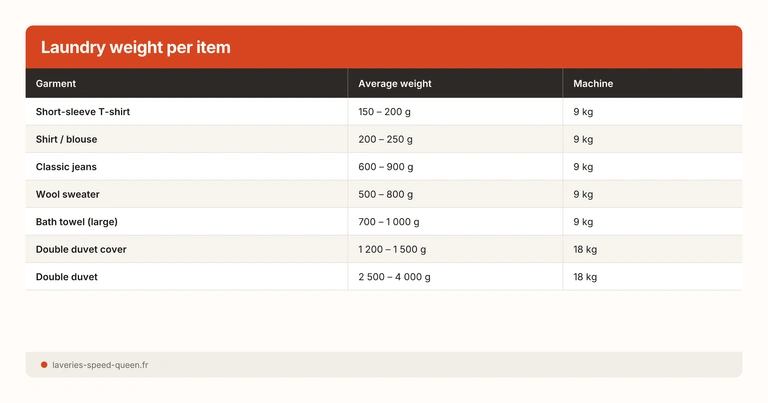
In a nutshell: Weight benchmarks: a pair of jeans weighs ~750 g, a double sheet ~800 g, a bath towel ~500 g, a t-shirt ~175 g. But choosing the right machine is never about weight alone — the fabric’s bulk, thickness, and compressibility matter just as much. Fill the machine to 70-80% and leave room for proper tumbling.
At a glance
Don't exceed 80% of the rated capacity — leave space for the laundry to tumble freely.
The hand test — a hand's width of space between the laundry and the top of the drum.
Weight isn't everything — sheets, jeans, towels, and duvets fill the drum differently.
Dry weight, not wet — the listed capacity always refers to dry laundry.
To check your loads, a simple kitchen scale↗ does the trick: place your pile of dry laundry on it and compare with the weights below.
Common clothing weights
A pair of jeans weighs between 600 and 900 g, a t-shirt between 150 and 200 g, a wool sweater between 500 and 800 g. For a quick estimate, count roughly 0.75 kg per pair of jeans, 0.18 kg per t-shirt, and 0.25 kg per dress shirt.
Just looking for jeans?
We’ve covered the most common sub-question in a dedicated article:
how much does a pair of jeans weigh by cut, size, and denim type
. You’ll also find a quick reference by machine capacity.
| Item | Average weight | Safe estimate in a 9 kg machine * |
|---|---|---|
Tops | ||
| Short-sleeve t-shirt | 150-200 g | ~25 t-shirts |
| Long-sleeve t-shirt | 250-350 g | ~18 |
| Tank top | 80-150 g | Always mixed loads |
| Polo shirt | 200-300 g | ~20 |
| Dress shirt / Blouse | 200-250 g | ~20 shirts |
| Light sweater (cotton, polyester) | 250-400 g | ~15 sweaters |
| Wool sweater | 500-800 g | ~10 (drum ⅓ max) |
| Sweatshirt | 350-500 g | ~12 |
| Hoodie | 500-700 g | ~10 hoodies |
| Vest / Cardigan | 300-500 g | ~14 |
Bottoms | ||
| Jeans | 600-900 g | ~6 pairs if the load is nearly all denim |
| Cotton trousers / Chinos | 400-600 g | ~14 pairs |
| Joggers / Sweatpants | 300-500 g | ~14 |
| Leggings | 150-250 g | ~20 |
| Skirt | 200-400 g | ~18 |
| Shorts / Bermudas | 200-350 g | ~18 |
Dresses and sets | ||
| Summer dress (light fabric) | 150-300 g | ~20 dresses |
| Heavy dress (denim, wool) | 400-600 g | ~12 |
| Adult pyjamas | 300-500 g | Always mixed loads |
| Nightgown | 150-300 g | Always mixed loads |
Underwear | ||
| Briefs / Boxers | 30-80 g | Always mixed loads |
| Bra | 50-100 g | Use a mesh laundry bag |
| Socks (pair) | 30-60 g | Always mixed loads |
Outerwear | ||
| Coat / Jacket | 800-1,500 g | Around 4 to 5 light coats; bulk is the limiting factor |
| Puffer jacket | 500-1,000 g | Bulk! → puffer jacket guide |
| Parka | 600-1,000 g | ~8 |
| Windbreaker | 300-500 g | ~14 |
| Trench coat | 800-1,200 g | ~8 |
Children (0-12 years) | ||
| Child’s t-shirt | 80-150 g | Always mixed loads |
| Child’s jeans | 250-500 g | Always mixed loads |
| Child’s trousers | 100-250 g | Always mixed loads |
| Child’s sweatshirt | 200-350 g | Always mixed loads |
| Child’s puffer jacket | 300-500 g | Always mixed loads; bulk is the limiting factor |
| Child’s pyjamas | 100-200 g | Always mixed loads |
| Baby bodysuit | 50-100 g | Always mixed loads |
Sportswear and accessories | ||
| Sport / Performance t-shirt | 100-180 g | Always mixed loads |
| Sport shorts | 100-200 g | Always mixed loads |
| Sport leggings | 150-250 g | Always mixed loads |
| Swimsuit | 100-250 g | Use a mesh laundry bag |
| Adult bathrobe | 1,000-1,500 g | ~6 bathrobes |
- Safe estimates for a mostly uniform load. Some items are limited by weight first, others by bulk or load density. In practice, always check the free space in the drum and choose a larger machine if the fabric is thick, bulky, or doesn’t compress well.
Estimate your load in 30 seconds
Don’t feel like doing the math yourself? Our
laundry weight calculatordoes the work for you: select your items, adjust the quantities, and instantly get the total weight, the recommended machine, and the estimated price at our laundromats.
Need this list at the laundromat? Print this page (Ctrl+ P or ⌘+P) to take a paper copy with you.
Household linen weights
A full set of fitted sheet + duvet cover + 2 pillowcases for a double bed typically weighs between 2.5 and 3.2 kg dry.
| Item | Average weight | Recommended machine |
|---|---|---|
| Single fitted sheet | 500-600 g | 9 kg |
| Double fitted sheet | 700-900 g | 9 kg |
| Single duvet cover | 800 g - 1 kg | 9 kg |
| Double duvet cover | 1-1.3 kg | 9-18 kg |
| Pillowcase | 150-200 g | 9 kg |
| Bath towel | 400-600 g | 9 kg |
| Bath sheet (large) | 700-1,000 g | 9 kg |
| Hand towel | 200-300 g | 9 kg |
| Kitchen towel | 80-150 g | 9 kg |
| Tablecloth | 500-1,500 g | 9 kg |
Household linen is often the heaviest part of a laundromat load. A family of 4 can easily accumulate 8 to 10 kg of sheets, towels, and covers in a week. The trick: bundle all your bedding into a single 18 kg machine instead of running two 9 kg loads — it’s faster and often cheaper. Also consider washing towels separately from clothes: terry cloth fibres leave lint on synthetics.
Bulky items: duvets, curtains, rugs
For a double duvet weighing 2 to 3 kg, go straight for an 18 kg machine to ensure proper tumbling. Here, it’s clearly bulk that decides, not weight.
| Item | Average weight | Minimum machine |
|---|---|---|
| Single duvet | 1.5-2 kg | 9-11 kg |
| Double duvet | 2-3 kg | 18 kg |
| Pillow | 500-800 g | 9 kg (2-3 per machine) |
| Throw blanket | 1-2 kg | 9 kg for a small batch only |
| Fleece blanket | 1-2 kg | 9-18 kg depending on thickness and the rest of the load |
| Curtains (standard pair) | 1-3 kg | 9-18 kg depending on size and fabric density |
| Bath mat | 500-1,000 g | 9 kg. For larger rugs, see our guide to washing rugs in a machine |
| Puffer jacket | 500-1,000 g | 9-18 kg (bulk!) |
Weight ≠ Bulk
A 2 kg synthetic duvet is lighter than a 2 kg pile of towels, but it takes up far more space in the drum. For bulky items (duvets, puffer jackets, pillows), it’s the volume that counts, not the weight. Choose a larger machine than the weight alone would suggest. See our guides: washing a duvet, washing a puffer jacket.
Now that you know the weight of each item, you can build your ideal load. The 9 kg, 11 kg, and 18 kg machines at our laundromats in Toulouse cover every need, from everyday laundry to a double duvet. Check the pricing by location to plan your budget, and our drying guide to save time after washing.
How many items per machine capacity?
The most common question: “How many sheets or towels fit in my machine?” Here’s a conservative cross-reference table for the capacities available at the laundromat. Don’t read these numbers as a strict mathematical maximum by weight — the actual bulk inside the drum matters just as much.
| Item | 9 kg machine | 11 kg machine | 18 kg machine |
|---|---|---|---|
| Double fitted sheets | 4-6 sheets | 6-8 sheets | 10-12 sheets |
| Bath towels | 6-7 towels | 8-9 towels | 12-14 towels |
| Jeans | 6 pairs | 7-8 pairs | 10-12 pairs |
| T-shirts | 25-30 t-shirts | 35-40 t-shirts | 55-65 t-shirts |
| Double duvets | ❌ Too small | 1 thin duvet only if it stays low-bulk | 1 duvet, sometimes 2 very thin ones without packing |
| Pillows | 2-3 pillows | 3-4 pillows | 5-6 pillows |
| Duvet covers | 4 covers | 5-6 covers | 8-10 covers |
Conservative estimates based on practical fill levels consistent with the site’s calculator, accounting for both dry weight and the real bulk of the fabric. Dense or bulky items (denim, terry cloth, thick bedding) often fill the drum before reaching the theoretical maximum weight.
These benchmarks cover the three capacities available at our Speed Queen laundromats in Toulouse and Blagnac. For families with children or a full week’s laundry, the 18 kg machine is often the most cost-effective option in a single run — check our pricing to compare.
Loading the machine properly
The ideal load fills the drum to 70-80%, which is roughly 6 to 7 kg in a 9 kg machine for a typical mixed load. With dense or bulky items, you may reach the right fill level by volume well before you hit the weight limit.
The hand test
Load the machine, then place your hand flat on top of the laundry. If there's roughly a hand's width of space between the laundry and the top of the drum, you've got the ideal load. If the laundry presses against the door, take some out.
80% of the rated capacity
The listed capacity (9 kg, 18 kg) is a theoretical maximum for dry cotton. For optimal washing, aim for just 70-80% as long as the load stays loose enough. With denim, terry cloth, or thick bedding, bulk can become the limiting factor before weight does.
Mix your sizes
Don't fill the machine with only sheets or only socks. A mix of sizes (large + small items) allows better agitation and a more effective wash.
Adjust the fill level to the fabric type
Cotton can handle filling the drum to three-quarters, but synthetics and wool need more space. This often-overlooked rule makes a real difference in wash quality.
| Fabric type | Max fill level | Why |
|---|---|---|
| Cotton / Linen | ¾ of the drum (75%) | Dense fibre, absorbs water well, effective agitation |
| Synthetics (polyester, nylon) | ½ of the drum (50%) | Swells with water, takes up more space when wet |
| Wool / Delicates | ⅓ of the drum (33%) | Reduces friction and the risk of felting |
| Everyday mixed load | 70-80% of capacity | General guideline for typical daily loads |
At the laundromat, most loads are everyday laundry (a mix of cotton and synthetics): the 70-80% rule applies. If you’re washing a batch of wool sweaters or performance wear, plan for a larger machine than the weight alone would suggest.
Sample full loads
A week’s worth of everyday laundry for 1 to 2 people comes to about 7 kg — a solid, efficient load for a 9 kg machine.
9 kg machine — Everyday laundry
8 t-shirts (1.4 kg) + 3 pairs of jeans (2.2 kg) + 2 dress shirts (0.5 kg) + 2 sweatshirts (1.1 kg) + 10 pairs of socks (0.5 kg) + 8 boxers (0.4 kg) + 2 lightweight trousers (1 kg) = about 7 kg. That's one week of laundry for 1-2 people.
18 kg machine — Household linen
2 double duvet covers (2.3 kg) + 2 double fitted sheets (1.6 kg) + 4 pillowcases (0.7 kg) + 6 bath towels (3 kg) = about 7.5 kg. Or: 1 double duvet + 1 duvet cover + 2 pillows. The 18 kg machines are essential for large, bulky items.
Our laundromat machines
Choosing the right capacity comes down to your actual need: 9 kg for everyday loads, 11 kg for medium loads, and 18 kg for bedding or large volumes.
Available capacities
9 kg machines (from 4.90 EUR), 11 kg, and 18 kg machines (from 9.80 EUR). Tumble dryers: 14 and 16 kg. Detergent and fabric softener are included in every price. See pricing by location.
In practice, most of our customers use the 9 kg machine for their weekly clothes (shirts, underwear, socks) and switch to the 18 kg machine once or twice a month for bedding and bulky items. This rotation keeps your laundry fresh without eating up every weekend. Total time at the laundromat? About 1 hour all-in (wash + dry) thanks to Speed Queen’s professional dryers.
To make sure you never overload your machine again, a kitchen scale↗ costing just a few euros will save you from wasted wash cycles.
Mistakes to avoid
- Overloading to "save" a cycle — the laundry will be poorly washed, poorly rinsed, and the machine wears out faster
- Stuffing a double duvet into a 9 kg machine — not enough room; the duvet won't be properly washed
- Weighing wet laundry — machine capacity always refers to dry weight
- Ignoring bulk — a 700 g puffer jacket needs an 18 kg machine (it's about volume, not weight)
Calculate your laundry weight
Rather than weighing each item, use our
laundry weight calculator. Select your items, adjust the quantities: the calculator gives you the total weight, the recommended machine, and the estimated price.
Need to wash bulky items? Our 18 kg machines are built for that. Not sure which capacity you need? Take our machine quiz in 4 questions. Our Toulouse Croix-Daurade laundromat, our Blagnac laundromat, and our upcoming Montaudran laundromat are open 7j/7, detergent included. Check our pricing. Torn between a laundromat and dry cleaning? See our
laundromat vs. dry cleaning comparison
. Have a question about your laundry weight? Contact us for personalized advice.
As an Amazon Associate, we earn a small commission on purchases made through the affiliate links in this article — at no extra cost to you. This helps us maintain this site and produce free guides.
Sources and references
- ISO 3758 Standard — Textile care labelling symbols (lien externe) (international labelling reference)
- GINETEX — International Association for Textile Care Labelling (lien externe) (standards body)
- Speed Queen — Commercial machine technical specifications (lien externe) (manufacturer)
- Choosing your machine (9 kg, 11 kg, 18 kg)
- Official Speed Queen Toulouse/Blagnac pricing