In a nutshell: moving generates a mountain of laundry — curtains, duvets, sheets, covers, towels. At a laundromat, 3 x 18 kg machines in parallel handle all the household linen of a home in ~1 hour (wash + dry). At home, the same volume would take 6-8 hours chaining cycles on a 7 kg machine.
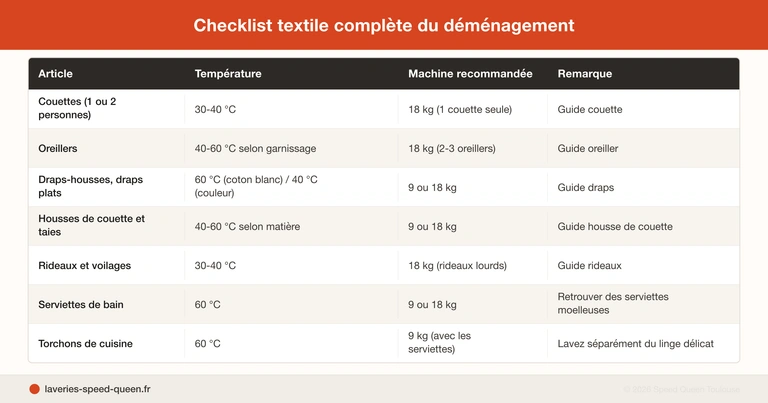
Complete moving day textile checklist
A move is the perfect time to take stock of all household textiles. Here’s the exhaustive list, room by room, so nothing gets forgotten.
| Item | Temperature | Recommended machine | Note |
|---|---|---|---|
| Duvets (single or double) | 30-40 °C | 18 kg (1 duvet alone) | Duvet guide |
| Pillows | 40-60 °C depending on filling | 18 kg (2-3 pillows) | Pillow guide |
| Fitted sheets, flat sheets | 60 °C (white cotton) / 40 °C (colors) | 9 or 18 kg | Sheet guide |
| Duvet covers and pillowcases | 40-60 °C depending on fabric | 9 or 18 kg | Duvet cover guide |
| Curtains and sheers | 30-40 °C | 18 kg (heavy curtains) | Curtain guide |
| Bath towels | 60 °C | 9 or 18 kg | Getting fluffy towels back |
| Kitchen towels | 60 °C | 9 kg (with towels) | Wash separately from delicates |
| Sofa covers | 30-40 °C (check label) | 18 kg | Check no non-removable foam inside |
| Removable cushion covers | 30-40 °C (cover only) | 9 kg | Only wash the cover, not the filling |
| Bath mats, washable doormats | 40-60 °C | 9 or 18 kg | Rug guide |
| Small rugs (bedside, play mats) | 30-40 °C | 18 kg | Check the label and non-slip backing |
| Throws and blankets | 30-40 °C | 18 kg | Wool: cold wash, wool program |
| Mattress protectors | 60 °C | 9 or 18 kg | Hygiene barrier — wash systematically |
Curtains and sheers — from both homes (old + new if kept). Curtain guide.
Duvets and pillows — wash before installing in the new bed. 18 kg machine recommended. Duvet guide.
Sheets, duvet covers, pillowcases — the first set for the first night, wash as priority.
Bath towels and kitchen towels — often forgotten in boxes. Wash before storing.
Sofa covers, removable cushion covers — if machine washable (check the label).
Washable rugs — doormat, bath mat, small rugs. Rug guide.
Throws and blankets — often forgotten because they're not seen as 'moving laundry'.
Mattress protectors — essential hygiene barrier, wash at 60 °C before placing on the new mattress.
Planning the laundromat visit
Sort BEFORE you go
Prepare 3-4 bags at home: hot whites (sheets, towels -> 60 °C), colors (covers, curtains -> 30-40 °C), bulky items (duvets, pillows -> 18 kg alone). You'll save time on site.
Load everything in parallel
This is THE key point. At a laundromat, you can load 3-4 machines at the same time. 3 machines in parallel = 1h for everything, versus 6-8h sequentially at home.
Right programs by category
White sheets and towels: 60 °C. Colored curtains and covers: 30-40 °C. Duvets and pillows: 30-40 °C in 18 kg. Always check the label.
Dry and fold on site
Dry laundry from the dryer folds right away and packs into moving bags. You leave with clean, dry laundry ready to put away.
Planning the visit: how many machines, how long, what cost
The key to a successful laundromat visit is planning. Here’s how to estimate your needs precisely.
Estimating total laundry weight
To choose the right number of machines, you need to estimate your laundry weight. Refer to our laundry weight guide per item for precise data. Here are the most common benchmarks for a move:
- Double duvet: 2.5-4 kg (synthetic) — fills nearly an entire 18 kg machine on its own
- Single duvet: 1.5-2.5 kg
- Pillow: 0.5-1 kg — you can fit 2-3 in an 18 kg machine
- Fitted sheet: 0.5-0.8 kg
- Duvet cover: 1-1.5 kg
- Bath towel: 0.5-0.8 kg
- Heavy curtains (pair): 2-4 kg — varies greatly by fabric and size
- Throw: 1-2 kg
Estimating the number of machines
| Home type | Laundry to wash (estimate) | 18 kg machines | Estimated budget |
|---|---|---|---|
| Studio / 1-bed | 1 duvet, 2-3 sheet sets, curtains, towels | 1-2 | 10-20 € |
| 2-bed / 3-bed | 1-2 duvets, 3-4 sheet sets, curtains, towels, covers | 2-3 | 20-35 € |
| 4-bed / House | 2-3 duvets, 4-6 sheet sets, multiple curtains, towels, covers | 3-4 | 30-50 € |
Total time on site
At a laundromat, time doesn’t depend on the number of machines but on the longest cycle. Here’s a realistic estimate:
- Loading: 10-15 minutes (sort, load, select programs)
- Washing: 25-35 minutes (standard cycle)
- Transfer to dryers: 5 minutes
- Drying: 25-40 minutes depending on thickness (duvets take longer)
- Folding: 10-15 minutes
Total: about 1h15 to 1h45 for a full 2-bed/3-bed home. Bring a book or some moving admin tasks to do on site.
The math that changes everything
3 x 18 kg machines in parallel = 54 kg of laundry washed and dried in 1 hour. On a 7 kg home machine, the same volume would require 8 cycles = about 12 hours of washing + drying. During a move, those hours count.
The 18 kg machine advantage for large volumes
The 18 kg machine is the laundromat’s main asset for a move. Here’s why it’s a game-changer compared to a 7-8 kg home machine.
One visit instead of five
A double duvet (3-4 kg) doesn’t fit properly in a 7 kg machine — it’s too compressed for proper tumbling and rinsing. In an 18 kg machine, the same duvet tumbles freely with plenty of room. Result: better washing, better rinsing and filling that doesn’t clump. See our guide to choosing the right capacity for a double duvet.
Heavy curtains and sofa covers
Heavy curtains (velvet, blackout, heavy linen) and large sofa covers are often impossible to handle properly in a home machine. The fabric is too compressed, rinsing is inadequate, and it would take multiple runs. In an 18 kg machine, even a pair of heavy living room curtains goes through in a single cycle. See our curtain washing guide.
Detergent is included
At our Speed Queen laundromats, detergent and softener are dosed automatically — no need to bring a bottle. It’s a detail that matters on moving day, when every liter of car space is precious. To understand dosing differences, see our detergent dosage guide.
The new home’s textiles
Moving isn’t just about YOUR laundry — the new home sometimes has textiles that need treating:
- Curtains left by the previous tenant: dust, allergens and odors accumulated over months or years. Wash before rehanging (30-40 °C, see curtain guide).
- Carpets / rugs: deep vacuuming + wash if possible. Small rugs fit in an 18 kg machine.
- Inherited mattress: not machine washable but a new mattress protector washed at 60 °C + an anti-dust mite cover is the first hygiene barrier (see dust mite protocol).
- Closets and wardrobes: wipe the inside with white vinegar↗ before storing clean laundry. Residual mothballs or humidity from the previous tenant transfer to fabric.
Before moving in: wash everything too
Many people think about the old home’s laundry but forget an essential step: preparing the new home before installing clean textiles.
Why it matters
An empty home isn’t a clean home. Between the previous occupant’s departure and your arrival, dust accumulates, surfaces are often only superficially cleaned, and signs of humidity or mold in closets remain invisible until you look closely.
What to do before storing clean laundry:
- Air the home — open all windows for at least 2 hours before installing anything.
- Clean inside the closets — wipe each shelf with a cloth soaked in diluted white vinegar (1 part to 2 parts water). Let dry with doors open.
- Inspect joints and corners — mold in a bathroom or kitchen closet will contaminate your clean laundry within days.
- Check existing curtains — if they smell musty, of tobacco or cooking, wash before rehanging.
- Protect the mattress immediately — even a new mattress benefits from a protector washed at 60 °C. If the mattress is inherited, it’s essential.
The residual humidity trap
If the home has been closed for several weeks, humidity may have settled in. Don’t store clean laundry in a closet that smells musty — the odor will transfer to fabric within days. If you detect a suspicious smell, place a dehumidifier↗ or moisture absorber in the closet for 48 hours before storing anything.
The first night: the absolute priority
Your first-night bed is the only thing that truly matters on moving day. Prepare in advance:
- 1 clean sheet set (fitted sheet + duvet cover + pillowcases) in a separate, easily accessible bag.
- 1 recently washed duvet (or plan the laundromat visit for the same day).
- Towels for the first shower.
Everything else can wait 24-48h. Don’t exhaust yourself trying to wash everything on day one.
When to visit the laundromat
Before leaving the old home
Ideal: you pack clean laundry, ready to install as soon as you arrive at the new place. First night, the bed is made with fresh sheets.
On moving day
If timing allows: while the movers are loading, run the machines. You collect clean, dry laundry by end of day.
The first days of settling in
If the new home has curtains left by the previous tenant, wash them. Same for inherited textiles (mattress, covers).
Choosing the right time slot
If you visit the laundromat on a Saturday move, aim for early morning (before 9 AM) or lunch time. Late morning and early afternoon slots are usually the busiest. If you need 3-4 machines in parallel, a quiet slot ensures you’ll find enough machines available at once. If it’s your first time at a laundromat, see our first visit guide.
Mistakes to avoid
- Packing dirty laundry in boxes — odors and moisture transfer to neighboring items. Wash before or separate in airtight bags.
- Forgetting to check labels — curtains, covers and cushions don't all have the same wash temperature. Check before loading. See our care label symbol guide.
- Overloading the 18 kg machines — a double duvet fills nearly the entire machine alone. Don't add other items at the risk of compressing the filling.
- Not bringing bags for the return — clean, dry laundry needs proper transport. Bring clean bags or covers.
- Storing clean laundry in a damp closet — air and clean the new home's closets before storing anything.
- Forgetting mattress protectors — it's the most important hygiene barrier for bedding. Wash at 60 °C before placing on the new mattress.
Moving day checklist: laundry not to forget
Amid boxes and moving-day stress, some textiles slip through the cracks. Here’s a list of items many people forget to wash that deserve a machine cycle before or after the move.
Curtains from the old home accumulate dust and cooking odors. Wash them in an 18 kg machine before rehanging in the new home — or store them clean if the new windows have different dimensions. Removable sofa cushion covers also deserve a wash: after years of use, covers are loaded with sebum and dust. Entrance mats and small rugs are often the dirtiest and most neglected textiles in the house.
Also think about storage textiles: fabric bags, storage duvet covers and sheets that have spent months in a closet. A refresh wash removes musty odor and any accumulated dust mites.
As an Amazon Partner, we earn a small commission on purchases made via the affiliate links in this article — at no extra cost to you. This helps us maintain this site and produce free guides.
Moving to Toulouse or Blagnac? Our laundromats at Blagnac, Croix-Daurade and Montaudran have 9 and 18 kg machines — detergent and softener included. Load 3 machines in parallel and leave with all your laundry clean and dry in ~1h. Payment CB sans contact ou espèces. See our pricing.
Sources and references
- How to wash a duvet in an 18 kg machine
- How to wash curtains and sheers
- Washing a rug in the machine
- Laundry weight per item (to estimate loads)
- First time at a laundromat: complete guide
- Washing a duvet cover
- Care label symbol guide
- Detergent dosage guide
- White vinegar and laundry
- What machine capacity for a double duvet