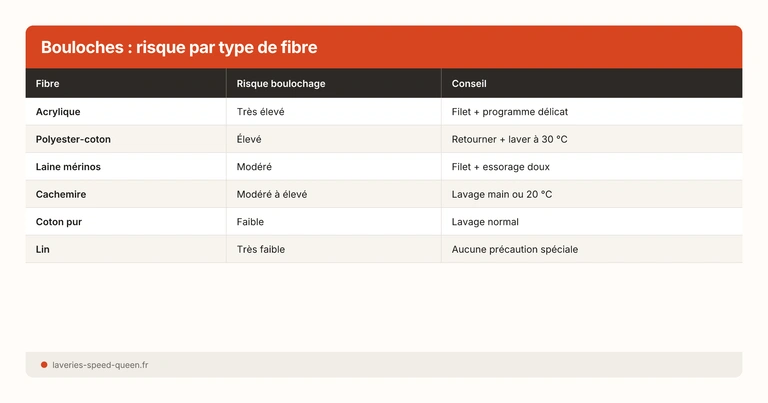
In short: pills (pilling) form through mechanical friction on short fibres — acrylic is the most affected, merino the least. To remove them, use a fabric shaver (most effective) or tape as a quick fix. To prevent them: wash inside out, in a mesh laundry bag, on a delicate cycle at 30 °C, without fabric softener. The tumble dryer is a major pilling accelerator.
At a glance
Pills come from friction -- wearing + washing + tumble drying detach short fibres that tangle together.
Fabric shaver = best tool -- trims at fabric level without damage. EUR 10-15.
Wash inside out in a mesh bag -- reduces mechanical friction by 60-70%.
No fabric softener -- it lubricates fibres and speeds up detachment.
Delicate cycle at 30 °C -- less rotation, less friction, less pilling.
Why clothes pill
Pilling is a mechanical phenomenon, not a manufacturing defect. It occurs in three stages.
Stage 1: fibre detachment. Every textile fibre is made of yarns, themselves composed of fibres twisted together. The shortest fibres (called staple fibres) protrude from the yarn surface. Mechanical friction — rubbing from a backpack, drum rotation, seatbelt contact — gradually pulls these fibres from the yarn twist.
Stage 2: migration to the surface. Detached fibres migrate to the fabric surface. They form a light “fuzz” visible under raking light.
Stage 3: tangling. The loose surface fibres tangle together through continued friction, forming small balls — pills. The more tensile-resistant the fibres (as with acrylic and polyester), the more pills stay attached. Paradoxically, the fibres that pill most are often the strongest, because the pills do not detach naturally.
By fibre: which pills and why
Not all fibres are equal when it comes to pilling. Fibre length and tensile strength are the two determining factors.
Acrylic -- severe pilling
The undisputed pilling champion. Acrylic is made of short, very strong fibres: they detach easily but do not break, so pills stay attached indefinitely. 100% acrylic jumpers pill from the first wears. Regular shaver treatment is necessary.
Polyester-cotton -- moderate pilling
The polyester-cotton blend (typical of basic t-shirts) pills moderately. Polyester (strong fibres) retains the pills formed by cotton (short fibres). Pilling is mostly visible at friction zones: armpits, collar, sides.
Cashmere -- initial pilling then stabilisation
Cashmere pills noticeably during the first 3-5 wears/washes, then stabilises. The shortest fibres detach first, leaving a smoother fabric afterwards. Initial cashmere pilling is NORMAL -- it is not a sign of poor quality. Remove pills with a comb (not a shaver on fine cashmere).
Merino wool -- low pilling
Merino has long, elastic fibres that resist friction well. Pilling is rare and light. This is one reason merino is preferred for sportswear and technical underwear -- it stays smooth after dozens of washes.
100% cotton -- low to moderate pilling
Pure cotton pills little because its fibres are moderately strong: pills that form detach and fall away naturally during washing. Cotton quality matters a lot: long-staple cotton (Egyptian, Pima) pills less than standard cotton.
Linen and silk -- virtually no pilling
Linen has very long, rigid fibres that do not tangle. Silk has continuous fibres (one thread per cocoon) -- there are no short fibres to detach. These two fibres almost never pill.
Pilling is not a quality defect
A quality cashmere jumper that pills in the first weeks is normal. It is a “breaking-in” process: the shortest fibres detach, then the fabric stabilises. By contrast, an acrylic jumper that pills continuously is an intrinsic characteristic of the fibre — not a garment defect. Choosing fibres that pill less (merino, long-staple cotton, linen) is the best prevention at the point of purchase.
How to remove pills: the methods
The fabric shaver (method no. 1)
The fabric shaver (or lint remover) is the most effective tool. Its principle: a rotary blade protected by a guard trims pills at the fabric surface without cutting the yarns.
Instructions:
- Lay the garment flat on a hard surface (table, ironing board).
- Gently stretch the fabric with one hand.
- Run the shaver in straight strokes without pressing. Let the blade do the work.
- Work zone by zone: armpits, collar, sides, sleeves.
- Empty the reservoir regularly — a full reservoir reduces effectiveness.
Price: EUR 10-25 for a quality rechargeable model. A lasting investment (several years of use).
Precautions: on very fine fabrics (chiffon, thin jersey), set the blade height to maximum. On fine cashmere, prefer a pilling comb.
The pilling comb
The pilling comb (or cashmere comb) is a small metal comb with very fine teeth that catch and pull pills. It is gentler than the shaver and recommended for fragile textiles (cashmere, fine wool, delicate jersey).
Instructions: run the comb in short strokes, always in the same direction (no back and forth). Pills accumulate on the teeth — remove them regularly.
Tape and lint roller
As a quick fix, wide adhesive tape (packing tape) or a lint roller removes surface pills. Wrap tape around your hand (sticky side out) and dab the fabric. Pills stick to the tape.
Less effective than a shaver for widespread pilling, but handy on the go or for quick touch-ups before heading out.
Pumice stone (thick textiles only)
A natural fine-grain pumice stone can remove pills from thick fabrics like denim, boiled wool or fleece. Rub gently in one direction on dry fabric. This method is too abrasive for fine textiles — reserve it for robust fabrics.
Washing prevention: the 5 key steps
Machine washing is the primary cause of pilling (ahead of wearing). Each wash cycle subjects clothes to tens of minutes of mechanical friction in the drum. Here is how to reduce that friction.
Wash inside out -- the visible face of the garment is protected from direct contact with the drum and other garments. The inner face (invisible) absorbs the friction.
Use a mesh laundry bag -- the bag isolates the garment and reduces cross-rubbing with other items. Especially important for jumpers, scarves and delicate textiles.
Delicate cycle at 30 °C -- the delicate cycle uses slower rotation and reduced spin (400-600 rpm). Less movement = less friction = less pilling.
No fabric softener -- fabric softener lubricates fibres, making short fibres detach more easily. Replace with half a glass of white vinegar in the softener tray.
Do not overload the drum -- a full drum increases pressure between garments and therefore friction. Fill to 75% maximum. See our capacity guide.
The role of the tumble dryer
The tumble dryer is a major pilling accelerator. Drum rotation combined with heat that softens fibres creates intense friction. The visible proof: the dryer lint filter accumulates a mat of detached fibres each cycle — those fibres come directly from your clothes.
For pilling-prone textiles: air dry on a drying rack or use the tumble dryer’s low-temperature programme if you have no other option. See our drying guide for alternatives.
Prevention at purchase
The best time to avoid pilling is when you buy. A few pointers for choosing clothes that resist pilling.
Prefer:
- Long fibres: merino, long-staple cotton (Egyptian, Pima, Supima), linen.
- Tight knits: a dense knit exposes fewer fibres at the surface.
- Smart blends: wool + polyamide (polyamide reinforces without excessive pilling).
Avoid or accept:
- 100% acrylic — pilling guaranteed and permanent. If you like an acrylic jumper, accept the idea of using the shaver regularly.
- Low-end polyester + cotton blends — polyester retains the pills formed by cotton.
- Loose knits — more fibre surface exposed = more pilling.
Care by garment type
| Garment | Typical fibre | Risk | Removal | Wash prevention |
|---|---|---|---|---|
| Acrylic jumper | 100% acrylic | Very high | Regular shaving | Inside out + bag + 30 °C |
| Cashmere jumper | Cashmere | High then stable | Cashmere comb | Hand or delicate 20 °C |
| Merino jumper | Merino wool | Low | Comb if needed | Delicate 30 °C, no tumble dryer |
| Polyester-cotton t-shirt | Polyester + cotton | Moderate | Shaver | Inside out + 30-40 °C |
| Fleece | Polyester | Moderate to high | Shaver or pumice | Inside out + bag + cold |
| Jeans | Cotton + elastane | Low (inside) | Shaver if visible | Inside out + 30 °C |
| Linen shirt | Linen | Almost none | — | 30-40 °C standard |
At the laundromat: the delicate programme
Professional laundromat machines offer a delicate programme at 30 °C with reduced spin, perfectly suited to pilling-prone clothes. The advantage of large-format drums: they give garments more space, reducing friction between items compared to a full domestic drum.
To wash your jumpers and knits at the laundromat, follow the same rules as at home: turn them inside out, place them in mesh laundry bags and select the delicate programme. The higher water volume and more thorough rinsing are an added benefit — less detergent residue in fibres means less stiffness and therefore less friction when worn.
Myths and realities
Myth: “Putting the garment in the freezer kills pills.” Reality: cold changes absolutely nothing about pilling. Pills are a mechanical phenomenon, not a biological one. The freezer is useful for removing chewing gum (cold hardens it), not pills.
Myth: “The more expensive a garment, the less it pills.” Reality: partially true. High-quality cashmere (long fibres) pills less than budget cashmere (short fibres). But a EUR 40 merino jumper will always pill less than a EUR 200 cashmere jumper — the fibre matters more than the price.
Myth: “Shaving thins the fabric.” Reality: the fabric shaver only cuts the balls of detached fibres on the surface. It does not touch the fabric yarns. A regularly shaved garment does not thin out faster than an unshaved one — the fibres forming the pills were already detached from the yarn.
Mistakes to avoid
- Using a beard razor -- the blade is too close to the fabric and can cut yarns. Use a fabric shaver with a protective guard.
- Pressing hard with the shaver -- you risk creating a hole or shaving too close. Let the blade skim the fabric.
- Using fabric softener to 'protect' fibres -- softener does the opposite: it lubricates fibres and speeds up detachment.
- Washing at high temperature -- heat softens synthetic fibres and makes detachment easier. 30 °C for sensitive textiles.
- Overloading the drum -- pressure between garments increases friction. Fill to 75% maximum.
- Skipping the mesh bag -- without a bag, the garment rubs against zips, buttons and rivets from other items.
- Thinking it is irreversible -- pills are easily removed with the right tool. A pilled garment is not ruined.
Summary: 3 common scenarios
Scenario 1 — Fully pilled acrylic jumper: Lay flat on a table. Run the fabric shaver zone by zone (10-15 minutes for a jumper). Brush off residue. Next wash: inside out + bag + 30 °C delicate + no softener. Expect to repeat in 5-10 wears — that is the nature of acrylic.
Scenario 2 — New cashmere jumper that pills: Do not worry, it is normal. Remove pills with a cashmere comb (not a shaver — too aggressive on initial pills). Wash by hand or on a wool programme at 20 °C. After 3-5 washes, pilling will stabilise naturally.
Scenario 3 — Fleece that fluffs after the dryer: Run the fabric shaver or gently rub with a fine-grain pumice stone. For future washes: inside out + bag + cold programme. Skip the tumble dryer — air dry. Fleece sheds fibres every dryer cycle (it is also a source of microplastics).
As an Amazon Partner, we earn a small commission on purchases made via the affiliate links in this article — at no extra cost to you. This helps us maintain this site and produce free guides.
The 30 °C delicate programme at our laundromats in Blagnac, Croix-Daurade and Montaudran is suited to pilling-prone garments. Large-format drums offer more space and reduce friction between items. Bring your mesh laundry bags for optimal protection. Payment CB sans contact ou espèces. Check our prices.
Sources and references
- Fabric softener: useful or not?
- White vinegar and laundry: uses and limits
- Delicate textile care
- Sportswear care
- Laundry weight guide
- How to wash jeans
- Drying guide
- Microplastics and synthetic washing
- Preventing shrinkage
- Pilling mechanism — friction of staple fibres and pill formation through tangling
- Textile fibre tensile strength — acrylic vs wool vs cotton vs polyester