In a nutshell: Shrinkage is caused by heat and mechanical agitation, not by water itself. The dryer shrinks clothes more than the washer. Wool can lose up to 30 % (irreversible felting), cotton 3 to 8 %, linen 3 to 5 %. Synthetics remain stable. Prevention: respect the maximum temperature per fibre, use the appropriate programme, and remove laundry from the dryer while still slightly damp. If cotton has shrunk, the conditioner + stretching method can recover 50 to 70 % of the lost size.
At a glance
Read the label — composition, maximum temperature and dryer symbol are the 3 essential pieces of information.
Wool = maximum danger — irreversible felting from 40 °C. Wool programme mandatory, no tumble drying.
Cotton = moderate risk — 3 to 8 % shrinkage possible, especially at the first high-temperature washes.
Synthetics = virtually harmless — polyester and nylon are stable. Elastane can lose its stretch.
The dryer shrinks more than the washer — heat + prolonged agitation is the worst combination.
Over-drying is enemy number one — remove sensitive laundry while still slightly damp.
Why clothes shrink: the 3 scientific mechanisms
Shrinkage does not have a single cause. It results from three distinct phenomena that combine and reinforce each other.
Fibre relaxation (cotton, linen)
During manufacturing, cotton and linen fibres are mechanically stretched to produce a smooth, even fabric. Heat (from washing or drying) releases this residual tension — the fibres return to their natural, shorter length. This shrinkage is greatest at the first wash and then stabilises. It is the main mechanism behind cotton shrinkage.
Felting (wool, cashmere)
Wool fibres have microscopic scales (cuticles) that open under heat and moisture. Under drum agitation, these scales lock together irreversibly — the fibre compacts and the garment shrinks. This is felting. A single wash cycle at too high a temperature can cause 10 to 30 % shrinkage.
Mechanical compression (all fibres)
The drum movement — in both washer and dryer — compresses the fibres against each other. Combined with heat, this mechanical effect reinforces shrinkage in sensitive textiles. This is why a larger drum (as in a commercial laundromat) causes less shrinkage: the laundry has more space and suffers less compression.
To understand in detail how heat affects each fibre type, see our washing temperature guide.
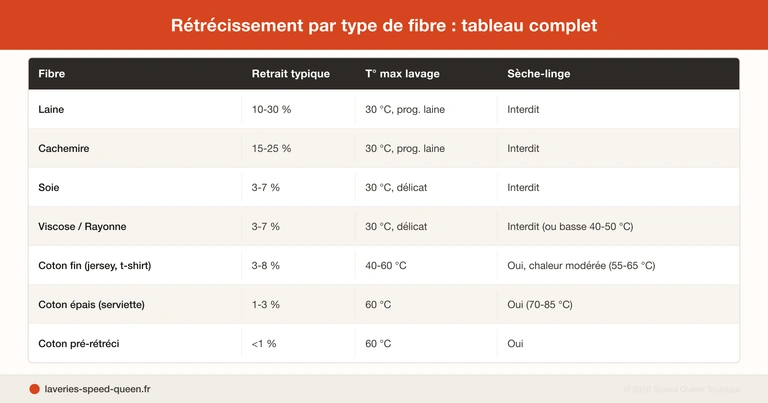
Shrinkage by fibre type: the complete chart
The basic rule: the more natural and fine the fibre, the higher the risk. Synthetics are stable; animal fibres (wool, cashmere, silk) are the most vulnerable.
| Fibre | Typical shrinkage | Max wash temp. | Tumble dryer | Risk | Mechanism |
|---|---|---|---|---|---|
| Wool | 10-30 % | 30 °C, wool prog. | Prohibited | Very high | Irreversible scale felting |
| Cashmere | 15-25 % | 30 °C, wool prog. | Prohibited | Very high | Felting, fibre finer than wool |
| Silk | 3-7 % | 30 °C, delicate | Prohibited | High | Protein fibre sensitive to heat |
| Viscose / Rayon | 3-7 % | 30 °C, delicate | Prohibited (or low 40-50 °C) | High | Regenerated cellulose fibre, sensitive to water and heat |
| Fine cotton (jersey, t-shirt) | 3-8 % | 40-60 °C | Yes, moderate heat (55-65 °C) | Moderate | Relaxation of stretched fibres |
| Thick cotton (towel) | 1-3 % | 60 °C | Yes (70-85 °C) | Low | Dense structure resists better |
| Pre-shrunk cotton | <1 % | 60 °C | Yes | Very low | Shrinkage triggered at factory |
| Denim (jeans) | 1-3 % in length | 40 °C | Moderate (55-65 °C) | Moderate | Length shrinkage, stabilises after 2-3 cycles |
| Linen | 3-5 % | 40 °C | Not recommended (55-65 °C if needed) | Moderate | Natural fibres contract under heat |
| Polyester | <1 % | 40 °C | Yes, low to medium (50-65 °C) | Very low | Thermoplastic fibre, stable |
| Nylon | <1 % | 40 °C | Yes, low to medium (50-65 °C) | Very low | Resistant, dimensionally stable |
| Elastane (Lycra) | No shrinkage | 30 °C | Low only (40-50 °C) | Low (but loss of elasticity) | Heat degrades the elastic polymer |
The dryer: cause number one of shrinkage
The dryer is responsible for more shrinkage than washing itself. Heat combined with prolonged mechanical drum movement contracts fibres cumulatively: each dryer cycle shrinks the garment a little more.
Why the dryer shrinks more than the washer
In the wash, fibres swell in water (which partially compensates for shrinkage). In the dryer, heat contracts fibres without compensation: water evaporates and the fibres tighten. Mechanical tumbling reinforces this contraction. Result: a high-temperature dryer cycle causes more shrinkage than a wash at the same temperature. See our drying guide for optimal settings per textile.
Drying temperatures by textile
Dryer temperature settings directly determine the level of shrinkage:
- Low (~45 °C): sensitive textiles (fine cotton, linen, viscose). Minimal risk.
- Medium (~65 °C): everyday cotton, sheets. Shrinkage stabilises after 2-3 cycles.
- High (~80 °C): towels and thick cotton sheets only. Never use for fine textiles.
For details per textile, see our guide to the tumble-dry prohibited symbol which explains how to read drying labels.
What should never go in the dryer
Certain textiles should never go in the dryer, regardless of temperature:
- Wool and cashmere: irreversible felting, even at low temperature
- Silk: protein fibres degrade and shrink
- Viscose/rayon: significant shrinkage and deformation
- Garments with prints or transfers: heat peels off the motifs
- Elastane underwear: heat destroys elasticity over repeated cycles
The impact of over-drying
Over-drying (leaving laundry tumbling after it is dry) is the main cause of excessive shrinkage. Fibres continue to contract in a hot, dry environment with no residual water to compensate. The solution: remove laundry while still slightly damp and finish in the open air.
Shrinkage in the wash: temperature and programme
The riskiest scenario is a hot wash followed by a high-heat dryer: on wool, a single cycle can be enough to trigger irreversible felting.
Temperature rules by fibre
30 °C maximum: wool, silk, viscose, cashmere
These fibres are the most sensitive to heat. Use the wool programme (wool, cashmere) or delicate (silk, viscose). Spin speed should not exceed 600 rpm. Above 30 °C, the risk of shrinkage increases sharply.
40 °C maximum: linen, polyester, nylon
Linen contracts with heat but is manageable at 40 °C. Synthetics tolerate this temperature without issue. Normal or delicate programme depending on fabric thickness.
60 °C: sturdy cotton only
Reserved for sheets, towels, tea towels and thick cotton. A fine cotton t-shirt should not be washed at 60 °C — it will lose size. For precise temperatures per textile, see our washing temperature guide.
The wrong programme: cause number two of shrinkage
A normal cycle (fast rotation, high spin) stresses sensitive fibres. The programme matters as much as the temperature:
- Wool programme: slow rotation, minimal spin, low temperature. Mandatory for wool and cashmere.
- Delicate programme: gentle rotation, moderate spin. For silk, viscose, linen, lace.
- Normal programme: suits cotton, polyester, nylon.
To find out which programme to choose for your textiles, see our delicate textiles guide.
The case of jeans and denim
Denim has a specific behaviour that deserves special attention.
Jeans: shrinkage then stretch
A 100 % cotton jean can lose 1 to 3 % in length after a hot wash and tumble dry, then stretch back out after 2 to 4 hours of wear. This is a normal and expected phenomenon. A jean with elastane (stretch) shrinks less in the wash but can lose its elasticity in the dryer. Shrinkage stabilises after 2-3 cycles. Tips: wash jeans inside out at 40 °C maximum, dry at medium temperature, and remove them while slightly damp.
The case of fibre blends
Modern garments often contain multiple fibres. Shrinkage behaviour depends on the blend:
- Cotton-polyester (65/35): polyester stabilises the fabric. Much less shrinkage than pure cotton. The easiest blend to care for.
- Wool-polyester or wool-acrylic: the synthetic reduces felting risk but does not eliminate it. Stay at 30 °C and wool programme as a precaution.
- Cotton-elastane: cotton can shrink while elastane loses its stretch with heat. Result: a shorter, less stretchy garment. Wash at 30-40 °C, no high-heat tumble drying.
- Viscose-polyester: viscose is the weak link. Follow viscose instructions (30 °C, delicate).
The rule: when a garment contains a blend, follow the instructions for the most sensitive fibre.
Initial shrinkage vs progressive wear
Not all shrinkage is the same. It is important to distinguish the different types to tailor prevention.
| Type | When | Fibres affected | Reversible | How to prevent |
|---|---|---|---|---|
| Initial shrinkage | 1st and 2nd washes | Cotton, linen, denim | No (anticipated by manufacturer) | Buy pre-shrunk garments or size up |
| Progressive shrinkage | Over repeated washes | Cotton, linen, viscose | Partially | Cold or warm water + gentle drying every cycle |
| Felting | 1 cycle is enough | Wool, cashmere | No | Wool programme, 30 °C, never tumble dry |
| Loss of elasticity | After repeated tumble drying | Elastane, lycra | No | Air dry or low temperature |
| Deformation | Hanging to dry | Knit, knitwear, wool | Sometimes | Dry flat on a towel |
Complete prevention protocol
Follow these 6 steps in order to eliminate shrinkage risk across all your laundry.
1. Read the label BEFORE buying
In the shop, check the composition and care symbols. A 100 % wool sweater requires more attention than a wool-polyester blend. A garment labelled 'dry clean only' means an ongoing maintenance cost. See our care symbols guide to decode each icon.
2. Sort by sensitivity
Separate sensitive fibres (wool, silk, viscose, fine cotton) from resilient ones (polyester, nylon, thick cotton). Do not mix them in the same wash or drying cycle. Delicate items over-dry when tumbled with resilient laundry.
3. Respect the maximum temperature
Never exceed the temperature shown on the label. When in doubt, wash at 30 °C — no fibre shrinks significantly at that temperature. Cold water is even safer for the most sensitive textiles.
4. Choose the right programme
Wool programme for wool and cashmere, delicate programme for silk, viscose and linen. Maximum spin 600 rpm for sensitive textiles. A normal programme suits cotton and synthetics.
5. Adapt the drying
Low temperature (~45 °C) for sensitive textiles. Flat drying for knitwear and sweaters. Air drying for wool, silk and viscose. If using the dryer, remove laundry while still slightly damp.
6. Flat drying for knitwear
Sweaters, cardigans, fine knits: always dry flat on a towel. The weight of water deforms the garment if you hang it. Flat, it returns to its natural shape without stretching or shrinking.
What to do if a garment has already shrunk
Speed is key. The sooner you act (while the garment is still damp), the better your chances of recovering the original size.
Method for shrunken cotton (conditioner)
- Fill a basin with warm (not hot) water and add a tablespoon of hair conditioner.
- Submerge the garment and soak for 30 minutes. The conditioner softens cotton fibres and releases the tension.
- Remove the garment without wringing. Lay it flat on a large towel.
- Gently stretch the garment in all directions — seams, sleeves, hem, neckline.
- Leave to dry completely flat, repositioning regularly.
- Expected result: recovery of 50 to 70 % of the lost size. Not guaranteed at 100 %, but often enough.
Method for shrunken denim
Denim is easier to rescue: wear the jeans slightly damp for 2 to 4 hours. Denim cotton stretches naturally under the tension of wearing. You can also soak and stretch as for cotton.
Steam method for cotton (alternative)
Hold a steam iron 5-10 cm from the garment while gently stretching the fabric. The hot steam relaxes the fibres without fully wetting them. Less effective than soaking, but faster for mild shrinkage.
Felted wool: the (virtually) irreversible case
- Wool felting is irreversible in most cases. The fibre scales have locked together permanently under heat and agitation.
- You can try soaking in diluted white vinegar (1 tablespoon per litre of warm water) for 30 minutes, then gently stretch. The result is uncertain and limited.
- This is why prevention is absolutely essential with wool: wool programme at 30 °C, no tumble drying, flat drying.
Polyester and synthetics shrinkage
Polyester rarely shrinks, but when it does (dryer too hot), the damage is permanent. Polyester is a plastic: once thermally deformed, it does not return. Prevention remains the only solution.
Recovery options summary chart
| Fibre | Recoverable? | Method | Recovery rate |
|---|---|---|---|
| Cotton | Partially | Conditioner soak + stretching + flat drying | 50-70 % |
| Denim | Often | Wear damp or soak and stretch | 70-90 % |
| Linen | Partially | Warm soak + gentle stretching | 40-60 % |
| Wool (felted) | Rarely | Diluted white vinegar + stretching (uncertain result) | 0-20 % |
| Synthetic | No | Permanent thermal deformation | 0 % |
Prevention at purchase: fibres that shrink the least
When choosing a garment in the shop, certain fibre blends are naturally more stable in the wash:
- Cotton-polyester blend (65/35): shrinks much less than pure cotton. Polyester stabilises the fabric.
- Pre-shrunk cotton: the manufacturer has already triggered shrinkage at the factory. The garment will hold its size.
- 100 % polyester: no significant shrinkage, regardless of washing method.
- Cotton-elastane with anti-shrink treatment: some brands apply chemical treatments that limit shrinkage to under 1 %.
In practice, check three things before buying: the composition (on the inner label), the care symbols (max temperature and dryer allowed or not), and the mention “pre-shrunk” if it is pure cotton.
Mistakes that make laundry shrink
- Washing a wool sweater on a normal cycle — guaranteed felting. Wool always requires the wool programme.
- High-heat dryer for fine cotton — shortens lifespan and causes cumulative shrinkage with each cycle.
- Drying wool 'just 10 minutes' — that is enough to trigger felting. Even a short high-temperature cycle damages wool.
- Mixing sensitive and resilient fibres in the dryer — the fine cotton t-shirt dries in 15 min, the towel in 40 min. The t-shirt over-dries while the towel finishes.
- Ignoring the label because 'it's cotton' — fine cotton (jersey) shrinks 3 times more than a terry towel. The knit and thickness change everything.
- Spinning wool at full speed — violent spinning tangles fibres and triggers felting.
- Drying everything on maximum 'to save time' — over-drying is the number one cause of shrinkage. Longer and gentler is better.
- Believing that sun drying never shrinks — direct sun can also shrink sensitive fibres, especially wool exposed to heat for a long time.
Professional drying: an advantage against shrinkage
Commercial dryers shrink less
Contrary to common belief, commercial dryers are gentler than domestic models. Their larger drum reduces mechanical friction (less fibre compression), and the moisture sensor stops the cycle at the right moment — no over-drying. By choosing the right temperature setting at our Speed Queen laundromats, professional drying treats your clothes better than a small domestic dryer that compresses the laundry and runs too long.
En tant que Partenaire Amazon, nous percevons une petite commission sur les achats effectués via les liens partenaires de cet article — sans surcoût pour vous. Cela nous aide à maintenir ce site et à produire des guides gratuits.
At Speed Queen laundromats, our commercial machines offer programmes tailored to every textile: normal, delicate, wool. Large drum for less compression, moisture sensors to prevent over-drying. Detergent included, from 4.90 €. Laundromats in Blagnac and Croix-Daurade. Check our prices.
Methodology and sources
- The shrinkage mechanism aligns with ISO 6330 standard testing logic (domestic washing/drying): wool felting when cuticle scales interlock under agitation above 40 °C, and cotton relaxation shrinkage when weaving/knitting tensions are released by heat + moisture.
- Shrinkage percentages are orders of magnitude from textile literature. Actual shrinkage varies by weight, weave, any anti-shrink treatments and washing/drying conditions.
- Programme/temperature sorting advice is cross-referenced with GINETEX (care symbols) and the distinction between initial shrinkage and progressive shrinkage over successive cycles.
- Data on wool felting has been established for decades in textile research.
Sources and references
- Textile care symbols (GINETEX / ISO 3758) (lien externe)
- ISO 6330 standard — Textiles — Domestic washing and drying procedures for textile testing
- Le Mahieu, Le bon réglage sèche-linge pour garder la forme de vos vêtements, published 23 October 2025
- BUT Blog, Quel programme de sèche-linge pour ne pas rétrécir ?, published 3 February 2026
- GINETEX, Symboles d’entretien textile, consulted 15 March 2026
- Speed Queen, Documentation technique sèche-linge professionnels
- Washing temperature guide
- Delicate textiles: adapted programmes
- Complete drying guide
- Tumble-dry prohibited symbol