Curry stains because of curcumin (colouring E100), a fat-soluble polyphenolic pigment that is ultra-stubborn. But curcumin has an Achilles heel: it is photosensitive. UV rays break it down into colourless by-products (vanillin and ferulic acid). The protocol: scrape the excess, apply glycerine (15-20 min), rub with Marseille soap, rinse cold, then expose to sunlight — the most effective method, even on old stains. Never use hot water or tumble dry before checking.
At a glance
Glycerine first — it dissolves curcumin through lipophilic affinity. Leave for 15-20 minutes.
Cold water only — hot water fixes curcumin into the fibres almost irreversibly.
Sunlight is your best ally — UV breaks down curcumin. 2-6 hours in direct sunlight removes even old stains.
No tumble dryer before checking — heat polymerises the pigment and makes the stain permanent.
By fabric — white = percarbonate + sunlight. Colour = glycerine + lemon. Synthetic = rubbing alcohol.
Why curry stains so much: the chemistry of curcumin
Curry is a spice blend, but a single molecule is responsible for its intense yellow colour and staining ability: curcumin (diferuloylmethane), extracted from the rhizome of Curcuma longa.
An industrial food colouring
Curcumin is such a powerful colourant that it is used industrially under the code E100 to colour foods (mustard, cheeses, drinks, confectionery), cosmetics and textiles. A concentration of 2 to 5% in turmeric powder is enough to dye a fabric almost permanently in seconds of contact.
It is a fat-soluble polyphenol — it dissolves in fats, not in water. That is why rinsing a curry stain with water alone is ineffective: curcumin adheres to the natural oils in the fabric and resists aqueous rinsing.
Double affinity: fat + fibres
Curcumin has a dual chemical affinity that makes it particularly stubborn:
- Lipophilic affinity: it dissolves in the fatty component of curry sauce (cooking oil, ghee, coconut milk) and penetrates fibres via this fat phase.
- Hydrogen bonding with cellulose: once in contact with cotton (cellulose), curcumin forms direct hydrogen bonds with the hydroxyl groups of the fibre. This is the same chemistry as textile dyeing — literally, curry dyes your garment.
That is why white cotton is the hardest fabric to treat: cellulose has maximum natural affinity with curcumin.
Curcumin and photodegradation
Curcumin is one of the rare food pigments that degrades under UV rays. UV breaks the central conjugated diene bond of the molecule, producing vanillin (colourless) and ferulic acid (nearly colourless). This mechanism makes sunlight the most effective stain remover against turmeric — no household chemical is as effective.
Fresh stain: the first 15 minutes
Speed is decisive. A fresh curry stain is much easier to treat than a dry one, because curcumin has not yet formed stable bonds with the fibres.
Step 1 — Remove the excess
Scrape the curry sauce from the surface with the back of a spoon. For turmeric powder, blow gently or brush with a soft-bristle brush. Never rub — rubbing spreads the pigment over a wider area and pushes it into the fibres.
Step 2 — Glycerine
Vegetable glycerine is the first response to a curcumin stain. Glycerine is a mild lipophilic solvent that dissolves curcumin through chemical affinity, without attacking fibres or fabric colours.
- Apply generously to the stain.
- Gently massage with your fingertips to work it in.
- Leave for 15 to 20 minutes — glycerine needs time to solubilise the pigment.
- Rub with Marseille soap on the area.
- Rinse with cold water (never hot).
Step 3 — Assessment
If the stain has significantly faded, proceed to machine washing (30-40 °C). If a yellow trace remains, do not machine wash — move to sunlight exposure (next section) or the old-stain treatment.
NEVER do this
Do not pour hot water on a curry stain. Heat accelerates the formation of hydrogen bonds between curcumin and cellulose, making the stain virtually permanent in seconds. It’s the same mistake as for red wine stains or chocolate: always start cold.
Sunlight: the secret weapon against turmeric
This is the most important point in this article and the least known to the public: UV rays break down curcumin. This is a well-documented photochemical phenomenon in food chemistry — it’s why manufacturers of turmeric-containing products (mustard, sauces) use opaque packaging to protect the colour.
How it works
UV-A and UV-B rays from the sun break the conjugated diene bond at the centre of the curcumin molecule. The degradation products — vanillin, ferulic acid, acetone — are colourless or nearly colourless. The yellow stain disappears progressively as curcumin molecules are broken down.
The sunlight protocol
- Pre-treat the stain (glycerine + Marseille soap↗ + cold rinse) to remove as much pigment as possible.
- Dampen the stained area slightly — UV penetrates damp fabric better than dry.
- Expose in direct sunlight — not in shade, not behind glass (glass filters some UV-B). Lay the garment flat or hang on a line.
- Duration: 2 to 4 hours in summer (strong sunlight), 4 to 6 hours in spring/autumn. Re-dampen the area every hour if it dries.
- Assess: the stain should have noticeably faded or disappeared. If residue remains, repeat the next day.
In winter or cloudy weather
UV passes through clouds (at 50-80% intensity), but the process is slower. Two options:
- Behind a south-facing window: UV-A passes through glass (UV-B is filtered). The effect is slower but real — allow a full day.
- Sodium percarbonate: if sunlight is not available, [percarbonate](/blog/percarbonate↗-de-soude-linge/) (active oxygen) is the best chemical alternative. 1 tablespoon per litre of warm water, soak for 1-2 hours.
Old or set-in stain
A turmeric stain that has dried, been through the machine without pre-treatment, or worse, been exposed to tumble-dryer heat, has become a dye fixed in the fibre. Stronger agents are needed.
70% rubbing alcohol
Curcumin is soluble in alcohol (ethanol, isopropanol). Rubbing alcohol is therefore a direct and effective solvent.
- Dab the stain with a white cloth soaked in 70% rubbing alcohol.
- Leave for 10 minutes.
- Rub with Marseille soap.
- Rinse with cold water.
- Expose to sunlight if possible.
Precaution: test on a hidden area (inner seam) for coloured fabrics. Alcohol can dull some fragile dyes.
Hydrogen peroxide (10 volumes)
Hydrogen peroxide oxidises curcumin and bleaches it. It is a powerful agent, to be used with care.
- Dab the stain with 10-volume hydrogen peroxide on a cotton pad.
- Leave for 30 minutes while monitoring the reaction.
- Rinse with cold water.
- Machine wash.
Precaution: hydrogen peroxide is a bleaching agent. It is safe on white cotton but can decolourise coloured fabrics. On colours, use glycerine + alcohol + sunlight instead.
Lemon + sunlight: the natural combination
Lemon juice (citric acid↗) combined with sun exposure creates a natural bleaching effect that complements the photodegradation of curcumin.
- Squeeze fresh lemon juice on the stain.
- Sprinkle with fine salt (gentle abrasive action).
- Expose to direct sunlight for 2-3 hours.
- Rinse and machine wash.
This method is gentle and suitable for coloured fabrics — lemon does not strip colourfast textiles. However, avoid it on silk and wool (acid attacks protein fibres).
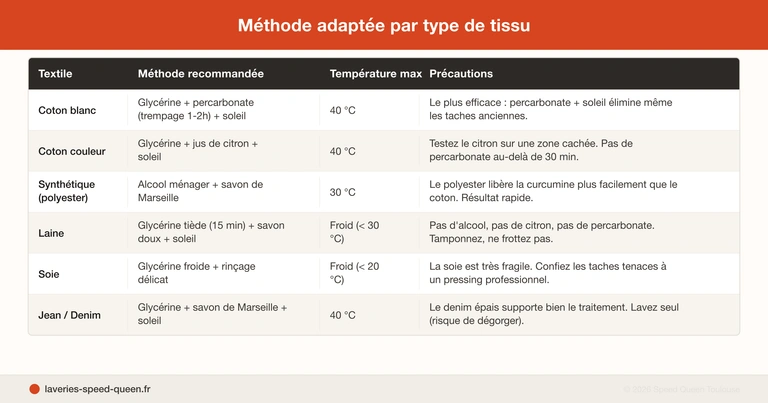
Method by fabric type
| Fabric | Recommended method | Max temperature | Precautions |
|---|---|---|---|
| White cotton | Glycerine + percarbonate (1-2 h soak) + sunlight | 40 °C | Most effective: percarbonate + sunlight removes even old stains. |
| Coloured cotton | Glycerine + lemon juice + sunlight | 40 °C | Test lemon on a hidden area. No percarbonate beyond 30 min. |
| Synthetic (polyester) | Rubbing alcohol + Marseille soap | 30 °C | Polyester releases curcumin more easily than cotton. Quick result. |
| Wool | Warm glycerine (15 min) + mild soap + sunlight | Cold (< 30 °C) | No alcohol, no lemon, no percarbonate. Dab, do not rub. |
| Silk | Cold glycerine + gentle rinse | Cold (< 20 °C) | Silk is very fragile. Take stubborn stains to a professional dry cleaner. |
| Jeans / Denim | Glycerine + Marseille soap + sunlight | 40 °C | Thick denim handles the treatment well. Wash alone (risk of colour bleeding). |
For delicate textiles, always refer to the garment’s care label. If in doubt about a valuable piece, a specialist dry cleaner has industrial stain-removal agents more effective than household products.
Mistakes that fix the stain
- Direct hot water — heat accelerates curcumin-cellulose bonding. Always start with cold water.
- Vigorous rubbing — rubbing spreads the pigment over a wider area and pushes it deep into the fibre. Dab, don't rub.
- Tumble dryer before checking — tumble-dryer heat (60-80 °C) polymerises curcumin and makes the stain virtually permanent.
- Bleach on colours — bleach strips the fabric and only works on pure white. Sunlight is equally effective and risk-free.
- Waiting — the more time curcumin has to bond with fibres, the harder it is to remove. Treat immediately.
Curry vs pure turmeric: what difference for stain removal?
Pure turmeric (powder)
Turmeric powder (2-5% curcumin) creates purely pigment-based stains. No fat, no proteins — just the pigment. Treatment is simpler: glycerine + sunlight suffices in most cases.
Curry sauce
A curry sauce is a complex mixture: curcumin (pigment) + cooking oil or ghee (fat component) + sometimes tomato (acidic pigment) + coconut milk (proteins and fat). The stain is composite and requires multi-step treatment:
- Treat the fat first: dish soap or fuller’s earth↗ to absorb the oily component. See our grease stain guide.
- Treat the pigment next: glycerine + sunlight for curcumin.
- Treat any acidity: if the sauce contains tomato, rinse with cold water first (acid fixes pigments when heated).
Turmeric in cosmetics
Turmeric is also used in face masks (anti-inflammatory) and leaves yellow traces on towels and pillowcases. The protocol is the same: glycerine + sunlight. For white towels, sodium percarbonate soaking is the fastest solution.
Machine washing
After pre-treatment, machine washing finalises the cleaning. The residual curcumin, weakened by glycerine and/or sunlight, is flushed out by the mechanical action of washing and the water volume.
Recommended settings
- Temperature: 30-40 °C maximum. Even after pre-treatment, stay below 40 °C for the first wash. If the stain has completely gone after checking, subsequent washes can be at normal temperature.
- Detergent: Standard liquid detergent. Detergents containing oxygen bleaching agents complement the treatment against curcumin.
- Rinsing: Thorough. Residual glycerine and soap remaining in the fibre can trap traces of pigment.
The advantage of water volume
Professional laundromat machines use 50 to 60 litres of water per cycle. This greater volume dilutes and flushes curcumin residues much more effectively than a domestic machine (15-20 litres). Professional rinsing is particularly beneficial for turmeric stains, where every trace of residual pigment creates a visible yellow ring.
En tant que Partenaire Amazon, nous percevons une petite commission sur les achats effectués via les liens partenaires de cet article — sans surcoût pour vous. Cela nous aide à maintenir ce site et à produire des guides gratuits.
Les taches de curry résistent souvent au volume d’eau limité des machines domestiques. Nos laveries de Blagnac, Croix-Daurade et Montaudran offrent un rinçage haute performance (50-60 litres) avec lessive incluse. Paiement CB sans contact ou espèces. Consultez nos tarifs.
Sources and references
- Guide des taches difficiles et prétraitement
- Enlever une tache de graisse ou d’huile
- Enlever une tache de vin rouge
- Percarbonate de soude : guide d’utilisation
- Étiquettes de lavage : comprendre les symboles
- Guide des températures de lavage
- Photodégradation de la curcumine — Journal of Agricultural and Food Chemistry (cinétique de dégradation UV de la curcumine en vanilline et acide férulique)
- Propriétés tinctoriales de la curcumine — E100, colorant alimentaire et textile, réglementation EU n°1333/2008