In a nutshell: deodorants leave two distinct types of stains. White marks are aluminium salt residue — they come out with white vinegar or friction (nylon stocking). Yellow stains under the arms result from a chemical reaction between aluminium, sweat and detergent — they need percarbonate (white fabric) or baking soda (coloured fabric). Best prevention: let deodorant dry before dressing.
At a glance
White marks = residue — aluminium salts deposited on fabric. Come out with white vinegar or friction.
Yellow stains = chemical reaction — aluminium + sweat + detergent. Percarbonate for white, baking soda for colours.
White vinegar first — dissolves aluminium salts and weakens yellow complexes.
Let deodorant dry — 2-3 minutes before dressing prevents 80% of white marks.
No bleach on yellow — chlorine bleach can worsen yellow underarm stains.
Two different problems, two treatments
When we talk about “deodorant stains”, we’re actually mixing two chemically distinct problems. Understanding the difference is the key to choosing the right treatment.
White marks
White marks are physical residue from antiperspirant. When you apply a stick or roll-on deodorant containing aluminium salts (aluminium chlorohydrate, the active ingredient in most antiperspirants), these salts deposit on the skin. If the product hasn’t had time to dry, the garment fabric rubs against the skin and picks up the residue as white powder.
This is a mechanical problem, not chemical. The solution is often simple: dislodge the residue through friction or dissolve it with a mild acid.
Yellow underarm stains
Yellow stains are a more complex chemical problem. They result from the reaction between three components:
- Aluminium salts from the antiperspirant
- Sweat proteins (urea, amino acids, lipids)
- Surfactants and bleaching agents in the detergent
This triple reaction produces aluminium-protein complexes that are yellow-brown in colour and embed in fibres. Heat (high-temperature washing, tumble drying, ironing) accelerates and fixes the reaction.
For a complete guide on sweat stains in general (not just deodorant-related), see our article on sweat stains and yellow rings.
The role of aluminium
Without aluminium, no yellow stains. Regular deodorants (without antiperspirant) contain no aluminium salts and therefore do not cause this reaction. If yellow stains are a recurring problem, switching deodorant type is the most radical solution.
Removing white deodorant marks
White marks are the simplest to treat. Here are the methods, from quickest to most thorough.
Method 1: nylon stocking (immediate fix)
This is the fastest first-aid gesture. Scrunch a nylon stocking into a ball and rub it over the white mark. Nylon friction dislodges aluminium particles without damaging the fabric. This method works in seconds and requires no product.
Alternative: a damp baby wipe can remove surface residue. Less effective than nylon on embedded marks, but handy in a pinch.
Method 2: white vinegar
Soak a cloth with pure white vinegar↗ and dab the white mark. Acetic acid dissolves aluminium salts (aluminium chlorohydrate is soluble in acid). Leave for 10-15 minutes, then rinse with cold water.
White vinegar is effective on all fabrics and all colours. For a complete guide to vinegar uses in laundry, see our article on white vinegar and laundry.
Method 3: lemon juice
Lemon juice works like vinegar (acid dissolution of aluminium salts), with a slightly lower pH (more acidic, therefore more effective). Apply fresh juice to the mark, leave for 15 minutes, rinse. Note: lemon can slightly lighten dark fabrics — test on a hidden area.
By fabric colour
Black clothing
White marks are most visible on black. Use white vinegar (not lemon — risk of lightening). A nylon stocking is the quickest fix before going out.
White clothing
White marks are barely visible on white, but they stiffen the fabric over time. Vinegar or lemon, no special colour precautions.
Coloured clothing
White vinegar preferred (lower risk than lemon). Test on an inner hem if the fabric is delicate or the colour vivid.
Removing yellow underarm stains
Yellow stains require more aggressive treatment than simple white marks, because they involve a chemical alteration of the fibres.
On white fabric: sodium percarbonate
Sodium percarbonate↗ is the most effective product against yellow underarm stains on white. It releases active oxygen when dissolved in warm water, bleaching the aluminium-protein complexes.
Protocol:
- Make a thick paste: 2 tablespoons of percarbonate + a little warm water (40 °C)
- Spread the paste on the yellow stains
- Leave for 2-4 hours (overnight for old stains)
- Rinse and machine wash at 40-60 °C
For a detailed usage guide, see our article on sodium percarbonate.
On coloured fabric: baking soda
Percarbonate is too oxidising for some coloured fabrics (risk of fading). Baking soda↗ is a gentler alternative.
Protocol:
- Make a paste: 3 tablespoons of baking soda + 1 tablespoon of water
- Apply to yellow stains
- Leave for 1-2 hours
- Gently brush with a soft toothbrush
- Rinse and wash at 30-40 °C
For full baking soda uses in laundry, see our article on baking soda and laundry.
Citric acid: the heavy artillery
For very old and deeply set yellow stains, citric acid↗ (powder, cleaning aisle) is more powerful than vinegar.
Protocol:
- Dissolve 2 tablespoons of citric acid in 500 ml of warm water
- Soak the stained areas for 2-4 hours
- Rinse thoroughly and machine wash
Citric acid dissolves residual aluminium salts and breaks down protein complexes. It can be used on white and coloured fabrics (test on a hidden area for fragile colours).
White vinegar + baking soda: the preventive duo
To stop yellow stains from forming, work a pre-treatment into your laundry routine:
- Before every wash: spray white vinegar on the garment’s underarm area
- Leave for 10 minutes while you sort the rest of the laundry
- Wash normally in the machine
This regular pre-treatment dissolves accumulated aluminium salts before they have time to form yellow complexes. It’s the most effective way to keep white t-shirt underarms impeccable long term.
Prevention: 5 habits that change everything
Let deodorant dry
Wait 2-3 minutes after application before dressing. This single habit prevents 80% of white marks by letting aluminium salts dry and adhere to the skin rather than the fabric.
Switch to aluminium-free deodorant
The most radical prevention. Natural deodorants (alum stone, baking soda, essential oils) contain no aluminium salts and produce neither white marks nor yellow stains.
Wash at moderate temperature
Heat fixes aluminium-protein complexes. Wash garments worn close to the body at 30-40 °C, not 60 °C. High temperature is useful for hygiene, but it worsens yellow stains.
Pre-treat underarms before every wash
A spray of white vinegar on underarms before putting the garment in the machine prevents the gradual build-up of aluminium residue.
Avoid the tumble dryer for stained garments
Tumble-dryer heat fixes yellow stains just as it fixes all organic stains. Check underarms before tumble drying.
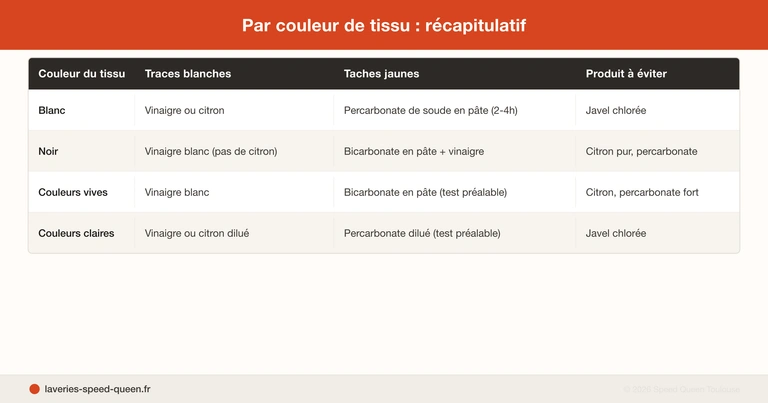
By fabric colour: summary
| Fabric colour | White marks | Yellow stains | Product to avoid |
|---|---|---|---|
| White | Vinegar or lemon | Percarbonate paste (2-4 h) | Chlorine bleach |
| Black | White vinegar (no lemon) | Baking soda paste + vinegar | Neat lemon, percarbonate |
| Bright colours | White vinegar | Baking soda paste (test first) | Lemon, strong percarbonate |
| Light colours | Vinegar or diluted lemon | Diluted percarbonate (test first) | Chlorine bleach |
When the garment is too damaged
There comes a point where yellow stains have become permanent. The fibres themselves are deeply tinted by aluminium-protein complexes, and no treatment can restore them.
Signs it’s time to accept it
- The stain persists after a 24 h percarbonate soak
- The fabric has become stiff and brittle in the underarm area
- The yellow colour has turned dark brown (advanced oxidation)
- The garment has already been through several treatments without result
What to do with the garment
Don’t throw it in the rubbish. A few second-life options:
- Cleaning cloth / floor rag — worn cotton makes excellent household cloths
- Textile recycling — collection bins accept worn clothing, even stained
- DIY undershirt — a t-shirt stained at the armpits is still functional for painting or gardening
Prevent rather than treat: 3 habits that eliminate the problem
The best treatment is the one you don’t need. Three simple changes in your daily routine reduce deodorant marks on clothing by 80 to 90%.
1. Apply deodorant and wait 2-3 minutes before dressing. The majority of white marks occur because the product hasn’t had time to dry on the skin. By waiting 2-3 minutes (enough time to brush your teeth or make coffee), aluminium salts dry and adhere to the skin instead of transferring to the fabric. This single habit is the most effective of all — it prevents immediate white marks and reduces the residue deposit that, over time, causes yellow stains.
2. Put the garment on from the bottom rather than over the head. When you pull a t-shirt or shirt over your head, the underarm area rubs directly against the fabric. Putting on the garment from below (pulling it up along the torso) reduces contact between the deodorant application zone and the fabric. This technique is especially useful for fitted t-shirts and formal shirts where marks are most visible.
3. Pre-treat underarms before every wash. Build a 10-second habit into your laundry-sorting routine: before putting a t-shirt or shirt in the machine, spray white vinegar on the underarm areas. This systematic pre-treatment dissolves aluminium salts deposited during wear, before they have time to form yellow complexes in contact with detergent and the heat of washing. It’s the difference between a white t-shirt that stays white for 2 years and one that yellows in 3 months.
Do “anti-mark” antiperspirants actually work?
Some brands market “anti-white-mark” or “invisible” antiperspirants. These formulations use finer aluminium salt particles that dry faster and leave less visible residue. They do reduce immediate white marks, but don’t prevent long-term yellow stains — aluminium chlorohydrate is still present.
The only way to completely eliminate yellow stain risk is to switch to a deodorant without aluminium salts. Alternatives (natural alum stone, baking soda deodorants, enzyme deodorants) do not cause the chemical reaction responsible for yellowing.
Mistakes to avoid
- Using bleach on yellow stains — bleach reacts with sweat proteins and can make stains more visible, darker or stiffer.
- Washing at high temperature without pre-treatment — heat fixes aluminium-protein complexes. Always pre-treat with vinegar before washing.
- Rubbing white marks with water — water alone doesn't dissolve aluminium salts. It spreads the residue and pushes it into the fibres. Use an acid (vinegar, lemon) or dry friction (nylon).
- Ignoring the first marks — yellow stains accumulate wash after wash. The sooner you treat, the less you'll need to treat later.
- Tumble drying without checking — as with all organic stains, tumble-dryer heat makes yellow stains permanent.
- Mixing vinegar and percarbonate at the same time — acid neutralises base. Use them at separate stages of treatment.
Recap: 3 common scenarios
Scenario 1 — White deodorant mark on a black t-shirt before going out: Rub with a scrunched nylon stocking (10 seconds). If the mark persists, a white vinegar wipe. Immediate result.
Scenario 2 — Yellow stains on a regularly worn white t-shirt: White vinegar 15 min on underarms, then percarbonate paste 2-4 h, wash 40 °C. Build in a systematic vinegar pre-treatment before every wash to prevent recurrence.
Scenario 3 — Old, stiff yellow stains on a formal shirt: Citric acid soak 4 h, then percarbonate overnight, wash 40 °C. If the stain persists, the garment is probably irreversibly damaged.
En tant que Partenaire Amazon, nous percevons une petite commission sur les achats effectués via les liens partenaires de cet article — sans surcoût pour vous. Cela nous aide à maintenir ce site et à produire des guides gratuits.
Nos laveries de Blagnac, Croix-Daurade et Montaudran disposent de machines professionnelles avec lessive incluse. Le volume d’eau supérieur aide à diluer et rincer les résidus d’anti-transpirant plus efficacement qu’une machine domestique. Paiement CB sans contact ou espèces. Consultez nos tarifs.
In the laundromat: the water volume advantage
For t-shirts and shirts with recurring deodorant stains, a trip to the laundromat offers a concrete advantage. Professional machines use 50-60 litres of water per cycle (versus 15-20 litres in a domestic machine). This greater volume dilutes and rinses antiperspirant residue trapped in fibres more effectively.
In practice, if you pre-treat underarms with white vinegar at home before coming to the laundromat, the thorough rinse of the professional machine more completely eliminates dissolved aluminium salts. It’s an effective combination: vinegar breaks the chemical residue, and the water volume flushes it out. The automatic detergent dosing in the laundromat also avoids overdosing which, let’s remember, contributes to forming yellow aluminium-protein complexes.
Sources and references
- Taches de transpiration et auréoles jaunes
- Vinaigre blanc et linge : usages et limites
- Le percarbonate de soude : guide d’utilisation
- Le bicarbonate de soude pour le linge
- Détacher le linge : solutions pour toutes les taches
- Guide des températures de lavage
- Fréquence de lavage des vêtements
- Chimie du chlorhydrate d’aluminium — interaction sels d’aluminium / protéines / tensioactifs
- Réaction de Maillard dans les taches textiles — complexes aluminium-protéine et jaunissement progressif