In short: egg is a protein stain — the white (albumin) coagulates with heat just like blood. Absolute rule: never use hot water. Scrape off the excess, rinse with cold water, rub with Marseille soap. For the yolk (greasy), add dish soap. Wash at 30-40 °C in the machine. Never tumble dry before confirming the stain has completely gone.
At a glance
Cold water mandatory — hot water cooks the albumin and sets the stain permanently.
Scrape, don't rub — remove the excess with a spoon, without spreading.
Marseille soap — alkaline pH that denatures proteins and emulsifies yolk fat.
Dish soap for the yolk — egg yolk is fatty (30% lipids); you need a degreaser.
30-40 °C in the machine — check the stain is gone before the tumble dryer.
Why egg stains: the chemistry at play
Egg consists of two parts with very different properties. Understanding this distinction is the key to successful stain removal.
Egg white (albumin) — the protein component
Egg white is 90% water and 10% protein, with the main one being ovalbumin. When cold, these proteins dissolve in water: a simple cold rinse removes most of the egg white.
The problem arises when the temperature rises. From 60 °C, ovalbumin denatures: its protein chains unfold and aggregate into an insoluble solid network — exactly what happens when you fry an egg. On fabric, this coagulation traps the protein in the fibres almost irreversibly.
This is the same mechanism as for blood stains (haemoglobin coagulates at ~40 °C) and milk (casein coagulates at ~40 °C). The rule is universal: all protein stains must be treated cold.
Egg yolk — the fatty component
Egg yolk is a natural emulsion containing roughly 30% lipids, 16% protein and carotenoid pigments (lutein, zeaxanthin) that give the characteristic yellow-orange colour.
The lecithin in the yolk is a natural emulsifier — ironically, the same type of molecule as the surfactants in your detergent. But on fabric, this lecithin keeps lipids suspended in the fibres, creating a stubborn greasy stain that resists ordinary soap.
For egg yolk, you therefore need a degreaser on top of the protein treatment. Dish soap, designed to emulsify food fats, is the most suitable product.
Carotenoids — the pigment component
The yellow colour of egg yolk comes from carotenoid pigments. These pigments are fat-soluble: they are dissolved in the yolk fat. By removing the fat, you also remove the pigments. This is why degreasing is doubly useful.
Absolute rule: cold water
Hot water is the fatal mistake on an egg stain. Albumin coagulates from 60 °C and turns into an insoluble white solid embedded in the fibres. Once cooked, the stain is extremely difficult to remove, even with enzymes. This principle also applies to blood, milk and any stain containing proteins.
Egg white vs yolk vs whole egg: the right treatment
Egg white only
The easiest to treat. Rinse with cold water within minutes — the protein is still soluble. If the stain has dried, rehydrate for 15 min with cold water then rub with Marseille soap. Success rate: almost 100% if treated cold.
Egg yolk only
More stubborn because of the fat (30% lipids) and pigments. Scrape the excess, rinse cold, then apply dish soap to emulsify the lipids. The yellowish trace comes out with a second pass of Marseille soap.
Whole egg (raw)
Double treatment: cold water first (white protein), then dish soap (yolk fat). Marseille soap as a complement. This is the most common kitchen scenario.
Cooked egg / cooking splash
The proteins are already coagulated by cooking. Scrape off the solid pieces, then treat the residual trace with Marseille soap + dish soap. Harder than a raw egg stain because the proteins are already polymerised.
Fresh stain: the immediate protocol
If you act within 5 minutes, the egg stain comes out 100% in the vast majority of cases.
Scrape off the excess — Use the back of a spoon to remove as much egg as possible without spreading it. For liquid raw egg, absorb with paper towels.
Rinse with cold water from the reverse — Turn the garment inside out and run the stain under a stream of cold water. The water pushes residues outward rather than into the fabric.
Rub with Marseille soap↗ — Rub a bar of Marseille soap directly on the damp stain. Leave for 10-15 minutes. The alkaline pH (9-10) denatures residual proteins and makes them soluble.
Treat the fat if necessary — If you see a yellowish trace (egg yolk), apply a drop of dish soap and rub gently. Dish soap is the best household emulsifier for food fats.
Rinse thoroughly and check the result. If the trace persists, repeat the soap + dish soap step before machine washing.
Dried egg stain: how to recover
A dried egg stain is more resistant because the albumin has partially polymerised while drying (a slower process similar to heat coagulation). But it is still treatable.
- Scrape the crust — With the back of a spoon or a soft-bristle brush, remove the dry residue without damaging the fabric.
- Rehydrate with cold water — Immerse the stained area in cold water for 15-30 minutes to soften the dried proteins.
- Marseille soap — Rub generously and leave for 30 minutes.
- Sodium percarbonate (white or colourfasts) — If a mark persists, soak in a [sodium percarbonate](/blog/percarbonate↗-de-soude-linge/) solution (1 tbsp per litre of water at 30 °C max) for 2 hours.
- Enzymatic cleaner (optional) — Proteases break down polymerised albumin into soluble amino acids. The most effective solution for dried or accidentally heat-set egg stains.
Egg stain accidentally set with hot water
If you rinsed with hot water by reflex, the proteins are now coagulated. A protease-based enzymatic cleaner is your best option: it breaks down cooked proteins into soluble amino acids. Apply, leave for 30 minutes, then rinse cold and machine wash at 30 °C. The result is not 100% guaranteed, but enzymes are the only effective approach on polymerised proteins.
By fabric: adapting the method
Not all fabrics react the same way to Marseille soap and degreasers. Here are the precautions by fibre.
White cotton
The most tolerant. Marseille soap + dish soap without restriction. If a yellow trace persists, sodium percarbonate for 2 hours. Final wash up to 60 °C. To whiten an old trace, sunlight on damp fabric helps.
Coloured cotton
Marseille soap and dish soap OK. Test percarbonate on an inner hem before use — it can lighten some colours. Wash at 30-40 °C.
Silk
Fragile protein fibre — no Marseille soap (too alkaline), no proteolytic enzymes (they attack fibroin). Rinse with cold water, dab with very diluted white vinegar (1 tbsp per 200 mL). See our delicate textiles guide.
Wool
Protein fibre (keratin) sensitive to alkalis and friction. Rinse with cold water, very diluted Marseille soap, no vigorous rubbing. Never use percarbonate. Learn more: washing a wool jumper.
Synthetic (polyester, nylon)
Synthetic fibres have less affinity with proteins — the stain is generally easier to remove. Cold water, Marseille soap, wash at 30 °C. Dish soap alone is often sufficient.
Table linen (tablecloth, napkin)
Usually cotton or linen — standard treatment. For white tablecloths, sodium percarbonate soaking is very effective on egg yolk traces.
Egg stain on special surfaces
Egg is not limited to clothes. In the kitchen, splashes often hit other surfaces.
Kitchen apron and tea towel
Aprons and kitchen tea towels are the first victims of egg splashes. Good news: most are cotton and can handle a 60 °C wash. Rinse with cold water as soon as possible, then add them to your next hot wash cycle.
Worktop and tiles
Dried egg sticks firmly to smooth surfaces. Rehydrate with a damp cloth soaked in cold water for 10 minutes, then scrape with a spatula. Clean with white vinegar↗ to remove residues.
Thrown egg (vandalism)
Eggs thrown at buildings or cars dry quickly and the albumin polymerises in the sun. On fabric (affected clothing), the standard protocol applies: cold water as an emergency. Do not wait.
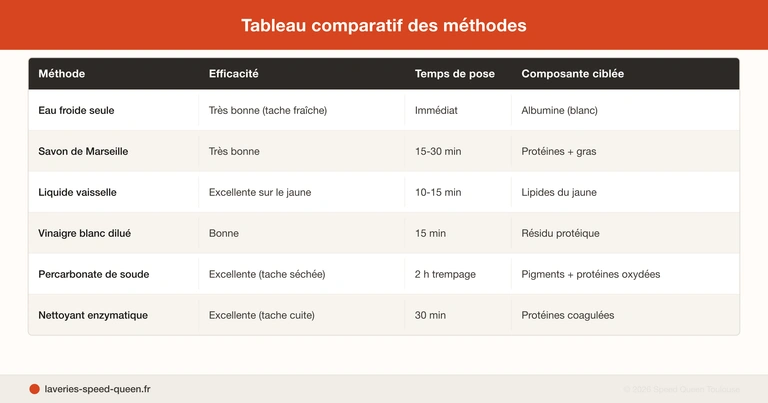
Comparison table of methods
| Method | Effectiveness | Contact time | Targeted component | Suitable fabrics |
|---|---|---|---|---|
| Cold water alone | Very good (fresh stain) | Immediate | Albumin (white) | All |
| Marseille soap | Very good | 15-30 min | Proteins + fat | Cotton, linen, synthetic |
| Dish soap | Excellent on yolk | 10-15 min | Yolk lipids | All (except silk) |
| Diluted white vinegar | Good | 15 min | Protein residue | Silk, wool (diluted) |
| Sodium percarbonate | Excellent (dried stain) | 2 h soak | Pigments + oxidised proteins | White and colourfasts |
| Enzymatic cleaner | Excellent (heat-set stain) | 30 min | Coagulated proteins | All except silk and wool |
Mistakes to avoid
- Hot water as first treatment — albumin coagulates at 60 °C and bonds to the fibres. The most common and most serious mistake.
- Rubbing raw egg — you spread the albumin + fat mixture into the fibres. Scrape the excess, then rinse.
- Ignoring the yolk fat — soap alone is not enough for egg yolk. Add dish soap to emulsify the lipids.
- Using bleach on egg — bleach can react with proteins and yellow the stain. Prefer sodium percarbonate for whitening.
- Tumble dryer before checking — heat permanently sets protein residues and yolk pigments.
- Enzymes on silk or wool — proteases degrade animal protein fibres. Reserve them for cotton and synthetic.
The parallel with other protein stains
Egg belongs to the great family of protein stains — alongside blood, milk, vomit and urine. They all share the same fundamental rule: cold water first, never hot water before pre-treatment.
The difference between these stains lies in their secondary components:
- Blood: protein (haemoglobin) + iron. The iron oxidises and creates a rust stain.
- Egg: protein (albumin) + fat (yolk). The fat requires a degreaser.
- Milk: protein (casein) + fat. Very similar to egg, same treatment.
- Vomit: digested proteins + gastric acid + food pigments. More complex.
If you master the principle “cold water + soap + degreaser”, you can treat all protein stains.
Kitchen prevention
Egg stains are almost always kitchen accidents. A few simple habits reduce their frequency:
- Wear an apron — a cotton apron washes easily at 60 °C. It is the first barrier against splashes.
- Crack eggs into a bowl — not directly into the pan or mixing bowl. An intermediate bowl limits splashes and lets you check freshness.
- Keep a damp cloth handy — immediate wiping with cold water prevents the stain from drying.
- Marseille soap near the sink — the “cold water + soap” reflex within 30 seconds guarantees a perfect result.
As an Amazon Partner, we earn a small commission on purchases made through the affiliate links in this article — at no extra cost to you. This helps us maintain this site and produce free guides.
Our laundromats in Blagnac, Croix-Daurade and Montaudran have professional machines with detergent included and 30-40 °C programmes suited to pre-treated laundry. The higher water volume (50-60 litres) ensures thorough rinsing of protein residues. Payment CB sans contact ou espèces. See our prices.
Sources and references
- Stain removal: solutions for all stains
- Remove a blood stain (same protein family)
- Marseille soap and laundry: complete guide
- White vinegar and laundry: uses and limits
- Sodium percarbonate: user guide
- Delicate textiles guide
- Wash temperature guide
- Ovalbumin: thermal denaturation at 60 °C — irreversible polymerisation of protein chains
- Egg yolk lecithin: natural emulsifier (phospholipid) and role in stain adhesion