Unlike protein stains (blood, egg) that require cold water, grease stains are the exception that proves the rule: they need heat. To effectively remove oil or grease, the best method is to apply pure dish soap directly onto the fibre, let it sit for 15 minutes, then wash the garment at a temperature between 40 °C and 60 °C. The goal is to liquefy the lipids so that surfactants can encapsulate and flush them out during rinsing.
At a glance: survival instincts
Immediately absorb the excess with a powder (talc, flour, fuller's earth).
Use concentrated dish soap for its exceptional degreasing power.
Favour hot water (minimum 40 °C) to liquefy grease molecules.
Check the result after washing and before any tumble dryer cycle.
NEVER tumble dry until the stain is gone — the heat 'bakes' the oil and sets it permanently.
Why grease is different from other stains
To understand how to remove stains effectively, you need to dive into the chemistry of surfactants. Grease molecules (triglycerides) are hydrophobic: they repel water and cling desperately to synthetic fibres like polyester. Unlike blood or wine stains that require different approaches, grease needs heat — see how to remove a blood stain or remove a red wine stain to compare methods.
Dish soap contains bipolar molecules. One end is hydrophilic (it loves water) and the other is lipophilic (it loves grease). By applying pure soap, you form micelles: micro-bubbles that trap oil particles at their centre. The heat of washing breaks down the viscosity of the grease, facilitating this encapsulation process. Without heat, the grease remains frozen in the fibre, and even the best detergent in the world will slide right over it.
Why synthetics hold onto grease
Synthetic fibres (sportswear, fleece) have a natural chemical affinity with grease. An oil stain on a technical t-shirt is much harder to shift than on pure cotton, because the fabric’s polymers literally “absorb” the lipid molecules. This is the same reason why sportswear retains odours — bacteria feed on the trapped grease.
The number-one reflex: dish soap (and why it works so well)
Dish soap is not a makeshift stain remover — it is the most effective product against grease stains, and here is why:
Dish soap is formulated for a single mission: dissolving food grease. It contains anionic surfactants (such as sodium lauryl sulphate) at a much higher concentration than textile detergents. In laundry detergent, surfactants are diluted to be gentle on fibres over a full 30-60 minute cycle. Dish soap, on the other hand, is designed for immediate, concentrated degreasing action.
How to use it correctly
- Apply 2-3 drops of dish soap directly onto the dry stain (do not wet it first).
- Massage gently with your fingertip to work the product into the fibres. Pure dish soap forms micelles on direct contact with grease — this is more effective than when diluted.
- Leave for 15-20 minutes — time for the surfactants to encapsulate the grease molecules.
- Add a little warm water and emulsify by massaging. You should feel the slippery texture of the grease/soap mixture disappear.
- Rinse thoroughly then machine wash at 40-60 °C.
Product choice: prefer a colourless (or transparent) dish soap to avoid any dye transfer onto the fabric. “Ultra concentrated” or “anti-grease” versions contain more surfactants and are slightly more effective.
Cooking oil vs mechanical grease vs butter: different greases, different methods
Not all grease stains are equal. Their origin determines the most suitable chemical treatment.
Food grease (oil, vinaigrette)
Olive oil, sunflower, rapeseed, vinaigrette, salad dressing. These are 'simple' triglycerides that respond very well to dish soap or Marseille soap. This is the easiest case to treat.
Butter, cream, cheese
Animal fat with a protein component (casein). Treat first with dish soap (grease), then rinse well. Wash temperature can be higher (50-60 °C) as animal fats are more solid and need more heat to melt.
Mechanical grease (engine grease, motor oil)
Very viscous, enriched with metal particles and chemical additives. Dish soap alone may not suffice. Use the 'grease on grease' method (fresh butter to soften) or a mild solvent (white spirit) before dish soap. Dry-rubbed Marseille soap is also effective.
Cosmetic grease (foundation, cream)
Foundation, lipstick, sunscreen, self-tanner. These products contain pigments set in a waxy base. Makeup remover (micellar water) dissolves the waxy base. Follow up with dish soap if needed. See our guide to removing makeup stains.
Bicycle chain grease
A mixture of oil and metal particles. First scrape off the excess with the back of a knife. Apply dry Marseille soap, rub, add warm water. Repeat 2-3 times. Dish soap as a follow-up is often necessary.
Fresh stain: the immediate method
If you have just spilt oil on your jeans or shirt, every minute counts to prevent the grease from migrating deep into the fibre.
- Generously sprinkle the stain with talc, flour or fuller’s earth↗. Do not rub — let the powder “soak up” the oil for 5 to 10 minutes.
- Shake the garment to remove the grease-saturated powder.
- Apply pure dish soap (preferably colourless to avoid dye transfer) to the area.
- Massage gently with your fingertips to work the soap in without damaging the fibres.
- Rinse with very hot tap water (respecting the textile’s limits — check the care label symbols).
- Wash normally in the machine with a dose of professional detergent.
Fuller’s earth: the secret for delicate fabrics and old stains
Fuller’s earth deserves a dedicated section because it is the most underrated stain removal product. This natural clay (smectite) has an absorbent power exceeding 80% of its weight in grease.
Why fuller’s earth is unique
Unlike dish soap which emulsifies grease (mixes it with water), fuller’s earth absorbs it physically. It is a dry process — no water is needed. This makes it ideal for:
- Non-washable fabrics: leather, suede, silk, cashmere
- Old stains: the clay attracts residual grease even after a failed first wash
- Non-textile surfaces: fabric sofa, rug, carpet (see our guide to washing a rug)
How to use
- Apply a thick layer (3-5 mm) of fuller’s earth to the dry stain.
- Do not wet — moisture reduces the absorbent power.
- Leave for at least 2 hours, ideally overnight (8-12 h).
- Brush gently to remove the saturated powder.
- Repeat if necessary — each application absorbs an additional layer.
The “grease on grease” trick for baked-in stains
If a grease stain has been through the tumble dryer, the oil is “baked” and polymerised. Fuller’s earth alone may not suffice. Use the butter trick:
- Rub a little fresh butter on the old stain. The fresh grease will soften the old, set grease.
- Then apply dish soap to emulsify everything.
- Wash at 60 °C.
Caution with grease on grease
This method is reserved for robust fabrics like cotton or denim. Never attempt this on silk or delicate fabrics where the butter could create a new permanent stain. See our delicate textiles guide if in doubt.
IMPORTANT: NEVER tumble dry before removing the stain
This is the golden rule of grease stain removal, and it deserves a detailed explanation.
The tumble dryer is the number-one enemy of grease stains
The heat of the tumble dryer (60-70 °C on a normal cycle, up to 80 °C on a cotton cycle) causes polymerisation of the lipids. The grease molecules bond to each other and to the fibres, forming a near-permanent plasticised complex. Even intensive pre-treatment after tumble drying does not guarantee the stain will disappear.
What if it is too late? If the garment has already been tumble dried:
- Use the “grease on grease” method (butter) to soften the polymerised grease.
- Apply concentrated dish soap and leave for 30 minutes.
- Wash at the maximum temperature allowed by the care label.
- Repeat if necessary — it sometimes takes 2-3 cycles to overcome a baked-in stain.
The same principle applies to ironing: never iron a garment whose grease stain has not completely gone. For more on drying, see our complete drying guide.
Treatment by fabric type
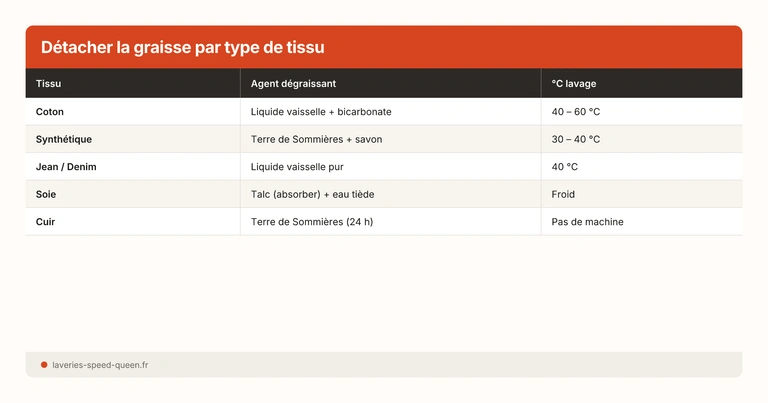
The choice of treatment depends on the fragility of the fibre. Here is how to adapt your strategy. For delicate textiles like silk or wool, see our detergent dosage guide to avoid damage:
Cotton & linen
Very resistant. You can go up to 60 °C and use Marseille soap or pure dish soap without worry. White cotton even handles a sodium percarbonate boost.
Jeans / denim
Watch out for colour bleeding. Prefer dry fuller's earth to avoid creating a faded area by rubbing too hard. See our guide to washing jeans.
Silk & satin
Ultra-fragile. Use only talc or dry fuller's earth. If the stain persists, take the garment to a dry cleaner.
Synthetic
Grease loves polyester (chemical affinity between polymers and lipids). Wash at 40 °C maximum but be generous with dish soap as a pre-treatment. A second wash is sometimes necessary.
Wool & cashmere
No hot water! Use dry fuller's earth, or hand wash in lukewarm water (30 °C max) with a gentle shampoo or special wool soap.
Sports polyester
Technical t-shirts hold grease odours. Add a little baking soda to the wash to neutralise smelly lipids. Dish soap pre-treatment is essential.
Baking soda: a useful complement for dried stains
Baking soda is not strictly a degreaser, but it is useful as a complement:
- As a paste (baking soda + water): apply to the dried stain, leave for 30 minutes. Baking soda absorbs some surface grease and its mild abrasive action helps dislodge residue.
- Added to the wash: 2 tablespoons in the drum. Baking soda softens the water (limescale reduces surfactant efficiency) and helps neutralise rancid grease odours.
- On sportswear: effective against persistent grease odours (sweat + sebum). Soak for 30 minutes in a baking soda solution before washing.
Summary treatment table
To help you choose the right method at a glance, here is the stain removal dashboard:
| Type of grease | Recommended product | Action time | Wash temperature |
|---|---|---|---|
| Cooking oil (olive, sunflower) | Dish soap | 15 min | 40 °C - 60 °C |
| Butter / Cream / Sauce | Marseille soap | 20 min | 60 °C |
| Engine grease / Motor oil | Butter then soap / dish soap | 1 hour | 60 °C |
| Bicycle chain grease | Dry Marseille soap then dish soap | 30 min | 40 °C - 60 °C |
| Greasy makeup | Makeup remover / Alcohol | 5 min | 30 °C - 40 °C |
| Massage oil / Sunscreen | Fuller’s earth | Overnight | 40 °C |
| Old stain / tumble dried | Butter + dish soap (grease on grease) | 30 min + wash | 60 °C |
Mistakes to avoid at all costs
- Cold water — it solidifies grease instead of dislodging it. On an oil stain, this is counterproductive.
- Tumble drying before checking — the heat will 'bake' the oil and make it permanent. This is the most serious and most common mistake.
- Excessive rubbing — you risk breaking fibres and creating a permanent wear mark.
- Overdosing detergent — too much foam prevents the machine's mechanical action from dislodging grease particles. See our dosage guide.
- Pure white vinegar — ineffective against grease, it can even set certain pigments found in sauces.
- Dish soap in the machine — it foams far too much. Use it only as a local pre-treatment.
- Fuller's earth on wet fabric — moisture reduces its absorbent power. Always apply it on dry fabric.
Common scenarios and solutions
Scenario 1 — Fresh olive oil stain on a white shirt: Talc 5 min, colourless dish soap 15 min, wash at 40 °C. Success rate: 95%.
Scenario 2 — Engine grease stain on jeans: Fresh butter on the stain, 15 min, dry-rubbed Marseille soap↗, lukewarm rinse, dish soap 10 min, wash at 60 °C. If the stain persists, second cycle.
Scenario 3 — Foundation stain on a silk collar: Micellar water on cotton, gentle dabbing. Fuller’s earth if a trace remains, 4 h. If the stain persists, dry cleaner.
Scenario 4 — Grease mark on jeans that went through the tumble dryer: “Grease on grease” method (butter), dish soap 30 min, wash at 60 °C. Repeat 2-3 times if necessary. Result not guaranteed — next time, check before tumble drying.
En tant que Partenaire Amazon, nous percevons une petite commission sur les achats effectués via les liens partenaires de cet article — sans surcoût pour vous. Cela nous aide à maintenir ce site et à produire des guides gratuits.
Grease stains often resist home washing. Our professional laundromat machines use a concentrated pre-dosed detergent with powerful surfactants, and a higher water volume for a thorough rinse. Laundromats in Blagnac, Croix-Daurade and Montaudran, detergent included, payment CB sans contact ou espèces. Prices.
Sources and references
- Guide to tough stains and pre-treatment
- Wash temperature guide
- Choosing the right detergent
- Removing a blood stain
- Removing a red wine stain
- Removing a makeup stain
- Baking soda and laundry
- Caring for delicate textiles
- AISE: Guide to surfactants and textile cleaning (lien externe) (accessed March 2026)
- Fuller’s earth: smectite clay technical data sheet (lien externe)
- Micelle formation — mechanism of lipid emulsification by anionic surfactants