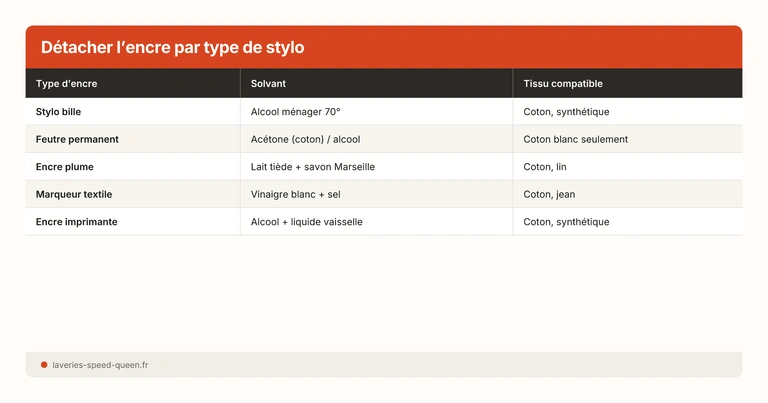
In a nutshell: each ink type needs a different treatment. Ballpoint (oil-based): 90% rubbing alcohol. Gel ink: cold water then alcohol. Permanent marker: isopropyl alcohol. Printer toner: dry brushing, never heat. Fountain pen: cold water, optionally warm milk. Hairspray is no longer the recommended method — pure alcohol is more reliable.
At a glance
Identify the ink first — oil, water, gel, solvent or toner. Treatment depends entirely on the type.
90% rubbing alcohol for ballpoint — dissolves oil-based ink. Dab, don't rub.
Never heat toner — heat melts it and permanently fuses it to fibres.
Hairspray = modern myth — the old formulas worked (more alcohol). Current ones don't.
Absorbent cloth under the stain — essential to prevent transfer to the other side of the fabric.
Why each ink is different
Inks are not all made from the same chemistry. The solvent carrying the pigment determines the treatment. For a more general approach to stain removal, see our guide to tough stains and solutions covering all common stain types.
| Ink type | Chemical base | Effective product | Contact time | Precaution |
|---|---|---|---|---|
| Ballpoint | Oil + dyes | 90% rubbing alcohol | 5-10 min dabbing | Test on hidden area (may strip dye) |
| Gel ink | Water + polymers + pigments | Cold water then 90% rubbing alcohol | Rinse + 5-10 min | Rinse with cold water first |
| Washable marker | Water + dyes | Cold water + normal wash | Wash is enough | None — designed to wash out |
| Permanent marker | Organic solvent + resin | 90% isopropyl alcohol | 10-15 min dabbing | Variable result depending on fabric and time |
| Printer (pigment) | Water + suspended pigments | Immediate cold water | Quick rinse | Don’t let it dry |
| Printer (toner) | Plastic powder | Dry brushing + alcohol | Brushing + 10 min | NEVER heat (melts and fuses) |
| Fountain pen | Water + dyes | Cold water, then warm milk if dried | Rinse or 1-2 h milk soak | Most come out easily |
Ballpoint vs gel ink vs marker vs printer ink
Understanding the chemistry of each ink helps you choose the right treatment first time. Here are the fundamental differences:
Ballpoint pen (BIC, etc.)
The ink is an oily paste: a dye dissolved in an oily solvent (benzyl alcohol, phenoxyethanol). The oil locks the colour to paper — and to fabric. It's the most common ink stain and 90% rubbing alcohol dissolves it very effectively.
Gel pen (Pilot, Uni-ball)
Water-based, thickened by polymers. Pigments are suspended, not dissolved. Cold water removes some of the ink, but the remaining pigments need alcohol. Dual action: cold water rinse first, then alcohol.
Permanent marker (Sharpie)
Organic solvent (xylene, toluene) + acrylic resin + dye. The solvent evaporates leaving a nearly impermeable coloured resin film. Isopropyl alcohol redissolves the resin, but the film is more resistant than ballpoint ink.
Inkjet printer ink
Pigments suspended in water. Very easy to treat when fresh (cold water is enough). Once dry, pigments bond to fibres and need alcohol or percarbonate.
Laser printer toner
Not ink in the classic sense — it's a plastic powder (resin + pigment). The printer's fuser melts it at 200 °C to fix it to paper. Any heat source (tumble dryer, iron, hot water) melts it and fuses it to the textile.
Rubbing alcohol: the key product for ink removal
Alcohol is the most effective solvent against the majority of inks. Here’s why, and how to use it best.
Why alcohol works
The dyes in ballpoint and marker inks are dissolved in organic solvents. Alcohol (90% ethanol or isopropyl alcohol) shares a chemical affinity with these solvents — it re-dissolves them. By dabbing with alcohol, you “re-liquefy” the ink that had set in the fibres, allowing you to transfer it to your absorbent cotton pad.
Which alcohol to choose?
- 90% rubbing alcohol (pharmacy, ~3 euros): the most common and versatile. Effective on ballpoint and gel ink. Undenatured = purer = more effective.
- Denatured rubbing alcohol (~2 euros/L in supermarket): denatured alcohol. Slightly less pure but more economical. Works well for ballpoint pens.
- 70-90% isopropyl alcohol (pharmacy): the most effective on permanent markers because it dissolves acrylic resins better than ethanol. It’s the product of choice for Sharpie stains.
Optimal dabbing technique
Place a white absorbent cloth under the stain — it catches the dissolved ink that passes through the fabric.
Soak a cotton pad (or piece of white fabric) with alcohol — don't pour alcohol directly on the fabric, it's less controllable.
Dab from the edge towards the centre — this direction prevents the ink from spreading in a ring.
Change cotton pads every 20-30 seconds — a saturated pad re-deposits pigment. This is the most common mistake.
Repeat 5-15 times — ballpoint requires an average of 5-8 passes, permanent marker 10-15.
Rinse with cold water between rounds — to flush dissolved ink before the next pass.
Why hairspray no longer works
Old hairsprays (1980s-90s) contained a lot of ethyl alcohol — it was the alcohol dissolving the ink, not the hairspray itself. Modern formulas contain film-forming polymers and much less alcohol. Result: a sticky film on the fabric, without effectiveness on the ink. Use 90% rubbing alcohol directly — it’s more effective and less messy.
Ballpoint pen: the complete method
Ballpoint pen ink is an oily paste carried by a solvent. Alcohol is the best agent to dissolve it.
Place an absorbent cloth under the stain — dissolved ink must be caught, not transferred.
Soak a cotton pad with 90% rubbing alcohol — dab from the edge towards the centre of the stain.
Change cotton pads regularly — a saturated pad re-deposits pigment on the fabric.
Rinse with cold water — then wash at 30 °C maximum.
Old ballpoint stain: if the stain is several days old, the ink has dried and the solvent has evaporated. The pigment is harder to redissolve. Use prolonged alcohol dabbing (15-20 minutes total, changing cotton pads frequently). If alcohol alone isn’t enough, try a 50/50 mix of alcohol + white vinegar — the vinegar helps lift dye residues bonded to fibres.
Warm milk method for old stains
Warm milk is an underrated traditional method, particularly effective on water-based inks (fountain pen, gel ink) and as a complement to alcohol on old oil-based inks.
Why milk works
Casein — the main protein in milk — has a chemical affinity with many ink pigments. It “captures” dye molecules through adsorption, lifting them from textile fibres. It’s the same principle used in winemaking, where casein is used to clarify wine by binding tannins — a mechanism also exploited to remove red wine stains.
How to use
- Heat whole milk (not skimmed — the fat content helps) without boiling (60-70 °C).
- Soak the stained area in warm milk.
- Leave for 1-2 hours for fountain pen ink, 2-4 hours for old ballpoint ink.
- Rub gently, rinse with cold water.
- Machine wash at 30 °C.
Milk is particularly suitable for delicate textiles (silk, fine wool) that cannot tolerate alcohol.
Permanent marker: isopropyl alcohol
Permanent marker (Sharpie, Posca) uses an organic solvent + resin that dries forming a water-resistant film. 90% rubbing alcohol works, but isopropyl alcohol (70% or 90%, from pharmacies) is more effective because it dissolves acrylic resins better than ethanol.
- Dab generously with a cotton pad soaked in isopropyl alcohol.
- Change cotton pads every 30 seconds — the resin colours the pad very fast.
- Repeat 5-10 times. Permanent marker fades gradually, rarely in a single pass.
- Honest result: on white cotton, it works well. On coloured cotton, alcohol may strip dye. On synthetics, result varies. On an old stain (>24 h), the resin film has hardened and is more resistant.
Fountain pen and India ink
Fountain pen ink is water-soluble — the easiest to treat. A quick cold water rinse is enough in most cases.
- Fresh stain: rinse immediately with cold water. 90% of stains come out at this stage.
- Dried stain: soak in warm milk for 1-2 h. The casein in milk captures the ink pigments and lifts them from the fabric. Rub gently, rinse, wash.
- India ink: more resistant (contains shellac or resin). Treat like permanent marker (isopropyl alcohol). Water alone won’t be enough.
Gel ink: the in-between case
Gel pens (Pilot G2, Uni-ball Signo) are increasingly common and their stains are often confused with ballpoint. Yet the treatment differs:
- Rinse with cold water first — gel ink is partially water-soluble. An immediate rinse removes 40-60% of the stain.
- Then dab with 90% rubbing alcohol — to dissolve the remaining polymers and pigments.
- Wash at 30 °C — no hotter, to avoid fixing residue.
Gel ink dries faster than ballpoint ink, and pigments are often more intense (more colouring). Act within the first minutes if possible.
Inkjet printer ink (pigment)
Inkjet printer ink is a suspension of pigments in water. If the stain is fresh, it comes out easily with cold water. If it has dried, pigments bond to fibres and become harder.
- Fresh stain: rinse immediately with cold water from the reverse side of the fabric. Don’t rub.
- Dried stain: dab with 90% rubbing alcohol, then soak 1 h in a [percarbonate](/blog/percarbonate↗-de-soude-linge/) solution (2 tablespoons per 2 L warm water).
- Don’t confuse with toner — inkjet ink is liquid, toner is powder. Treatment is completely different.
Printer toner: the critical case
NEVER heat a toner stain
Toner is a plastic powder designed to melt in the printer’s fuser and fix to paper. If you iron, tumble dry or wash hot, you replicate exactly this mechanism — the toner melts and fuses to the textile fibres. The stain then becomes permanent. See our drying guide for best practices.
- Dry brush with a soft brush to remove unfixed powder.
- Shake the garment outdoors.
- Dab residue with 90% rubbing alcohol.
- Wash at cold only (30 °C max).
By fabric: adapting the treatment
White cotton
The most tolerant. 90% rubbing alcohol, percarbonate as backup if needed. Supports a final 60 °C wash (after cold treatment). To whiten after treatment, see our guide to whitening yellowed laundry.
Coloured cotton
Test alcohol on an inner hem — it can strip some dyes. Dab, don't soak. Warm milk is a gentler alternative.
Silk
Alcohol and solvents are too aggressive. Dab with cold water mixed with a little milk. If the stain persists, take to a dry cleaner. Warm milk is the safest method for silk.
Synthetic (polyester)
Responds well to alcohol. Ballpoint ink adheres less to polyester than to cotton. Standard treatment works well.
Wool
Dab gently with diluted alcohol (50/50 water-alcohol). Don't rub — wool felts under pressure. Warm milk is preferable for fine woolens. See our delicate fabrics guide.
Jeans / denim
90% rubbing alcohol works well on denim. Note: on raw (unwashed) denim, alcohol can create a lighter area. Test on the inside of the waistband. See our guide to washing jeans.
Common scenarios and solutions
Scenario 1 — Ballpoint mark on a white shirt (fresh stain): Cloth under the stain, 90% rubbing alcohol dabbing, 5-8 passes changing cotton pads. Cold water rinse, wash 30 °C. Success rate: 90%.
Scenario 2 — Permanent marker stain on a cotton t-shirt: 90% isopropyl alcohol, intensive dabbing, 10-15 passes. Cold water rinse. Variable result — depends on time elapsed and fabric colour.
Scenario 3 — Dried fountain pen ink on a linen tablecloth: Warm milk soak 2 h. Gentle rubbing, rinse, wash 40 °C. Success rate: excellent (fountain pen ink is the easiest to treat).
Scenario 4 — Toner stain on trousers: Careful dry brushing, 90% rubbing alcohol dabbing, wash at 30 °C only. No tumble dryer, no iron. Decent result if no heat was applied beforehand.
Scenario 5 — Old ballpoint stain on jeans (several weeks): 90% rubbing alcohol, prolonged dabbing (15-20 min), then alcohol + white vinegar↗ 50/50 mix. Warm milk 2 h soak as supplement. Wash 30 °C. Uncertain result — the stain has had time to polymerise.
Mistakes to avoid
- Rubbing the stain — you spread the ink and push it into the fibres. Always dab.
- Heating before treating — ironing, tumble drying or hot water fixes the ink (especially toner).
- Using modern hairspray — it deposits a sticky film without dissolving the ink. Use pure alcohol.
- Soaking in hot water — useless on oil-based ink (ballpoint) and dangerous on toner.
- Confusing washable and permanent marker — check the packaging. Permanent marker needs a solvent, not a simple wash.
- Not changing cotton pads — a saturated pad re-deposits pigment instead of absorbing it. Change every 20-30 seconds.
- Using bleach on ink — bleach can fix some ink pigments and yellow white fibres. Alcohol is more effective and safer.
En tant que Partenaire Amazon, nous percevons une petite commission sur les achats effectués via les liens partenaires de cet article — sans surcoût pour vous. Cela nous aide à maintenir ce site et à produire des guides gratuits.
Nos laveries de Blagnac, Croix-Daurade et Montaudran disposent de machines professionnelles avec lessive incluse. Le volume d’eau (50-60 litres) et le brassage intensif aident à extraire les résidus d’encre après prétraitement. Paiement CB sans contact ou espèces. Consultez nos tarifs.
Sources and references
- Détacher le linge : solutions pour toutes les taches
- Entretien des textiles délicats : soie et laine
- Guide des températures de lavage
- Vinaigre blanc et linge : usages et limites
- Percarbonate de soude et linge
- Enlever une tache de vin rouge (caséine et tanins)
- Guide complet du séchage
- Dissolution des encres par les alcools — affinité chimique solvant/solvant entre éthanol et base huileuse de l’encre bille
- Adsorption des pigments par la caséine du lait — mécanisme de clarification utilisé en oenologie