Makeup stains because it combines pigments, oils or silicones and often waxes resistant to water. The universal method: remove the excess without rubbing, dissolve the stain with micellar water or a bi-phase makeup remover, then soap with Marseille soap and rinse with cold water. Standard foundation comes out at 40 °C in the machine; waterproof and long-wear formulas require pre-treatment with rubbing alcohol or makeup-removing oil before washing.
At a glance
Never rub a fresh makeup stain — dab to avoid spreading pigments into the fibre.
Dissolve with a makeup remover (micellar water, bi-phase or oil) before any machine washing.
Marseille soap as the second step: its surfactants emulsify residual foundation grease.
Cold water for rinsing — hot water sets makeup pigments in textile fibres.
Check before tumble drying — heat makes a foundation stain permanent.
Why makeup stains so much
Modern makeup is designed to resist sweat, sebum and moisture. This is precisely what makes it formidable on textiles. A standard foundation contains four families of ingredients that together create a particularly stubborn stain:
- Mineral pigments (iron oxides, titanium dioxide): responsible for the colour. They lodge between fibres and resist simple rinsing.
- Oils and emollients (silicone oil, fatty acid ester): they provide the fluid texture and create a greasy base that adheres to fibres — the same mechanism as a grease stain.
- Waxes (beeswax, carnauba wax): found mainly in lipstick, mascara and compact foundations. They fix pigments on the fabric like a varnish.
- Film-forming polymers (dimethicone, cyclomethicone): responsible for the “long-wear” and “waterproof” effect. These silicones create a hydrophobic film that prevents water alone from dislodging the stain.
Unlike coffee or wine stains that are water-soluble, makeup is a mixed stain: both greasy (oils, waxes) and pigmented. You therefore need to attack on two fronts — dissolve the greasy base, then dislodge the pigments.
Waterproof = double challenge
Waterproof formulas add polymers that form a continuous film on the skin. This same film deposits on fabric and resists ordinary soap. This is why a bi-phase makeup remover (water + oil) is essential: the oil phase dissolves the silicones, the aqueous phase carries away the pigments.
Liquid vs powder vs waterproof foundation
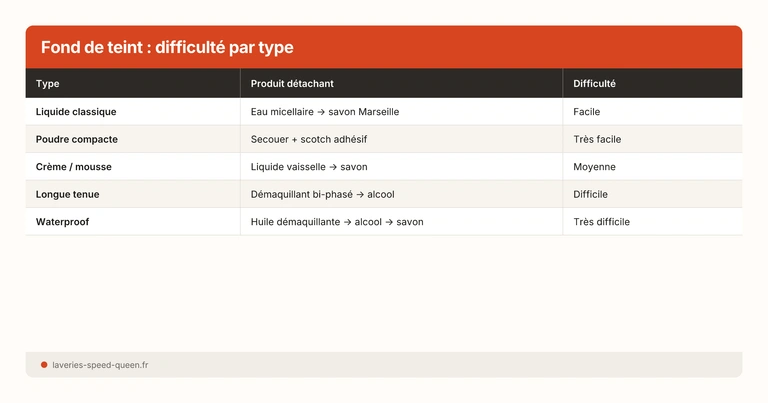
Not all foundations stain in the same way. Treatment must be adapted to the product’s formulation.
| Type | Dominant composition | Stain removal product | Difficulty |
|---|---|---|---|
| Standard liquid | Water + pigments + emollients | Micellar water then Marseille soap | Easy |
| Loose / compact powder | Talc + pigments (little grease) | Shake then adhesive tape to lift particles | Very easy |
| Cream / mousse | Oils + waxes + pigments | Dish soap then Marseille soap | Medium |
| Long-wear / matte | Silicones + polymers + pigments | Bi-phase remover then rubbing alcohol | Difficult |
| Waterproof | Heavy silicones + film-forming polymers | Makeup-removing oil then rubbing alcohol then soap | Very difficult |
The usual zones
Certain areas of your clothing and household linen are particularly exposed to makeup transfer. Knowing them allows you to act fast — and to prevent.
Shirt collar and turtleneck
This is the most common makeup stain. The friction of fabric against the jaw and neck transfers foundation with every movement. On a white shirt, the beige mark is immediately visible. The problem: this transfer happens gradually, layer after layer, creating a set-in stain in just a few days.
Reflex: treat the collar before every wash by rubbing damp Marseille soap↗ directly on the area, even if the stain seems light. See our guide on ironing and caring for shirts for a complete protocol.
Pillowcase and pillow
Going to bed without removing makeup (or with incomplete removal) transfers foundation, mascara and eyeliner onto the pillowcase. Over time, pigments work through the case and reach the pillow itself. For a full wash of your stained pillows, follow our guide to washing a pillow in the machine.
Scarf and wrap
Contact with the made-up face is direct and repeated. Wool or cashmere scarves are particularly vulnerable as their natural fibres absorb makeup oils. See our guide on delicate textiles before treating these fragile materials.
Face towel
The makeup-removal towel accumulates mascara, foundation and lipstick. Without pre-treatment, these stains set over successive washes and eventually become permanent.
Step-by-step stain removal protocol
Here is the complete method, suited to the majority of foundation and makeup stains on fabric.
1. Remove the excess
For fresh liquid foundation: place a tissue on the stain and dab gently. Never rub — you would push pigments deeper into the fibres and enlarge the stain.
For powder foundation: turn the garment inside out and tap from the reverse to shake out particles. You can also press adhesive tape sticky-side down on the stain to lift the powder without rubbing.
For mascara or eyeliner: let it dry completely before gently scraping off the dry excess with the back of a spoon. Trying to remove it while still wet would only spread the product.
2. Dissolve with a makeup remover
Apply micellar water or bi-phase makeup remover to a cotton pad, then dab the stain from the outside inward. The makeup remover’s micelles are designed to capture the pigments and greasy substances of makeup — exactly what you need on fabric.
For waterproof formulas, prefer a makeup-removing oil: it dissolves the film-forming silicones that standard micellar water cannot reach. Leave for 5 minutes.
Alternative: a few drops of dish soap also work, thanks to their degreasing surfactants. It is the same logic as for grease stains.
3. Soap with Marseille soap
Dampen the pre-treated area and rub a bar of Marseille soap directly on the stain. Massage in small circles with your fingertips for one to two minutes. Marseille soap combines an alkaline pH (which lifts pigments) and vegetable surfactants (which emulsify residual grease).
4. Rinse with cold water
Rinse from the reverse side of the fabric to push residue outward instead of driving it in. Use cold water: unlike pure grease stains that need heat, makeup stains contain pigments that heat may permanently set. To understand the impact of temperature, see our wash temperature guide.
5. Check and repeat if necessary
If a shadow of the stain remains after rinsing, repeat steps 2 to 4 before putting the garment in the machine. It is always easier to re-treat a damp stain than to rescue one that has been through a wash and dry cycle.
Set-in stain (already washed)
If the stain has already been washed and dried, apply pure vegetable glycerine to the area. Leave for 30 minutes — the glycerine softens set pigments. Rub with Marseille soap, rinse and rewash. For the most stubborn cases, a paste of sodium percarbonate (1 tbsp + a few drops of water) acts as a powerful oxygen stain remover on white and colourfast textiles.
Other makeup stains
Lipstick
Lipstick is a mixture of waxes, oils and concentrated pigments. Its wax content makes it more resistant than foundation. Scrape off the excess with the back of a spoon, then dab with rubbing alcohol (70%) on a cotton pad. The alcohol dissolves the waxes and releases the pigments. Then rub with Marseille soap and rinse with cold water. For matte long-wear lipsticks, makeup-removing oil is more effective than alcohol because it dissolves the film-forming polymers.
Mascara
Mascara is composed of waxes, black pigments (black iron oxide or carbon black) and polymers. Let it dry completely before intervening — this is counter-intuitive, but dry mascara fragments and detaches more easily than when wet. Scrape off the dry fragments, then apply bi-phase makeup remover. For waterproof mascara, makeup-removing oil is essential. Rub with Marseille soap, rinse cold. On whites, sodium percarbonate↗ soaking (30 minutes) removes the last black residues.
Eyeliner and kohl
Liquid eyeliner contains pigments suspended in a water-based or latex-based medium — it dries quickly and forms a film. Kohl is essentially a greasy powder. Same method as mascara: let dry, scrape, bi-phase remover, Marseille soap. For felt-tip eyeliner, rubbing alcohol is particularly effective because it dissolves the felt’s resins.
Method by fabric type
Treatment must be adapted to the fragility of the textile. Some products that are too harsh can damage delicate fibres or strip colour from a fabric.
| Fabric | Recommended product | Wash temperature | Precaution |
|---|---|---|---|
| White cotton | Remover then Marseille soap then sodium percarbonate | 40-60 °C | Percarbonate bleaches: safe on white |
| Coloured cotton | Micellar water then Marseille soap | 30-40 °C | Avoid rubbing alcohol which may strip colour |
| Synthetic (polyester) | Dish soap then Marseille soap | 30-40 °C | Polyester holds greasy pigments — insist on pre-treatment |
| Silk | Gentle micellar water only | 30 °C max (or hand wash) | No alcohol, no rubbing. Dab only |
| Wool / cashmere | Micellar water then mild shampoo | Cold hand wash | Do not rub: wool felts under mechanical action |
| Linen | Marseille soap then percarbonate (if white) | 40-60 °C | Linen is robust but creases easily — do not spin too hard |
For fragile textiles, see our complete guide to delicate textiles before treating the stain.
Prevention: avoiding makeup stains
The best stain is the one that never happens. A few simple habits dramatically reduce makeup transfer onto laundry.
Dressing / makeup order. Apply your makeup after putting on your clothes — especially tops with narrow necklines. If you need to pull on a jumper or turtleneck after applying makeup, protect your face with a light scarf as you pull it over your head.
Collar protector. Adhesive collar-protector strips exist for white professional shirts. They are placed inside the collar and changed after each day. A more economical alternative: apply a thin layer of translucent loose powder on your neck and jawline after applying makeup — it creates a barrier between skin and fabric.
Protective scarf. Slip a silk scarf or headband between your scarf and your face in winter. The scarf washes more easily than a wool coat.
Complete makeup removal in the evening. The main cause of stained pillowcases is incomplete or absent makeup removal. Five minutes of cleansing saves hours of stain removal — and also preserves the quality of your pillow.
Dedicated towel. Use a dark towel (black or dark grey) exclusively for makeup removal. Makeup stains will be invisible on it and will not damage your light towels.
Machine washing
After pre-treatment, the machine wash completes the cleaning. A few rules ensure the best result.
Temperature. Wash at 30-40 °C for most makeup-stained textiles. Unlike pure grease stains, makeup contains pigments that heat can set. White colourfast cotton can handle 60 °C if the stain persists after a first wash at 40 °C. See our temperature guide to adapt settings for each textile.
Detergent. A liquid detergent with surfactant agents is more effective than a powder on makeup stains. The pre-dosed professional detergent in our Speed Queen machines contains concentrated surfactants suited to this type of soiling.
Pillows and duvet covers. These bulky items stained with foundation do not always fit in a domestic 7-8 kg washing machine. The 10 to 18 kg machines available in our laundromats offer the water volume and space needed for effective washing and thorough rinsing.
Check before drying. Take out the laundry and inspect the stained area before putting it in the tumble dryer. If a shadow remains, re-treat and rewash. The heat of the tumble dryer sets makeup pigments almost irreversibly.
- Hot water at first rinse — it bakes pigments into the fibre. Always rinse with cold water first.
- Bleach on colours — it strips the fabric around the stain. Use sodium percarbonate (oxygen bleach) instead.
- Rubbing a fresh stain — you spread the pigments and enlarge the stained area. Dab only.
- Tumble drying without checking — heat permanently sets makeup pigments.
- Alcohol on silk or wool — it dries out and breaks fragile natural fibres.
En tant que Partenaire Amazon, nous percevons une petite commission sur les achats effectués via les liens partenaires de cet article — sans surcoût pour vous. Cela nous aide à maintenir ce site et à produire des guides gratuits.
Pillows, duvet covers or coats stained with makeup: our professional machines of 10 to 18 kg offer the water volume needed for thorough stain removal. Laundromats in Blagnac, Croix-Daurade and Montaudran, detergent included, payment CB sans contact ou espèces. Prices.