Milk — cow’s, breast or formula — contains casein, a protein that coagulates with heat like an egg. The absolute rule: never use hot water on a milk stain. Rinse with cold water, rub with Marseille soap, and wash at 30-40 °C maximum. Breast milk adds an important fat component (lipids) that requires additional degreasing treatment. With the right protocol, even a dried stain can be rescued — provided it has not been “cooked” with heat.
At a glance
Cold water ONLY — casein coagulates at 40 °C. Hot water sets the stain nearly irreversibly.
Marseille soap first — its alkaline surfactants emulsify fats and lift protein.
Dish soap for breast milk — breast milk contains more lipids; dish soap boosts degreasing.
30-40 °C in the machine — check the stain has gone before tumble drying.
Glycerine for dried stains — it rehydrates set proteins before soaping.
Why milk stains: the chemistry of casein
To remove stains effectively, you need to understand what you are dealing with. Milk is not a simple stain — it is a complex emulsion of three families of compounds, each requiring a tailored treatment.
Casein: the protein trap
Casein accounts for 80% of the proteins in cow’s milk. It is a phosphoprotein that forms micelles (colloidal aggregates) suspended in water. At room temperature, casein is soluble and rinses easily with cold water.
But from 40 °C, casein undergoes thermal denaturation: its protein chains unfold and aggregate irreversibly, exactly like egg white going from transparent to opaque during cooking. The “cooked” protein bonds to textile fibres through near-unbreakable covalent bonds. This is what makes a milk stain run through hot water so resistant — the same mechanism as for blood or egg stains.
Lipids: the fatty component
Whole cow’s milk contains about 3.5% fat. Breast milk contains 3.5 to 5%, up to 40% more. These lipids (triglycerides, cholesterol, phospholipids) penetrate the fibres and leave a characteristic translucent mark, visible by transparency.
Milk fat is treated like a standard grease stain: surfactants (soap, dish soap) encapsulate it in micelles and flush it out during rinsing.
Lactose and minerals
Lactose (milk sugar) dissolves easily in water, cold or hot. It is the simplest component to remove. Minerals (calcium, phosphorus) are present in small amounts and pose no stain removal problem. However, in iron-enriched infant formula, iron salts can leave yellowish or orange traces that require an oxidising treatment (sodium percarbonate↗).
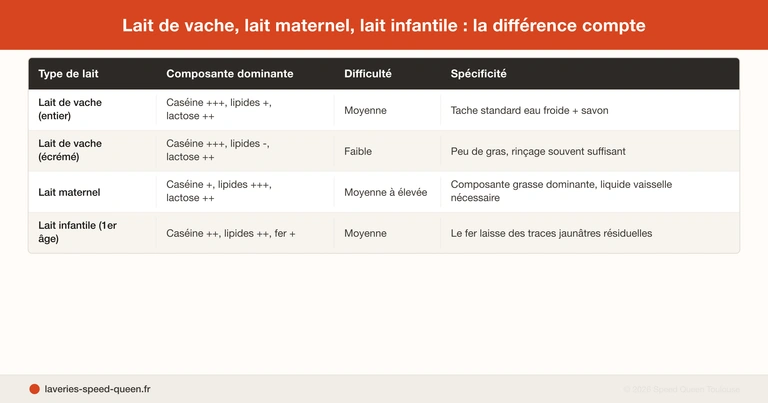
Cow’s milk, breast milk, infant formula: the difference matters
The three types of milk do not stain in the same way. Their composition determines the optimal protocol.
| Milk type | Dominant component | Difficulty | Specificity |
|---|---|---|---|
| Whole cow’s milk | Casein +++, lipids +, lactose ++ | Medium | Standard stain: cold water + soap |
| Skimmed cow’s milk | Casein +++, lipids -, lactose ++ | Low | Little fat, rinsing often sufficient |
| Breast milk | Casein +, lipids +++, lactose ++ | Medium to high | Dominant fat component, dish soap needed |
| Infant formula (first age) | Casein ++, lipids ++, iron + | Medium | Iron leaves yellowish residual traces |
Breast milk: fattier than you think
Breast milk has a unique composition. It contains more lipids than cow’s milk, but less casein (40% of proteins versus 80% for cow’s milk). The dominant protein is whey, which is more soluble and less likely to coagulate with heat. However, the fat component is greater — hence the need for a degreaser (dish soap) to complement Marseille soap.
Fresh stain: act within the first 15 minutes
A fresh milk stain comes out easily if you follow the right protocol. The milk has not yet dried, the casein is still soluble, and the fat has not penetrated deeply.
Step 1 — Blot without rubbing
Dab the excess milk with a paper towel or clean cloth. The motion should be vertical (dabbing), never horizontal (rubbing). Rubbing spreads the milk over a larger area and pushes proteins into the fibres.
Step 2 — Rinse with cold water from the reverse side
Turn the garment inside out and hold the stained area under a strong stream of cold water. Cold water immediately dissolves the lactose and flushes most of the still-soluble casein. By rinsing from the reverse, you push residue towards the outside of the fabric.
Why from the reverse? If you rinse from the front, you push milk particles through the fibre. From the reverse, the water stream pushes them outward, in the opposite direction to penetration.
Step 3 — Marseille soap
Rub a block of Marseille soap↗ directly on the damp stain. Marseille soap is an alkaline surfactant (pH 9-10) that performs two functions simultaneously: it emulsifies milk lipids by forming micelles, and its basic pH helps dissolve remaining casein (casein is more soluble in alkaline than in neutral conditions).
Leave for 15 minutes, forming a crust of soap over the area. During this time, the surfactants penetrate the fibres and encapsulate fat and protein residue.
Step 4 — Degreasing treatment (breast milk)
If you are treating a breast milk stain, Marseille soap alone may leave a residual greasy mark. In that case, apply one drop of concentrated dish soap (colourless if possible) directly to the area after soaping. Dish soap contains non-ionic surfactants specifically designed to emulsify food fats — it is more powerful than bar soap on lipids.
Massage gently and leave for 5-10 minutes, then rinse with cold water.
Step 5 — Check before machine washing
Examine the area in natural light. If the stain has gone, wash normally at 30-40 °C. If a trace remains, do not put it in the machine — repeat the treatment or move to the dried stain methods below.
Dried stain or one that has been through the machine
A milk stain that has dried for several hours — or worse, been through the machine without pre-treatment — is more resistant. The casein has had time to bond to the fibres, the fat has penetrated deeply, and if the machine heated above 40 °C, the protein has probably coagulated.
Glycerine: soften before treating
Vegetable glycerine is the most effective tool for softening a dried milk stain. It acts as a humectant that rehydrates set proteins and makes them accessible to surfactants again.
- Warm slightly the glycerine (lukewarm to the touch, in a bain-marie).
- Apply generously to the stain and massage with your fingertips.
- Leave for 30 minutes — the glycerine needs time to penetrate the dried protein crust.
- Soap with Marseille soap and gently rub fabric against fabric.
- Rinse with cold water and assess the result.
Sodium percarbonate: for stubborn traces
If glycerine and soap are not enough, sodium percarbonate takes over. It releases active oxygen on contact with water, which oxidises and bleaches protein residue.
- Dissolve 1 tablespoon of percarbonate per litre of water at 40 °C.
- Submerge the textile and soak for 1 to 2 hours.
- Rinse and machine wash at 30-40 °C.
Precaution with percarbonate
Percarbonate is a bleaching agent. Safe on white cotton, it can dull delicate colours or prints. On a coloured baby garment, limit soaking to 30 minutes and test on an inside hem first.
Diluted ammonia: the last resort
For very old milk stains or those that have been “cooked” in the machine (60 °C programme or higher), diluted ammonia is sometimes the final option. Ammonia (ammonium hydroxide) is a powerful alkaline solvent that breaks down coagulated proteins.
- Dilute 1 tablespoon of household ammonia in 500 ml of cold water.
- Dab the stain with a soaked cloth. Do not pour directly.
- Leave for 15-20 minutes.
- Rinse thoroughly with cold water.
- Soap and machine wash at 30-40 °C.
Precautions: work in a ventilated room (irritating fumes), wear gloves, and never mix ammonia with bleach (dangerous chemical reaction). Ammonia is not recommended on silk or wool.
Stain removal by fabric type
The textile determines how much leeway you have. A white cotton bodysuit tolerates vigorous treatments; a silk garment demands the greatest delicacy.
| Textile | Recommended method | Max temperature | Precautions |
|---|---|---|---|
| White cotton (baby bodysuits) | Marseille soap + percarbonate (soak 1-2 h) | 60 °C | The most resistant. Sunlight bleaches residual traces on damp white cotton. |
| Coloured cotton | Marseille soap + glycerine | 40 °C | Percarbonate limited to 30 min. Test colour fastness. |
| Synthetic (polyester, lycra) | Dish soap + Marseille soap | 30-40 °C | Polyester holds fat. Insist on degreasing. |
| Wool / Cashmere | Gentle Marseille soap (dab, do not rub) | Cold (< 30 °C) | No percarbonate, no rubbing, no ammonia. |
| Silk | Warm glycerine + cold water rinse | Cold (< 30 °C) | Extremely fragile. Dab only, never rub. |
Milk stains on the mattress
The baby mattress is particularly exposed to milk stains (night-time spit-ups). Since the mattress cannot go in the machine, you must treat it locally.
Fresh stain on the mattress
- Blot immediately with paper towels. Press firmly to absorb liquid deep down.
- Dab with a cloth soaked in cold soapy water (Marseille soap).
- Sprinkle dry baking soda↗ on the still-damp area.
- Leave to dry for 30 minutes — baking soda absorbs moisture and odours.
- Vacuum the dry baking soda.
Dried stain on the mattress
- Prepare a paste of baking soda and cold water (2/3 baking soda, 1/3 water).
- Apply to the stain in a thick layer.
- Leave for 30-60 minutes.
- Scrape off the dry paste and vacuum.
- If a trace remains, spray a mixture of cold water and white vinegar↗ in equal parts. Dab and leave to dry.
Prevention on the mattress
A waterproof and breathable mattress protector is the best defence against milk stains on a baby mattress. Choose a model with a waterproof membrane (polyurethane) and a textile face in cotton or bamboo for comfort. Wash it every 2 weeks at 60 °C. See our guide to washing a mattress protector.
Milk stains on adult clothes
Parents are also victims of milk stains: spit-up on the shoulder during burping, a milky coffee knocked over, splashes while preparing a bottle.
The muslin cloth reflex
The simplest way to protect your clothes: place a muslin cloth on your shoulder during feeding and burping. The cloth absorbs the spit-up and washes easily at 60 °C. Always have 3-4 in rotation.
On-the-spot treatment (at work, out and about)
If you are away from home when the stain happens:
- Dab with a tissue dampened with cold water (fountain, bottle).
- Rub with a little liquid hand soap (available in toilets).
- Rinse with cold water.
- Dry with paper towels.
This emergency treatment will not work miracles, but it stops the stain from drying and setting. You can complete the full treatment at home.
Machine washing: precautions
Once pre-treatment is done, the machine wash finishes the cleaning. But the setting is crucial.
Temperature: 30-40 °C maximum
For all types of milk, stay at 30-40 °C for the first wash after pre-treatment. This temperature is sufficient for the detergent’s surfactants to finish the cleaning job, with no risk of coagulating casein residue that pre-treatment may not have completely eliminated.
Thorough rinsing
Rinsing is particularly important after milk stain removal. Residual Marseille soap or dish soap left in the fibres can leave a drying mark — a yellowish ring visible on light textiles.
Professional laundromat machines, with their 50 to 60 litres of rinse water, offer a clear advantage here. The higher water volume dilutes and flushes soap and milk residue much more effectively than a domestic machine (15-20 litres).
Mandatory check
Take the garment out of the machine and examine the area in natural light. If the stain has gone, dry normally. If a trace remains — even a faint one — do not tumble dry. The drying heat (60-80 °C) will permanently set the casein residue. Repeat pre-treatment and rewash.
- Direct hot water on the stain — coagulates casein and sets the stain in the fibre nearly irreversibly.
- Tumble drying before checking — the heat (60-80 °C) cooks residual proteins. Always check in natural light.
- Rubbing a fresh stain — you spread the milk and push proteins into the fibres. Dab, do not rub.
- Bleach on colours — bleach strips colour from the fabric. Sodium percarbonate is a gentler bleaching alternative.
- Ironing over the stain — the iron's soleplate (150-200 °C) sets the protein permanently.
Preventing milk stains
Prevention is the best strategy, especially with a baby who frequently spits up.
Bibs and muslin cloths
A bib at every bottle/feed. A muslin over the shoulder for burping. Waterproof bibs for solid food meals. Wash bibs at 60 °C after every meal to remove food residue.
Waterproof mattress protector
On the baby mattress, a protector with a waterproof membrane stops spit-ups before they reach the mattress. Change and wash it regularly at 60 °C.
Protective clothing
Wear an old t-shirt over your clothes during breastfeeding or bottle feeding. Less elegant, but effective at protecting the clothes you care about.
En tant que Partenaire Amazon, nous percevons une petite commission sur les achats effectués via les liens partenaires de cet article — sans surcoût pour vous. Cela nous aide à maintenir ce site et à produire des guides gratuits.
Milk stains resist the limited water volume of home machines. Our laundromats in Blagnac, Croix-Daurade and Montaudran have professional machines with detergent included and high-performance rinsing (50-60 litres). Payment CB sans contact ou espèces. See our prices.