Nail polish is a polymer film (nitrocellulose) that laundry surfactants cannot dissolve — only an organic solvent can tackle it. The solvent choice depends on the fabric: acetone on cotton and linen, non-acetone remover on synthetics, dry cleaning for silk and acetate. Absolute rule: never rub a nail polish stain — dab only, always from the back of the fabric.
At a glance
Do not rub -- scrape the dry excess, then dab only. Rubbing spreads the polish.
Acetone = cotton and linen only -- the most effective solvent, but it destroys acetate and some synthetics.
Non-acetone remover = synthetics -- less powerful but compatible with polyester, nylon, spandex.
Silk and acetate = dry cleaner -- solvents risk creating marks or dissolving the fibre.
Treat from the back -- the solvent pushes the polish outward through the fabric instead of deeper in.
Why nail polish is a unique stain
Nail polish is not a food, grease or protein stain like most textile soiling. It is a plastic film deposited on the fabric — and this chemical nature explains why it resists all conventional stain removal methods.
Regular polish composition
A regular nail polish contains three main components that each pose a specific challenge:
Nitrocellulose (15-25 %). This is the film-forming polymer — the substance that creates the hard, glossy film on the nail (or fabric). Nitrocellulose is cellulose treated with nitric acid, resistant to water and standard detergents. Only organic solvents (acetone, ethyl acetate) dissolve it effectively.
Resins (5-10 %). Resins such as tosylamide-formaldehyde or polyurethane reinforce the film’s adhesion and wear resistance. These resins mechanically bind the polish film to the textile fibres, making the stain even more tenacious.
Pigments and glitter (1-5 %). Coloured pigments (iron oxides, titanium dioxide, organic dyes) give the polish its colour. Some pigments — especially reds and purples — have a strong affinity for textile fibres and leave a coloured trace even after the polymer film is dissolved.
Why detergent is not enough
Laundry surfactants are designed to encapsulate fats and solubilise them in water (micellisation). But nail polish is not a fat — it is a plastic polymer. Surfactants slide over its surface without dissolving it, exactly like water on plastic. This is why machine washing without solvent pre-treatment only sets the stain: hot water and mechanical agitation push the pigment into the fibre without dissolving the film.
Acetone dissolves acetate
Acetate (or viscose acetate) is a synthetic textile derived from cellulose found in jacket linings, satin blouses and some evening dresses. Acetone dissolves acetate instantly — the fabric literally melts on contact with the solvent. Always check the composition label before using acetone.
The three solvents and their uses
The solvent choice is the most important decision in nail polish stain removal. Each has its strengths and limits.
Acetone: the most powerful
Acetone (propanone) is the reference solvent for nail polish. It is the same solvent used in professional removers. Its effectiveness is superior to all other household solvents.
Compatible with: cotton, linen, hemp and all natural cellulosic fibres. Acetone does not dissolve cellulose.
Incompatible with: acetate (destroyed), triacetate (destroyed), modacrylic (damaged), some fine polyesters (possible distortion). On silk and wool, acetone does not attack the fibre itself but can dissolve or alter the dye.
Mode of action: acetone dissolves the nitrocellulose and resins of the polish within minutes. The film liquefies and can be absorbed by a cloth. Its rapid evaporation (boiling point 56 °C) means it leaves no residue on the fabric.
Non-acetone remover: for synthetics
“Non-acetone” removers generally contain ethyl acetate as the main solvent, sometimes combined with isopropyl alcohol. Ethyl acetate is a milder solvent than acetone — less aggressive on fibres but also less effective against polish.
Compatible with: polyester, nylon (polyamide), spandex (Lycra), acrylic, and most common synthetic fibres.
Less effective than acetone: contact time must be longer (5-10 minutes versus 2-5 for acetone) and multiple applications are often needed for thick stains.
Mode of action: ethyl acetate gradually dissolves nitrocellulose but acts more slowly on adhesion resins. The film softens before liquefying, which requires more persistent dabbing.
Rubbing alcohol: the gentle alternative
Rubbing alcohol (denatured ethanol at 90°) is the most versatile and least aggressive of the three. It is compatible with nearly all textiles, but its effectiveness is significantly lower than acetone and non-acetone remover.
Compatible with: cotton, linen, polyester, nylon, wool (test on colours), most blends.
Limits: rubbing alcohol only partially dissolves nitrocellulose. It is effective on thin, fresh polish but insufficient on thick layers or gel polish. It mainly works by softening the film, which requires additional mechanical scraping.
Mode of action: ethanol weakens the intermolecular bonds of nitrocellulose without completely dissolving it. Combined with patient dabbing, it can remove light stains in 15-20 minutes of treatment.
Acetone
The most effective. Dissolves polish in 2-5 min. For cotton, linen, hemp only. Destroys acetate and some synthetics. Rapid evaporation, no residue.
Non-acetone remover
Alternative for synthetics (polyester, nylon, Lycra). Ethyl acetate based. Less powerful: 5-10 min contact, multiple passes needed.
Rubbing alcohol 90°
The mildest and most versatile. Compatible with nearly all textiles. Limited effectiveness on thin, fresh polish. Requires patience and repetition.
Dry cleaner (silk, acetate)
The only safe option for silk, acetate, lined garments and precious pieces. Professional solvents dissolve polish without risking the fibre.
The detailed step-by-step protocol
Step 1 — Scrape without spreading
If the polish is still wet, immediately scrape the excess with the back of a spoon or a butter knife. The goal is to remove as much material as possible before it penetrates the fibre. Work from the edge toward the centre of the stain to avoid enlarging it.
If the polish has dried, scrape the hardened crust to break and remove the surface film. On sturdy fabric (jeans, thick cotton), you can use the blunt side of a razor blade. On delicate fabric, stick to the back of a spoon.
The reflex to avoid: rubbing with a tissue or paper. Rubbing spreads wet polish over 3-5 times the original area and pushes the pigment into the fibre core.
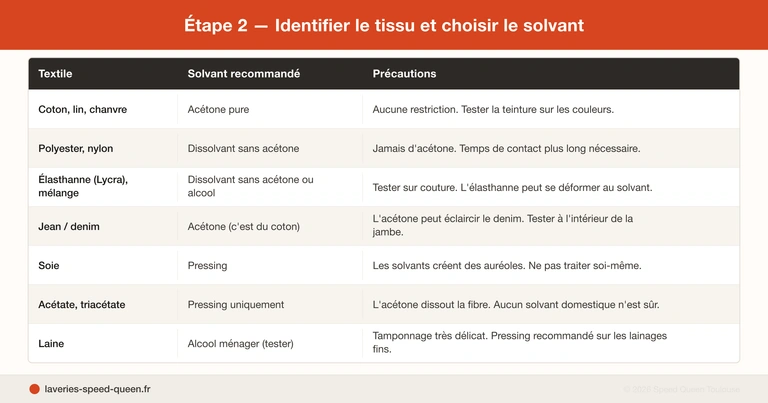
Step 2 — Identify the fabric and choose the solvent
Check the composition label of the garment. This is the deciding factor for solvent choice:
| Textile | Recommended solvent | Precautions |
|---|---|---|
| Cotton, linen, hemp | Pure acetone | No restrictions. Test dye on colours. |
| Polyester, nylon | Non-acetone remover | Never acetone. Longer contact time needed. |
| Spandex (Lycra), blends | Non-acetone remover or alcohol | Test on seam. Spandex may distort with solvent. |
| Jeans / denim | Acetone (it is cotton) | Acetone may lighten denim. Test inside the leg. |
| Silk | Dry cleaner | Solvents create water marks. Do not treat yourself. |
| Acetate, triacetate | Dry cleaner only | Acetone dissolves the fibre. No household solvent is safe. |
| Wool | Rubbing alcohol (test) | Very gentle dabbing. Dry cleaning recommended on fine woolens. |
Step 3 — Test the solvent
Before tackling the stain, apply a drop of the chosen solvent to an invisible area of the garment (inner hem, hidden seam, inside pocket). Wait 5 minutes and check:
- The colour has not changed (no fading, no halo)
- The texture is intact (no softening, no hardening)
- The fibre has not dissolved (no hole, no transparent area)
If the test is clear, you can treat the stain safely. If the fabric reacts badly, try a milder solvent or opt for dry cleaning.
Step 4 — Treat from the back
This is the key technique for nail polish stain removal:
- Turn the garment inside out — you will work from the back.
- Place a white cloth (or white paper towels) under the stain, right side. This cloth will absorb the dissolved polish as you work.
- Soak a cotton pad in solvent (generously but not dripping).
- Dab the stain from the back — vertical motions, from edge toward centre. The solvent passes through the fabric and pushes the dissolved polish toward the absorbent cloth below.
- Change the absorbent cloth as soon as it picks up colour — otherwise, the dissolved polish redeposits on the fabric.
- Repeat until the absorbent cloth no longer picks up any colour.
Multiple passes are normal
Nail polish never disappears in a single application. The solvent dissolves the film layer by layer — expect 3-6 applications for regular polish, and up to 10 for gel polish. Change the solvent-soaked pad with each pass to avoid redepositing dissolved polish.
Step 5 — Treat residual pigment
After dissolving the nitrocellulose film, a pigment trace may remain in the fibre — especially with red, purple and fuchsia polishes whose organic pigments have a strong affinity for textile fibres.
For natural fibres (cotton, linen):
- Marseille soap — rub a block of damp Marseille soap directly on the residual trace. Leave for 15 minutes, then rinse with cold water.
- Sodium percarbonate (white cotton only) — soak in a solution of [percarbonate](/blog/percarbonate↗-de-soude-linge/) (1 tbsp per litre of water at 40 °C) for 1 hour.
For synthetics:
- Dish soap — apply a few drops to the residual trace, massage gently and rinse. Degreasing surfactants can dislodge residual pigments floating in the dissolved film.
Step 6 — Machine wash
Wash the garment on its normal cycle at the temperature indicated on the label. Machine washing removes the last traces of solvent and pigment.
Check the result when the garment comes out of the machine, before the tumble dryer. The heat of the tumble dryer (60-80 °C) permanently sets residual pigment in the fibre. If a trace remains, repeat the solvent treatment.
Gel polish vs regular polish
Gel polish (or semi-permanent polish) has become very popular — and unfortunately, it is significantly harder to remove from fabric than regular polish.
Why gel resists more
Gel polish is photopolymerised — exposed to a UV lamp for 30-60 seconds, its monomers (methacrylates) form a three-dimensional network of interconnected polymers. This network is much denser and more solvent-resistant than the simple nitrocellulose film of regular polish.
In chemical terms: regular polish is a thermoplastic (it softens and dissolves on solvent contact), while gel polish is a thermoset (its crosslinked bonds resist simple dissolution).
The gel polish protocol
- Scrape the excess mechanically — scraping is more important than for regular polish, since the solvent will act more slowly.
- Pure acetone (on cotton/linen) — apply generously and leave for 15-30 minutes under a soaked pad placed directly on the stain. Cover with plastic wrap to prevent evaporation.
- Scrape again — after the soaking time, the softened gel can be scraped mechanically.
- Repeat — the acetone + scrape cycle often needs to be repeated 2-3 times for gel polish.
- Treat residual pigment as for regular polish.
On synthetics, non-acetone remover is significantly less effective on gel than on regular polish. If the stain resists after 3 attempts, dry cleaning is probably the best option.
| Characteristic | Regular polish | Gel polish (semi-permanent) |
|---|---|---|
| Polymer | Nitrocellulose (thermoplastic) | Crosslinked methacrylate (thermoset) |
| Solubility in acetone | Fast (2-5 min) | Slow (15-30 min, softening) |
| Non-acetone remover effectiveness | Good (5-10 min) | Poor (limited effect) |
| Number of passes needed | 3-6 | 6-10+ |
| Overall difficulty | Medium | High |
By fabric type: practical guides
White cotton
The simplest case. Pure acetone dissolves the polish with no risk to the fibre. If a residual pigment trace remains, sodium percarbonate (2 tbsp per litre at 40 °C, soaking 1-2 hours) removes residual colours by oxidation. Sunlight completes the job — UV breaks down the organic pigments in polish.
Coloured cotton
Acetone is possible, but test the dye fastness on an inner hem first. Acetone does not affect reactive dyes (the majority of industrial dyes on cotton), but some direct dyes or digital prints may be altered. If the dye moves, switch to rubbing alcohol.
Jeans / Denim
Denim is cotton — acetone works. However, acetone may lighten the indigo dye of jeans (indigo is a surface pigment not chemically bonded to the fibre). Test inside the leg or waistband. See our guide on washing jeans.
Polyester and nylon
Non-acetone remover only. Dab from the back, change the absorbent cloth frequently. Polyester is a fibre that retains oily pigments — insist on treating residual pigment with dish soap after dissolving the film.
Silk
Do not treat yourself. Silk is too sensitive to solvents and rubbing. A nail polish stain on a silk dress or blouse justifies a trip to the dry cleaner. Perchloroethylene (dry cleaning solvent) dissolves polish without damaging silk.
Wool
Rubbing alcohol is the safest option. Dab very gently (wet wool is fragile) and rinse with cold water immediately after. If the garment is a valuable wool jumper, dry cleaning is preferable.
Mistakes that set the stain
- Rubbing with cotton -- spreads the wet polish and pushes the pigment into the fibres. Always dab without lateral motion.
- Hot water or tumble dryer -- heat hardens the nitrocellulose film and sets the pigment. Cold water only until the stain is treated.
- Acetone on synthetics without checking -- acetone melts acetate and can distort fine polyester. Always check the label.
- Machine washing without pre-treatment -- detergent is powerless against the polymer film. Machine washing sets the stain instead of removing it.
- Mixing solvents -- do not apply acetone then non-acetone remover on the same area. Rinse completely between each attempt to avoid unwanted chemical reactions.
Machine wash and laundromat
After solvent pre-treatment, the machine wash completes the cleaning by removing pigment and solvent residue. Wash on the usual programme and temperature for the garment.
Professional machines at our laundromats offer a higher water volume (50-60 litres versus 15-20 litres in a domestic machine), ensuring more effective rinsing of solvent residue. The pre-dosed professional detergent contains enzymes and stain-removal agents that complement the solvent’s action on residual pigment traces.
As an Amazon Partner, we receive a small commission on purchases made via affiliate links in this article — at no extra cost to you. This helps us maintain this site and produce free guides.
After pre-treating your nail polish stain with solvent, finish with a professional machine wash for optimal rinsing. Our laundromats in Blagnac, Croix-Daurade and Montaudran are open 7 days a week, professional detergent included, payment CB sans contact ou espèces. See our prices.