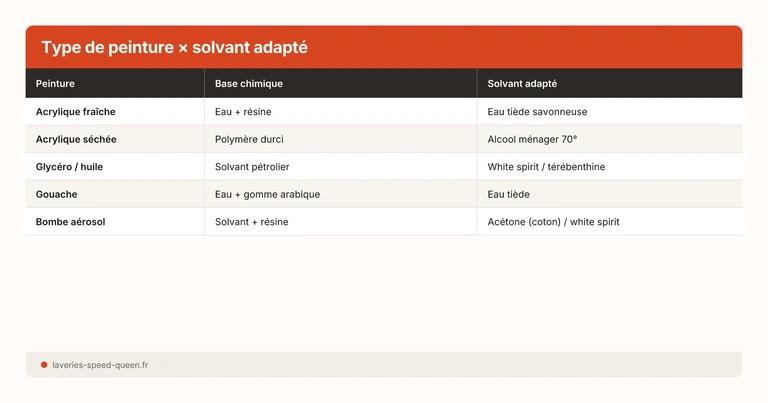
In short: treating a paint stain depends on its chemical base. Fresh acrylic (water-based): warm water + soap. Dried acrylic: rubbing alcohol at 70%. Oil-based / glycero paint: turpentine or white spirit (with ventilation and gloves). Gouache and watercolour: soapy water — they come out easily. Always scrape off the excess before treating, and never tumble dry before confirming the stain has gone.
At a glance
Fresh water-based paint (acrylic, gouache, watercolour) — rinse with warm water + Marseille soap. Act within 30 minutes.
Dried acrylic paint — scrape off the excess, then rubbing alcohol at 70% for 15 minutes.
Oil-based / glycero paint — turpentine or white spirit. Always ventilate and wear gloves.
Spray paint — acetone on cotton or linen, white spirit on other textiles. Never acetone on synthetic.
Identify the paint type
The first step is to know what has stained the garment. Treatment depends entirely on the chemical base of the paint. Check the tin label if you still have it. For an overall approach to stain removal, our guide to tough stains and solutions covers other common stain types.
| Paint type | Chemical base | Suitable solvent | Difficulty |
|---|---|---|---|
| Acrylic | Water + acrylic resin | Warm water (fresh) / rubbing alcohol (dried) | Easy if fresh, medium if dried |
| Oil-based (glycero) | Petroleum solvent + alkyd resin | Turpentine or white spirit | Difficult — requires a solvent |
| Gouache | Water + gum arabic + pigments | Warm soapy water | Easy — water-soluble |
| Watercolour | Water + gum arabic (very diluted) | Cold water | Very easy |
| Spray paint | Solvent + resin (variable) | Acetone (cotton) or white spirit | Difficult — dries very fast |
Fresh vs dried: why timing is crucial
Time is the determining factor. The longer you wait, the harder the stain becomes — and the mechanism varies by paint type.
Acrylic paint: while wet, acrylic behaves like a standard water paint. It rinses out easily. But as it dries (around 30 minutes at room temperature), the acrylic resin polymerises: polymer chains cross-link and form a waterproof plastic film. This film no longer dissolves in water. You then need a solvent (alcohol) to soften it.
Oil-based paint: it dries by oxidation — the oil reacts with oxygen in the air to harden. This process is slower (6 to 12 hours to touch dry, several days for full cure). You have more time, but even fresh, oil-based paint does not dissolve in water. A petroleum solvent is required from the start.
Gouache and watercolour: they do not polymerise. Even dried, they remain soluble in warm water. A 30-minute soak is usually enough to rehydrate them.
Acrylic paint
This is the most common paint today — decoration, crafts, artistic painting. It accounts for the majority of paint stains on clothes.
Fresh stain (under 30 minutes)
- Remove the excess with paper towels by dabbing, not rubbing.
- Rinse with warm water (not hot) from the reverse of the fabric to push paint out of the fibres.
- Rub with Marseille soap↗ directly on the stain. Marseille soap is slightly alkaline and loosens pigments.
- Rinse with cold water and check. If a trace remains, repeat the soaping.
- Machine wash at 30-40 °C according to the garment label.
Dried stain (hardened film)
Scrape off the excess — with the back of a spoon or a plastic spatula. Remove as much hardened material as possible.
Soak with 70% rubbing alcohol — the alcohol softens the acrylic resin film. Leave for 15 minutes.
Rub with Marseille soap — work the area between your fingers to loosen the softened residue.
Rinse with cold water — flush the alcohol and pigments. Repeat if necessary.
Machine wash at 30-40 °C — check the stain has gone before tumble drying.
Alternative: if you do not have rubbing alcohol, hot white vinegar↗ (60 °C) can soften a light acrylic film, but it is less effective than alcohol on a thick layer. For more on the uses of white vinegar in laundry, see our dedicated article.
Oil-based / glycero paint
Oil-based paint (also called ‘glycero’ or ‘alkyd’) is used for woodwork, radiators and surfaces exposed to moisture. It does not dissolve in water, even when fresh. A petroleum solvent is needed from the start.
Safety: petroleum solvents
Turpentine and white spirit are flammable solvents that release irritating vapours. Respect these rules: work in a ventilated room (open the window), wear nitrile gloves, keep away from any flame or heat source, and never pour solvent directly on the fabric — soak a clean cloth instead. Dispose of soaked cloths in a sealed container (risk of self-ignition).
Protocol
- Scrape off the excess with a plastic spatula. For fresh paint, absorb as much as possible with paper towels.
- Place an absorbent cloth under the stain to catch the pigment-laden solvent.
- Dab with a cloth soaked in white spirit (or turpentine). Work from the edge towards the centre to avoid spreading.
- Leave for 10 minutes, then dab again. Switch to a clean area on the cloth as it picks up colour.
- Rub with Marseille soap to remove the oily solvent residue. Marseille soap is a good natural degreaser — the same logic as for a grease stain.
- Rinse thoroughly with cold water.
- Machine wash at 30-40 °C. Machine washing helps remove the last traces of solvent and pigment.
Dried oil-based paint: the treatment is the same, but allow a longer contact time (30 minutes to 1 hour) and several dabbing passes. If the layer is thick and old, scrape off as much as possible before applying solvent.
Children’s paint: gouache and watercolour
Good news for parents: gouache and watercolour are the easiest paints to remove. They are water-based with pigments bound by gum arabic — a water-soluble natural binder.
Gouache
- Fresh stain: rinse under warm water. The paint dilutes immediately. Rub lightly with soap if the colour is intense (red, dark blue).
- Dried stain: soak the garment in warm soapy water for 30 minutes. The gouache rehydrates and comes off. Rub with Marseille soap, rinse and machine wash at 40 °C.
- Stubborn stain (thick dried gouache on white): add a tablespoon of sodium percarbonate↗ to the soaking water. The percarbonate releases active oxygen that bleaches the pigments.
Watercolour
Watercolour is even more diluted than gouache. A cold water rinse is sufficient in almost all cases. If a very concentrated pigment (like artists’ tube cadmium red) leaves a trace, treat like dried gouache.
'Washable' children's paint
Children’s paints sold as ‘washable’ (Crayola, Giotto, Pebeo) are formulated with water-soluble colourants and no strong binding resin. They come out in a normal 30-40 °C wash. If a trace remains on white cotton, a sodium percarbonate soak removes the last pigments.
Method by fabric type
The textile determines which products you can use and the wash temperature. Always check the care label before applying a solvent.
| Textile | Acrylic | Oil-based | Precaution |
|---|---|---|---|
| White cotton | Rubbing alcohol + soap + machine 40 °C | White spirit + soap + machine 40 °C | The most resilient — tolerates all treatments |
| Coloured cotton | Rubbing alcohol (test on inner hem) | White spirit (test on hidden area) | Alcohol and white spirit can discolour some dyes |
| Jeans (denim) | Rubbing alcohol + soap + machine 40 °C | Dab with white spirit + soap + machine 40 °C | Turn jeans inside out to protect the outer colour |
| Synthetic (polyester, nylon) | 70% rubbing alcohol — dab gently | White spirit with caution — test first | Never acetone — it dissolves synthetic fibres |
| Silk, wool | Diluted alcohol (50/50 water-alcohol), dab | Take to a dry cleaner | Fragile fibres — see our delicate textiles guide |
| Workwear | Pure rubbing alcohol + intensive wash | White spirit + intensive wash in large-capacity machine | Often multiple stains — a large professional machine makes rinsing easier |
Mistakes that set the stain
- Acetone on synthetic — acetone dissolves polyester and nylon. The fabric melts, distorts and the stain becomes irreversible. Only use acetone on cotton or linen.
- Heat on dried acrylic — ironing or tumble drying re-melts the resin and permanently fuses it to the fibres. Always treat cold.
- Rubbing a fresh stain — you spread the paint and push it into the fibres. Dab or scrape, never rub.
- Hot water on fresh paint — hot water accelerates acrylic polymerisation. Use warm (30-35 °C) or cold water.
- Mixing solvents — do not use white spirit then acetone on the same area. The combined chemical residues can damage the fabric and release harmful vapours.
Machine washing
After pre-treatment, machine washing is essential to remove solvent, soap and pigment residues. To choose the right wash temperature, refer to the garment label.
- Temperature: 30-40 °C for most textiles. White cotton can handle 60 °C if the label allows.
- Detergent: use your usual detergent. No need to overdose — the pre-treatment has done most of the work.
- Check: inspect the treated area before tumble drying. If a trace remains, repeat the pre-treatment. Dryer heat would set the residues.
- Bulky workwear: overalls, painters’ suits — these garments are often too large or too soiled for a domestic 5-7 kg machine. A professional 9-14 kg machine provides the water volume and agitation needed for thorough solvent rinsing.
Special case: paint stains on workwear
Tradespeople, painters and DIY enthusiasts accumulate paint stains on workwear over time. Unlike isolated accidental stains, multiple splashes require a different approach.
For overalls covered in dried acrylic stains, a prolonged soak (4-6 hours) in warm water with liquid detergent softens most deposits. Scrape off the thickest residues, then machine wash at 40 °C. Do not aim for perfection — workwear does not need to be immaculate. The goal is to remove enough paint for the fabric to remain supple and comfortable.
For large volumes of workwear, the 18 kg laundromat machine is ideal. The larger drum allows efficient agitation even with thick, paint-stiffened textiles. The automatically dosed professional detergent contains concentrated surfactants that help loosen paint residues softened by prior soaking.
As an Amazon Partner, we earn a small commission on purchases made through the affiliate links in this article — at no extra cost to you. This helps us maintain this site and produce free guides.
Our laundromats in Blagnac, Croix-Daurade and Montaudran have professional machines from 9 to 14 kg with detergent included. The water volume (50-60 litres) and intensive agitation are particularly suited to paint-stained workwear after pre-treatment. Payment CB sans contact ou espèces. See our prices.