Tomato sauce is a composite stain: lycopene (a red carotenoid pigment) colours the fibre, and oil (olive or sunflower in the sauce) greases it. To remove it, you must treat both components in the right order: first the oil with dish soap, then the pigment with Marseille soap or white vinegar. Absolute rule: cold water only at the start — hot water sets lycopene permanently.
At a glance
Scrape, do not rub — remove excess sauce with the back of a spoon.
Cold water is mandatory — hot water sets lycopene in the fibres irreversibly.
Dish soap first — its surfactants dissolve the oily component of the sauce.
Marseille soap next — its alkaline pH lifts the pigment from the fibres.
Sunlight is your ally — UV rays break down residual lycopene through photolysis.
Why tomato sauce is a stubborn stain
Tomato sauce is not a simple stain. It is a cocktail of several components that act simultaneously on the fabric, each requiring a specific treatment.
Lycopene (the pigment component). Lycopene is the carotenoid pigment that gives the tomato its intense red colour. Unlike many food colourings, lycopene is fat-soluble — it dissolves in fats, not in water. This is what makes it particularly stubborn: it bonds by affinity to the hydrophobic zones of textile fibres and resists water rinsing alone. Furthermore, lycopene has a long chain of conjugated double bonds that makes it resistant to simple oxidation.
Oil (the greasy component). Almost all tomato sauces contain oil — olive, sunflower or rapeseed depending on the recipe. Industrial ketchup also uses vinegar and sugar, but the greasy base remains. This oil acts as a vehicle: it carries lycopene deep into the fibre and creates a hydrophobic barrier preventing water from dislodging the pigment.
Sugar and acidity (secondary components). The natural sugar in tomato (and the added sugar in ketchup) forms a sticky crust as it dries, trapping the lycopene and oil in the fibre. The natural acidity of the tomato (pH 4-4.5) acts as a fixer that reinforces the bond between pigment and textile — the same principle as vinegar used in dyeing to fix colours.
The challenge of removing tomato sauce is therefore twofold: dissolve the fat that traps the pigment, then dislodge the pigment itself. Every mistake — hot water, rubbing, premature drying — sets one of these components deeper.
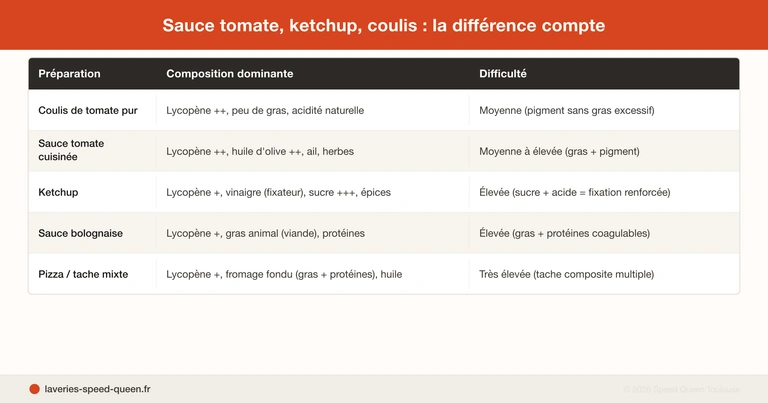
Tomato sauce, ketchup, coulis: the difference matters
Not all tomato-based preparations stain the same way. Their composition determines the difficulty of removal.
| Preparation | Dominant composition | Difficulty |
|---|---|---|
| Pure tomato coulis | Lycopene ++, little fat, natural acidity | Medium (pigment without excess fat) |
| Cooked tomato sauce | Lycopene ++, olive oil ++, garlic, herbs | Medium to high (fat + pigment) |
| Ketchup | Lycopene +, vinegar (fixer), sugar +++, spices | High (sugar + acid = reinforced fixation) |
| Bolognese sauce | Lycopene +, animal fat (meat), proteins | High (fat + coagulable proteins) |
| Pizza / mixed stain | Lycopene +, melted cheese (fat + proteins), oil | Very high (multiple composite stain) |
Ketchup is paradoxically more stubborn than homemade tomato sauce. The vinegar it contains acts as a pigment fixer — exactly like a mordant acid used in dyeing to anchor colours into fabric. The concentrated sugar forms a sticky film that traps the lycopene in the fibre as it dries.
Bolognese sauce adds the difficulty of animal proteins (meat) and animal fat, which coagulate on heating just like the proteins in blood or milk. Treat it like a grease stain combined with a pigment stain.
Pizza or mixed sauce stain
Pizza stains combine tomato sauce, melted cheese and oil. Treat the fat first (dish soap), then the pigment (Marseille soap), then the cheese proteins (cold water + rinsing). Never heat before treating all components: heat simultaneously sets the fat, the pigment and the proteins.
Fresh stain: the first 15 minutes
It is in the first minutes that the stain is most vulnerable. The lycopene has not yet penetrated deeply, the oil has not been absorbed by the fibre core, and the sugar has not formed a crust. If you act quickly, success is almost certain — even on white.
Step 1 — Remove the excess
Scrape the sauce from the surface with the back of a spoon, a butter knife or a spatula. The goal is to lift the material without spreading it. Never rub a fresh tomato sauce stain: you push the lycopene and oil into the fibres and enlarge the stained area.
If the sauce is still wet and thick (large bolognese splash), first absorb the excess with paper towel by dabbing gently — never wiping.
Step 2 — Rinse with cold water from the reverse
Turn the garment inside out and run the stained area under a strong stream of cold water for 2 to 3 minutes. Cold water dissolves the sugar and salt from the sauce, and flushes surface lycopene residues without setting them in the fibre. By rinsing from the reverse, you push pigment particles towards the outside of the fabric instead of through the fibre.
Why cold water is essential. Lycopene is heat-resistant: it is one of the rare food pigments that does not break down during cooking (which is why tomato sauce stays red even after hours of simmering). However, heat accelerates its penetration into textile fibres by “opening” the fibre structure. Hot water is the worst possible reflex on a fresh tomato stain.
Step 3 — Dish soap (the degreaser)
Apply a few drops of concentrated dish soap (preferably colourless to avoid adding dye) directly on the damp stain. Dish soap is the best domestic degreaser available: its surfactants are specifically formulated to encapsulate food fats into micelles and make them water-soluble.
Gently massage from the edge towards the centre of the stain for 1 to 2 minutes. You should see the stain lighten progressively as the oil dissolves. Rinse with cold water.
Step 4 — Marseille soap (the pigment lifter)
Marseille soap↗ has an alkaline pH (9-10) that neutralises the acidity of the tomato and lifts the lycopene from the fibres. Rub a block of Marseille soap directly on the damp stain and build up a thick layer of soap. Leave for 15 minutes.
Marseille soap is particularly suited here because it combines surfactant action (dissolving residual fat) and alkaline action (lifting pigment) in a single product. It has been the weapon of choice for Italian mothers for generations — and for good reason.
Step 5 — Check before washing
Examine the area in natural light. If the stain has gone, wash normally at 30-40 °C. If an orange trace persists, move to the next section before machine washing.
Dried or ingrained stain
A tomato sauce stain that has dried — or worse, that has been through the tumble dryer — requires a more intensive approach. The lycopene has bonded to the fibres, the oil has penetrated deeply, and the sugar has formed a protective shell.
Glycerine: soften before removing
Vegetable glycerine is the best agent for softening an ingrained food stain. It penetrates the dried crust, rehydrates the fixed components and makes them accessible to surfactants again.
- Warm the glycerine slightly (lukewarm, in a bain-marie or 10 seconds in the microwave).
- Apply generously to the stain and massage with your fingertips.
- Leave for 30 minutes minimum (up to 1 hour for very old stains).
- Rub with Marseille soap and rinse with cold water.
White vinegar: dissolve the pigment
White vinegar↗ is a useful ally on dried tomato stains — paradoxically, because the acidity of the tomato itself fixes the pigment. The difference lies in concentration: the acetic acid in white vinegar (8 %) is more concentrated than the citric acid↗ in tomato (0.5 %) and acts as a solvent that displaces the lycopene from the fibre into the liquid.
Soak a cotton pad or clean cloth in white vinegar and dab the stain for 5 minutes. Leave for 15 minutes, then rub with Marseille soap and rinse.
Sodium percarbonate: the rescue oxidiser
For resistant stains on white cotton, sodium percarbonate is the ultimate weapon. On contact with water, it releases hydrogen peroxide which oxidises the lycopene and breaks its conjugated double bonds — chemically bleaching it.
- Dissolve 2 tablespoons of percarbonate per litre of water at 40 °C.
- Immerse the garment and soak for 1 to 2 hours.
- Rinse and machine wash at 40-60 °C.
Percarbonate and colours
Sodium percarbonate is a whitening agent. It is safe on white cotton and colourfast fabrics, but may dull delicate shades or prints. On a coloured garment, limit soaking to 30 minutes and test on an inside seam.
Method by fabric type
The fabric determines your margin for manoeuvre. White cotton tolerates vigorous treatments; a silk garment requires the greatest care.
| Fabric | Recommended method | Max temperature | Precautions |
|---|---|---|---|
| White cotton | Dish soap + Marseille soap + percarbonate | 60 °C | The most resilient. Sunlight bleaches residual lycopene traces. See our guide to whitening laundry. |
| Coloured cotton | Dish soap + Marseille soap | 40 °C | Percarbonate limited to 30 min max. Test colour fastness on a seam. |
| Synthetic (polyester) | Cold water + dish soap + white vinegar | 30-40 °C | Polyester holds greasy pigments. Focus on degreasing. Rinse thoroughly. |
| Silk / Wool | Warm glycerine + gentle soap for delicate fabrics | Cold (< 30 °C) | No vigorous rubbing, no percarbonate. Dab only. |
| Jeans / Denim | Marseille soap (rub fabric against fabric) | 40 °C | Denim is robust and tolerates soaping well. Jeans washing guide. |
Sunlight: a natural ally against lycopene
This is an often overlooked tip, but scientifically proven: ultraviolet rays (UV) break down lycopene through a process called photolysis. UV energy breaks the conjugated double bonds of lycopene — the very chemical structure responsible for its red colour — and progressively bleaches the stain.
To exploit this effect:
- Pre-treat the stain normally (dish soap + Marseille soap).
- Leave the garment still damp — water amplifies the UV effect on pigments.
- Hang in direct sunlight for 2 to 4 hours.
- Check the result. If a trace remains, dampen again and put back in the sun.
This technique works particularly well on white cotton and light natural fibres. It is less effective on dark synthetics (the fabric dye absorbs UV before it reaches the lycopene) and not recommended on fragile colours (UV can also dull delicate shades).
Mistakes that set the stain
- Hot water on a fresh stain — lycopene penetrates three times deeper into fibres at 60 °C than at 15 °C. Always start cold.
- Vigorous rubbing — you spread the pigment over a wider area and push it into the fibre core. Scrape, dab, but do not rub.
- Tumble dryer before checking — dryer heat (60-80 °C) sets lycopene irreversibly. Always check in natural light before any tumble drying.
- Bleach on colours — bleach discolours the fabric as well as the stain. Use sodium percarbonate on white only.
- Waiting to treat — lycopene sets progressively as it dries. Every hour that passes makes the stain harder to remove. The first 15 minutes are decisive.
Machine washing: temperature and programme
Once pre-treatment is done, machine washing completes the cleaning. The choice of temperature is key.
What temperature?
Stay between 30 and 40 °C for the first wash. This range is warm enough to activate detergent surfactants without risking setting residual lycopene. If the stain has fully disappeared after pre-treatment, you can go up to 40-60 °C as the label allows for subsequent washes.
See our washing temperature guide to adapt the programme to each fibre.
Which programme?
A normal cotton cycle with generous rinsing is ideal. Lycopene residues need thorough rinsing to be fully flushed out — avoid eco or short programmes that use less water.
The advantage of water volume at a laundromat
The professional machines in our laundromats use between 50 and 60 litres of water per cycle, compared with 15 to 20 litres for a domestic machine. This extra volume offers a real advantage for stain removal: more water means better dilution of pigment and grease residues, and more effective rinsing. The mechanical action of the professional drum (larger capacity = better tumbling) also helps dislodge ingrained particles.
The pre-dosed professional detergent in our machines contains enzymes (proteases and lipases) that actively break down the proteins and food fats — exactly the components of a bolognese or pizza stain.
As an Amazon Partner, we earn a small commission on purchases made via the affiliate links in this article — at no extra cost to you. This helps us maintain this site and produce free guides.
Tomato sauce stains often resist the limited water volume of domestic machines. Our laundromats in Blagnac, Croix-Daurade and Montaudran have professional machines with detergent included and high-performance rinsing. Payment CB sans contact ou espèces. See our prices.