In short: urine stains and smells because of uric acid, urea and ammonia . For a fresh stain, blot immediately then apply white vinegar (neutralises ammonia) followed by baking soda (absorbs odours). For a dried stain, add hydrogen peroxide. Absolute rule: never use hot water — it sets the proteins and makes the stain permanent. For mattresses, same protocol but no machine: vacuum and air out.
At a glance
Blot, never rub -- absorb as much as possible before any treatment.
Cold water only -- hot water cooks the proteins and sets the stain.
White vinegar -- neutralises ammonia (smell) and dissolves uric acid.
Baking soda -- absorbs residual moisture and lingering odours.
Hydrogen peroxide for dried stains -- safely whitens light-coloured textiles.
Why urine stains and smells
Urine is a complex biological fluid. It mainly contains water (95 %), but also urea, uric acid, ammonia, proteins and pigments (urochrome, responsible for the yellow colour). Each of these compounds poses a specific challenge for stain removal.
Urea breaks down into ammonia on contact with air — this produces the characteristic smell of dried urine. Uric acid forms microscopic crystals that embed themselves in textile fibres and mattress foam. These crystals are virtually insoluble in water and resist standard detergents. This is why a urine stain can appear clean after washing, yet the smell returns as soon as moisture reactivates the crystals.
Urine proteins behave like those in blood: they coagulate when heated. This is the main reason hot water is strictly forbidden as a first treatment.
Baby, adult, pet urine: the differences
Not all urine is equal when it comes to stain removal difficulty. The concentration of uric acid and proteins varies considerably.
Baby urine
The least concentrated and easiest to treat. Infants mainly drink milk and their urine contains little uric acid. A cold water rinse followed by white vinegar is enough in most cases. Stains are rarely stubborn if treated within hours.
Child urine (bedwetting)
More concentrated than a baby's but less than an adult's. The main issue is volume: a child can urinate 200-400 mL in bed, deeply soaking the mattress. Speed of response is crucial. White vinegar + baking soda is the standard protocol.
Adult urine
Medium to high concentration depending on hydration. Morning urine is the most concentrated (dark colour = more pigment and uric acid). The standard vinegar + baking soda treatment works well on fresh stains. Dried stains often require hydrogen peroxide.
Cat urine
The hardest to treat. Highly concentrated in uric acid and felinine (a cat-specific amino acid). Uric acid crystals are extremely resistant and the smell returns systematically if treatment is incomplete. An enzymatic cleaner is often essential alongside vinegar.
Dog urine
Less concentrated than cat urine but higher volume. Uric acid is present but in smaller amounts. The vinegar + baking soda protocol gives good results. For repeat offenders, an enzymatic cleaner removes the scent markers that encourage the animal to urinate in the same spot.
Fresh stain on fabric: the immediate protocol
If you act within minutes, the urine stain will disappear in the vast majority of cases. Speed is your best asset.
Blot the excess -- dab with clean paper towels, pressing firmly. Change paper as soon as it is saturated. The more urine you absorb at this stage, the shorter the treatment.
Rinse with cold water -- run the fabric under cold water from the back side. Cold water dilutes the urea and carries away pigments before they set.
Apply pure white vinegar -- soak the stained area. Leave for 15-30 minutes. The acetic acid neutralises ammonia and dissolves forming uric acid crystals.
Rinse and check -- rinse thoroughly. If a trace remains, repeat with vinegar or move to baking soda.
Machine wash at 30-40 °C -- with your usual detergent. Check the result BEFORE the tumble dryer.
Never use hot water on urine
Hot water coagulates urine proteins exactly like cooking an egg white. The cooked proteins trap pigments (urochrome) in the fibres, creating a permanent yellowish stain. The same principle applies to blood: cold water first, always.
Dried stain on fabric: rehydrate then treat
A dried urine stain has had time to form stable uric acid crystals in the fibres. The smell is often stronger than at the time of the accident, because urea has broken down into ammonia through bacterial action.
- Rehydrate — Spray cold water on the area to partially dissolve the crystals. Do not flood the fabric, just dampen it.
- White vinegar — Apply pure white vinegar↗ to the dampened area. Leave for 30 minutes to 1 hour.
- Baking soda paste — Mix 3 tbsp of baking soda↗ with 1 tbsp of hydrogen peroxide (3 %) and a few drops of dish soap. Apply the paste to the stain. Let it dry completely (2-4 hours).
- Brush and vacuum — Once the paste is dry, gently brush it off then vacuum.
- Machine wash — At 30-40 °C. For resistant stains, add 2 tbsp of [sodium percarbonate](/blog/percarbonate↗-de-soude-linge/) directly into the drum.
For sheets and bedding, a prolonged soak (4-6 hours) in a basin of cold water with 2 tbsp of sodium percarbonate and 1 cup of white vinegar before machine washing gives excellent results.
Urine stain on a mattress: specific protocol
The mattress is the surface most frequently affected by urine stains — bedwetting, incontinence, pet accidents. The challenge: a mattress cannot go in the machine and absorbs liquids deep into its foam.
Fresh stain (less than 2 hours)
- Blot thoroughly — Stack several layers of paper towels and press down with your body weight. The goal is to extract as much liquid as possible from the foam. Repeat until the paper comes up nearly dry.
- Spray white vinegar — Mix white vinegar and cold water (50/50) in a spray bottle. Spray generously over the entire affected area. The vinegar will penetrate the foam and neutralise ammonia deep inside.
- Blot — After 15 minutes, blot with a clean cloth to absorb the excess.
- Sprinkle baking soda — Cover the entire area with a thick layer of baking soda (be generous — at least 3-4 tbsp). The baking soda will absorb residual moisture and odours over several hours.
- Leave overnight — The baking soda needs time to absorb deeply.
- Vacuum — The next day, vacuum the entire area. Air out the mattress (ideally by standing it against a wall near an open window).
Old stain on mattress
For dried stains with yellow rings and persistent odour, the basic protocol is not always enough. Add hydrogen peroxide to the treatment.
Mix in a spray bottle: 200 mL of hydrogen peroxide (3 %), 3 tbsp of baking soda and 2-3 drops of dish soap. Shake until the baking soda dissolves. Spray on the stain, let it foam and dry naturally (4-6 hours). The hydrogen peroxide releases active oxygen that oxidises the yellowed chromogens and destroys the bacteria responsible for the odour. Vacuum the residue once dry.
- Test first -- hydrogen peroxide can lighten some coloured fabrics. Test on a hidden area of the mattress before full application.
- Ventilate well -- hydrogen peroxide breaks down into water and oxygen, but good ventilation speeds drying and prevents mould in the foam.
Effective products in detail
White vinegar: the first response
White vinegar (acetic acid 8-10 %) is the most effective product for first intervention on urine. Its action is threefold: it neutralises ammonia through an acid-base reaction, it partially dissolves uric acid crystals, and it has antibacterial properties that limit the breakdown of urea into ammonia. For more on its uses, see our white vinegar guide for laundry.
Baking soda: the odour absorber
Baking soda excels at absorbing odours. Its alkaline pH (around 8.5) complements vinegar’s action by neutralising residual acids. Sprinkled on a damp surface, it absorbs water and the odour molecules trapped in the moisture. It is the essential product for mattresses, rugs and carpets.
Hydrogen peroxide: the gentle whitener
Hydrogen peroxide (3 %) releases nascent oxygen on contact with the stain. This oxygen oxidises the chromogens responsible for the yellowish colour of dried urine. It is gentler than bleach and does not produce toxic gases on contact with ammonia.
Enzymatic cleaners: for pet urine
Enzymatic cleaners contain specific enzymes (proteases, ureases, lipases) that biologically break down urine components into odourless molecules. They are particularly effective on cat urine, whose uric acid crystals resist conventional chemical treatments. Apply them after vinegar, never at the same time (acid deactivates enzymes).
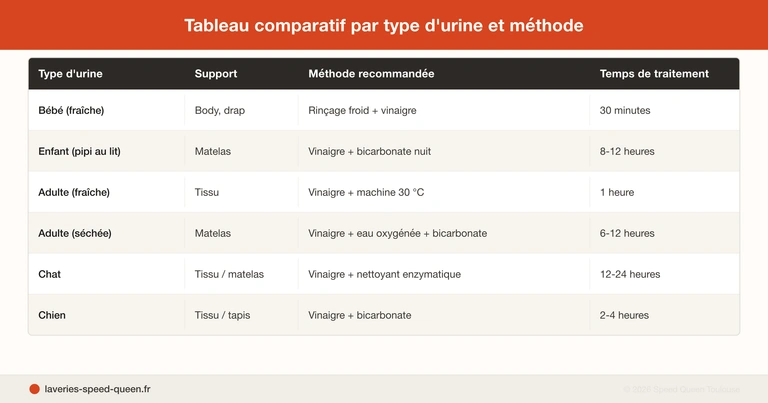
Comparison table by urine type and method
| Urine type | Surface | Recommended method | Treatment time | Effectiveness |
|---|---|---|---|---|
| Baby (fresh) | Body suit, sheet | Cold rinse + vinegar | 30 minutes | Excellent |
| Child (bedwetting) | Mattress | Vinegar + baking soda overnight | 8-12 hours | Very good |
| Adult (fresh) | Fabric | Vinegar + machine 30 °C | 1 hour | Very good |
| Adult (dried) | Mattress | Vinegar + hydrogen peroxide + baking soda | 6-12 hours | Good |
| Cat | Fabric / mattress | Vinegar + enzymatic cleaner | 12-24 hours | Good to very good |
| Dog | Fabric / rug | Vinegar + baking soda | 2-4 hours | Very good |
By textile: adapting the treatment
Not all fabrics react the same way to urine. Natural fibres absorb more than synthetics, and some are more fragile when treated.
White cotton (sheets, body suits, towels)
The most common and easiest to treat. Pure white vinegar, then wash at 40-60 °C. Sodium percarbonate is an excellent add-on to whiten yellowed rings. White stained sheets handle prolonged soaking well.
Coloured cotton
Same protocol as white, but limit temperature to 30-40 °C and avoid concentrated hydrogen peroxide which can lighten colours. White vinegar is safe for colours.
Baby clothes (jersey, terry cloth)
Avoid harsh products. Diluted white vinegar (50/50 water) + baking soda is enough. Rinse thoroughly as baby skin is sensitive to residues. Wash at 40 °C with a gentle baby detergent.
Wool and delicate textiles
Wool absorbs liquids heavily. Blot, then apply diluted white vinegar (30/70). No percarbonate or hydrogen peroxide on wool. See our delicate textiles guide for washing.
Synthetic (polyester, microfibre)
Synthetic fibres absorb less than cotton but retain odours more stubbornly. White vinegar is very effective. Add an extra rinse cycle in the machine to remove any trace of smell.
Mattress cover and protector
These textile protections can be machine washed at 60 °C -- it is even recommended to destroy bacteria. Pre-treat with white vinegar if the stain is visible, then machine wash. In a laundromat, use a 60 °C machine for optimal results.
Eliminating residual odour: the critical point
Urine odour is often more problematic than the visible stain. It is caused by two distinct mechanisms:
Ammonia — produced by bacterial breakdown of urea. White vinegar neutralises it effectively through an acid-base reaction (acetic acid + ammonia = ammonium acetate, which is odourless).
Uric acid crystals — virtually insoluble in water, they reactivate on contact with moisture (sweat, ambient humidity). This is why the smell can return even after a wash that seemed effective. Only enzymatic cleaners or prolonged vinegar treatment dissolves these crystals.
For mattresses and upholstery that cannot go in the machine, the baking soda overnight method is the most reliable: sprinkle generously, leave for 8-12 hours, vacuum. Repeat if necessary. Baking soda absorbs the volatile molecules responsible for the odour.
For clothing and bedding, a machine wash cycle with white vinegar (1 cup in the softener compartment) effectively eliminates residual odours after stain treatment.
Prevention: mattress protectors and covers
The best strategy against urine stains on mattresses is prevention. A waterproof mattress protector blocks 100 % of liquids before they reach the foam.
Types of mattress protectors:
- PU (polyurethane) membrane — waterproof, breathable, silent. The best comfort/protection compromise. Machine washable at 60 °C.
- PVC — completely waterproof but less breathable and noisier. Suited to high-risk situations.
- Terry towelling + membrane — comfortable and absorbent on the surface, waterproof underneath. Ideal for children.
The mattress protector should be washed regularly in the machine — at least monthly, more often if accidents are frequent. In a laundromat, professional machines at 60 °C with their large water volume offer superior results to domestic machines for this type of thick linen.
Special case: rugs and carpets
Rugs and carpets pose the same challenge as mattresses: they cannot go in the machine and absorb liquids deep down. The protocol is similar (blot, vinegar, baking soda), but with a few adjustments:
- Blot by pressure — place a thick cloth on the area and walk on it to apply maximum pressure.
- Vinegar by spray — do not pour directly, spray to control the amount of liquid added.
- Baking soda in a thick layer — leave for at least 6-8 hours.
- Steam cleaner — if you own one, use it after the vinegar treatment. Steam (120-150 °C) kills bacteria without over-wetting the carpet. Warning: do not use before vinegar treatment (heat would set the proteins).
For small removable rugs, see our guide on washing a rug in a laundromat.
Mistakes to avoid
- Using hot water -- it cooks the proteins and permanently sets the yellow stain. Cold water only.
- Rubbing the fresh stain -- you spread the urine and push it deeper into the fibres. Blot.
- Mixing bleach and urine -- the bleach + ammonia reaction produces chloramines (toxic gases). Dangerous.
- Using standard detergent alone -- it does not dissolve uric acid crystals. The smell will return.
- Tumble drying without checking -- heat sets remaining protein residues. Check stain and smell before drying.
- Applying enzymatic cleaner with vinegar -- acid deactivates enzymes. Use them separately: vinegar first (rinse), then enzymatic.
- Only treating the mattress surface -- urine penetrates deep. Spray enough vinegar to reach the inner layers.
Summary: 3 common scenarios
Scenario 1 — Child bedwetting, discovered in the morning (4-6 hours): Remove sheets and mattress cover. Blot the mattress. Spray vinegar + water (50/50), blot. Sprinkle baking soda generously. Leave all day. Vacuum in the evening. Wash sheets and cover at 60 °C with 2 tbsp percarbonate.
Scenario 2 — Cat urinated on a sofa cushion: Blot. Apply pure white vinegar, leave 30 minutes, blot. Then apply an enzymatic cleaner designed for animal urine as per product instructions (12-24 hours). If the cover is removable and washable, machine wash at 30-40 °C.
Scenario 3 — Old urine stain with yellow ring on mattress: Spray the hydrogen peroxide + baking soda + dish soap mix. Let it dry completely (4-6 hours). Vacuum. Sprinkle pure baking soda to deodorise on top (overnight). Vacuum the next day. Repeat if the smell persists.
As an Amazon Partner, we receive a small commission on purchases made via affiliate links in this article — at no extra cost to you. This helps us maintain this site and produce free guides.
Your sheets, mattress covers and protectors can go in a professional machine at our laundromats in Blagnac, Croix-Daurade and Montaudran. Large-format machines (10-18 kg) with a higher water volume (50-60 litres) extract urine residue better than a domestic machine. 60 °C programme available. Payment CB sans contact ou espèces. See our prices.
Sources and references
- Remove a blood stain (same cold water principle)
- White vinegar and laundry: uses and limits
- Baking soda for laundry
- Sodium percarbonate: usage guide
- Whiten yellowed laundry
- Washing baby clothes
- Delicate textiles guide
- Urine chemistry — breakdown of urea into ammonia by bacterial urease
- Uric acid crystals — crystalline structure and resistance to aqueous solvents
- Enzymatic cleaners — action of proteases and ureases on biological residues