In short: vomit stains because of its stomach acids, digestive enzymes and food pigments. First reflex: put on gloves, remove solids without rubbing, rinse with cold water. Baking soda neutralises the acid and absorbs the odour. An enzymatic cleaner (protease) destroys embedded proteins. Final wash at 60 °C for hygiene. Never tumble dry before confirming the stain and odour are completely gone.
At a glance
Gloves are mandatory -- vomit contains stomach acid, bacteria and potential viruses.
Remove solids without rubbing -- a spoon or stiff cardboard, never rubbing which pushes residue deeper.
Cold water first -- hot water cooks proteins and sets the stain like blood.
Baking soda = neutraliser + deodoriser -- it neutralises stomach acid and absorbs odours.
60 °C in the machine -- temperature needed to eliminate bacteria after pre-treatment.
Why vomit is a particularly tough stain
Vomit is not an ordinary stain. It is a complex biochemical cocktail that attacks textile fibres on multiple fronts simultaneously.
Hydrochloric stomach acid (pH 1-3). Vomit is extremely acidic — more than white vinegar↗ (pH 2.5) or lemon juice (pH 2). This acid directly attacks fibres, especially natural fibres like cotton and wool. The longer the contact, the greater the damage. This is why speed of intervention is crucial.
Digestive enzymes. Pepsin (stomach protease) and lipase continue acting on the fabric after contact. Pepsin degrades animal fibre proteins (wool, silk), while lipase emulsifies food fats and spreads them through the fabric.
Food pigments. Depending on the ingested meal, vomit may contain carotenoids (orange — carrot, tomato), anthocyanins (red/purple — berries, beetroot) or chlorophylls (green — vegetables). These pigments embed like any food stain.
Volatile fatty acids. The characteristic vomit smell mainly comes from butyric acid and isovaleric acid — short-chain fatty acids produced by digestion. These molecules are volatile (hence the immediate smell) but also adhesive: they bond to fibres and continue to emit odour for days if not neutralised.
Personal protection: a non-negotiable prerequisite
Wear gloves
Vomit can contain viruses (norovirus, rotavirus), bacteria (Salmonella, E. coli) and parasites. Norovirus is extremely contagious: 10-100 particles are enough to infect a person. Wear disposable nitrile or latex gloves, and wash your hands with soap for 20 seconds after cleaning. Ventilate the room throughout the operation.
If you are cleaning the vomit of a child or sick person (gastroenteritis), double the precautions: wear a mask if possible, use a sealed bin bag for residues, and clean surrounding surfaces with a disinfectant or white vinegar.
The universal 5-step protocol
Whatever the surface (clothing, sheet, mattress, carpet), the fundamental principles remain the same. Only the final steps change.
Step 1 — Remove solids
With a spoon, spatula or piece of stiff cardboard, collect the solid residue and place it in a bin bag. Never rub: you would push the acidic matter and pigments into the fibres, making the stain much harder to treat.
For thick textile surfaces (carpet, mattress), work from the outside toward the centre to avoid spreading the contaminated area.
Step 2 — Rinse with cold water
For washable textiles (clothing, sheets, covers), rinse immediately under cold water from the back of the fabric. Cold water is essential: partially digested food proteins coagulate when heated, exactly like stains from blood or egg.
For non-washable surfaces (mattress, carpet), sponge with a cloth soaked in cold water. Dab, do not rub.
Step 3 — Baking soda (neutralisation + deodorisation)
Generously sprinkle the area with baking soda. Baking soda works on two fronts:
- Chemical neutralisation: its alkaline pH (~8.5) reacts with stomach acid to form salt, water and CO2. It is the same reaction as in an antacid tablet.
- Odour adsorption: the porous structure of baking soda traps butyric acid and isovaleric acid molecules responsible for the smell.
Leave for at least 30 minutes on thin fabric, 2-4 hours on a mattress or carpet. The baking soda should be dry before removal — that is when it has absorbed the maximum moisture and odours.
Step 4 — Targeted treatment (enzymes or vinegar)
After baking soda, two options depending on severity:
Option A — White vinegar (light stains, moderate odour). Apply pure white vinegar to the area. The acetic acid completes the neutralisation of pigments and residual ammonia. Leave for 15 minutes, then rinse.
Option B — Enzymatic cleaner (stubborn stains, embedded proteins). Enzymatic cleaners contain proteases that break down food proteins into soluble amino acids. They are particularly effective on vomit because they attack precisely the protein residues that baking soda and vinegar cannot decompose. Apply as per product instructions (typically 15-30 minutes).
Step 5 — Final wash or drying
For washable textiles: machine wash at 60 °C (if the label allows) to destroy residual bacteria and viruses. For delicate textiles, 40 °C with an antibacterial detergent.
For non-washable surfaces (mattress, carpet): vacuum the dry baking soda, air out for several hours and check for odour absence.
By surface: adapting the protocol
Clothing (cotton, synthetic)
Full protocol: solids -> cold water -> baking soda 30 min -> vinegar or enzymes -> machine 60 °C. For delicate textiles (silk, wool), reduce to 30 °C and use only baking soda + diluted vinegar.
Sheet and duvet cover
Remove the sheet from the bed immediately. Rinse under the shower with cold water. Pre-treat with baking soda 30 min, then machine wash at 60 °C. Cotton sheets handle high temperatures well. See our guide on washing sheets.
Mattress
The mattress cannot go in the machine. Solids -> sponge with cold water -> spray white vinegar (50/50 water) -> baking soda overnight -> vacuum. For old stains, add a few drops of hydrogen peroxide (3 %). Then protect with a waterproof mattress protector.
Carpet / rug
Solids -> baking soda 2-4 hours -> vacuum -> dab with diluted white vinegar -> dry with cloth. Do not saturate with water: carpet dries slowly and moisture promotes mould. An enzymatic cleaner is recommended for stubborn odours. See our guide washing a rug.
Car seat
Solids -> sponge cold water -> baking soda 4 hours (windows slightly open) -> vacuum -> white vinegar or enzymatic cleaner. For removable fabric seats (child car seat), remove the cover and machine wash at 40 °C. Place a bowl of baking soda in the car for 48 hours for residual odours.
Baby clothes / body suit
Baby spit-up is frequent and less acidic than adult vomit. Rinse with cold water, soak 30 min in water + baking soda (1 tbsp/L), then wash at 40-60 °C with a baby-safe detergent. A permanent soaking bucket simplifies daily life.
Baby and child vomit: the most frequent case
Spit-ups and vomiting are daily life for parents of young children. Gastroenteritis, teething, motion sickness — the occasions are plentiful.
Infant spit-up (0-12 months)
Spit-ups consist mainly of partially digested milk. They are less acidic than older child vomit and contain few food pigments (unless diversified feeding has started). Treatment is simple:
- Wipe the excess
- Rinse the body suit or bib with cold water
- Soak 30 minutes in cold water + 1 tablespoon baking soda per litre
- Machine wash at 40-60 °C
Practical tip: keep a soaking bucket (cold water + baking soda) in the bathroom. Drop soiled bibs, body suits and cloths in throughout the day. Wash everything at the end of the day.
Child vomiting (gastroenteritis, motion sickness)
A child’s vomit who eats solid food is more coloured (food pigments) and more acidic. Follow the full protocol: gloves -> solids -> cold water -> baking soda -> wash 60 °C.
Stuffed toy or comforter affected
If vomit reached the stuffed toy or comforter, don’t panic. Most stuffed toys can go in the machine at 30-40 °C in a laundry mesh bag. See our guide on washing stuffed toys. Complete drying is mandatory before returning the comforter to the child.
Residual odour: the real challenge
With a vomit stain, the visible stain usually disappears fairly easily. It is the odour that persists and causes problems. Here is why and how to treat it.
Why the smell comes back
Butyric acid and isovaleric acid responsible for the smell are lipophilic molecules: they bond to the natural fats in textile fibres (wool lanolin, cotton waxes). A superficial wash can remove the visible stain while leaving these odour molecules in the fibres. On contact with moisture or heat, they become volatile again — and the smell returns.
The 3-step anti-odour protocol
- Baking soda (immediate neutralisation) — Sprinkle, leave, vacuum. This is the first barrier against odour.
- White vinegar (chemical neutralisation) — Acetic acid destroys nitrogen compounds (ammonia) and complements baking soda’s action on fatty acids.
- Prolonged airing — Expose the textile or mattress to open air (ideally in sunlight) for several hours. UV breaks down certain odour molecules and airflow dissipates residual volatile compounds.
If the smell persists after these three steps, an enzymatic cleaner is the last resort. Enzymes (proteases, lipases) break down organic residues at the source, permanently eliminating the odour substrate.
Dried vomit stain: how to recover
A dried vomit stain is harder to treat because the stomach acid has had time to attack the fibres and the pigments have oxidised. But it is not irreversible.
- Rehydrate — Dampen the area with cold water to soften the dried residue. Do not scrape dry: you risk damaging fibres weakened by acid.
- Baking soda soak — Submerge the textile in warm water (30 °C) with 2 tablespoons of baking soda per litre. Soak for 2-4 hours.
- Enzymatic cleaner — Apply after soaking to break down residual proteins. Dried stains are where enzymes are most useful.
- Sodium percarbonate (white textiles) — If a yellow mark persists, soak in a solution of [sodium percarbonate](/blog/percarbonate↗-de-soude-linge/) (1 tbsp/L warm water) for 2 hours.
- Machine wash — At 60 °C if possible. Check the result before tumble drying.
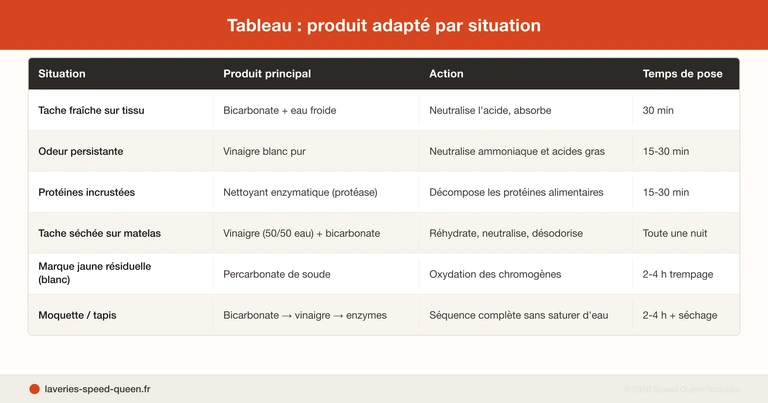
Table: product by situation
| Situation | Main product | Action | Contact time |
|---|---|---|---|
| Fresh stain on fabric | Baking soda + cold water | Neutralises acid, absorbs | 30 min |
| Persistent odour | Pure white vinegar | Neutralises ammonia and fatty acids | 15-30 min |
| Embedded proteins | Enzymatic cleaner (protease) | Breaks down food proteins | 15-30 min |
| Dried stain on mattress | Vinegar (50/50 water) + baking soda | Rehydrates, neutralises, deodorises | Overnight |
| Residual yellow mark (white) | Sodium percarbonate | Oxidation of chromogens | 2-4 h soak |
| Carpet / rug | Baking soda -> vinegar -> enzymes | Full sequence without saturating with water | 2-4 h + drying |
Mistakes to avoid
- Rubbing fresh residue -- you push stomach acid and pigments into the fibres. Remove solids, dab.
- Using hot water first -- food proteins coagulate when heated and set permanently in the fabric.
- Mixing bleach and ammonia -- bleach reacts with the ammonia in vomit to produce chloramines, irritating gases. Prefer white vinegar.
- Saturating carpet with water -- trapped moisture under carpet promotes mould and bad odours. Dab, do not soak.
- Tumble drying without checking -- heat sets residual proteins and pigments. Check that the stain and smell are gone.
- Ignoring personal protection -- gloves are mandatory. Norovirus survives hours on surfaces and is contagious at very low doses.
- Delaying mattress treatment -- stomach acid penetrates deeply within minutes. The longer you wait, the more the mattress absorbs.
Prevention: limiting damage upfront
Prevention is the best treatment. Here are some reflexes that drastically reduce damage in case of vomiting.
- Waterproof mattress protector: essential on children’s beds and in guest rooms. A PU (polyurethane) protector blocks 100 % of liquids without affecting comfort. Wash it at 60 °C regularly.
- Bucket or basin within reach: during gastroenteritis, place a bucket beside the bed. A simple reflex that saves hours of cleaning.
- Towel on car seats: when travelling with young children or in case of motion sickness, a terry towel on the seat protects the car fabric — much easier to wash than a seat cover.
- Sealed bag in the handbag/travel bag: a freezer bag (Ziploc type) allows you to isolate a soiled garment when out, until you can treat it at home.
The machine wash: the final step
After pre-treatment, machine washing is essential for hygiene. Some specific rules for vomit-soiled laundry:
- Wash alone or with lightly soiled laundry — do not mix with your regular laundry to avoid cross-contamination.
- 60 °C minimum if the label allows — this is the temperature at which most bacteria and viruses are destroyed.
- Add sodium percarbonate to the detergent for extra disinfecting effect (1 tbsp in the drum).
- Check before tumble drying — smell the still-damp laundry. If an odour persists, run another cycle with white vinegar (100 mL in the softener compartment).
For large sheets, covers and blankets, the high-capacity machines (11-18 kg) available at the laundromat ensure more effective agitation and rinsing than a domestic machine.
As an Amazon Partner, we receive a small commission on purchases made via affiliate links in this article — at no extra cost to you. This helps us maintain this site and produce free guides.
Our laundromats in Blagnac, Croix-Daurade and Montaudran have professional machines from 9 to 18 kg with detergent included. The 60 °C programme eliminates bacteria and viruses. Ideal for soiled sheets and blankets too bulky for a domestic machine. Payment CB sans contact ou espèces. See our prices.
Sources and references
- Stain removal: solutions for all stains
- Remove a blood stain (same protein + cold water logic)
- Baking soda and laundry: usage guide
- White vinegar and laundry: uses and limits
- Washing temperature guide
- Washing baby clothes
- Cleaning a mattress: complete guide
- Butyric acid and isovaleric acid — volatile fatty acids responsible for vomit odour
- Norovirus: contagiousness and environmental survival — infective dose of 10-100 viral particles