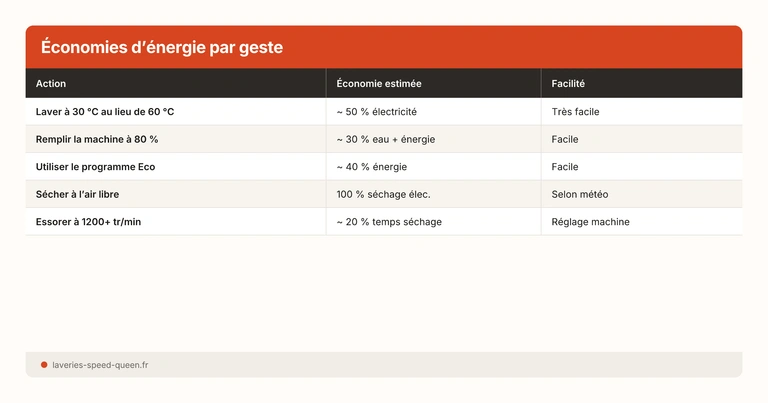
An average household uses 10,000 to 15,000 litres of water and 150 to 250 kWh of electricity per year just for laundry, totalling EUR 80 to 150. By applying 10 simple habits — low temperature, full loads, eco programme, maximum spin, natural drying — you can cut this bill by 30 to 50% without sacrificing cleanliness. The highest-impact step: lowering the temperature from 60 °C to 30 °C, which halves the cycle’s electricity consumption.
At a glance
30 °C instead of 60 °C — halves electricity consumption. Modern detergents work from 20 °C.
Always full loads — a half-full machine wastes 50% of water and energy per kilogram of laundry.
Eco programme — 30-50% less energy, 20-30% less water. Longer, but more economical.
Maximum spin — reduces drying time and therefore dryer consumption.
Natural drying when possible — the dryer uses 2-4 kWh per cycle, as much as 4 wash cycles.
How much does a washing machine really consume?
Before optimising, you need to measure. A washing machine’s consumption depends on three factors: water temperature, water volume, and cycle duration.
Electricity: 75-85% goes to heating water
The main electricity consumer in a washing machine is not the motor — it is the heating element. Heating 50 litres of water from 15 °C (mains temperature) to 60 °C requires about 2.6 kWh of thermal energy. In practice, with element losses, a 60 °C cycle consumes 0.9 to 1.2 kWh.
| Temperature | kWh per cycle | Electricity cost (EUR 0.20/kWh) | Annual cost (220 cycles) |
|---|---|---|---|
| Cold (< 20 °C) | 0.15-0.25 | EUR 0.03-0.05 | EUR 7-11 |
| 30 °C | 0.30-0.40 | EUR 0.06-0.08 | EUR 13-18 |
| 40 °C | 0.50-0.70 | EUR 0.10-0.14 | EUR 22-31 |
| 60 °C | 0.90-1.20 | EUR 0.18-0.24 | EUR 40-53 |
| 90 °C | 1.50-2.00 | EUR 0.30-0.40 | EUR 66-88 |
The takeaway is clear: switching from 60 °C to 30 °C divides electricity consumption by 2.5 to 3. Over a year, that saves EUR 25 to 40 on the electricity component alone.
Water: 40 to 60 litres per cycle
A modern domestic washing machine (7-8 kg, class A) uses 40 to 60 litres of water per full cycle (wash + rinse). Older or larger machines can reach 70-80 litres.
Over a year (220 cycles), that represents 8,800 to 13,200 litres of water, or about EUR 30 to 45 at an average water price.
For detailed consumption data by machine type, see our water and electricity consumption guide.
Tip 1 — Wash at low temperature
This is the highest-impact habit. Water temperature is the factor that most influences energy consumption, and it is also the easiest to change.
Why 30 °C is enough for everyday laundry
Modern detergents are formulated to work at low temperatures. The enzymes (proteases, lipases, amylases) in detergents are active from 20 °C and reach optimal effectiveness between 30 and 40 °C. They break down proteins (sweat, food stains), fats (sebum) and starches without needing heat.
Washing at 30 or 40 °C is sufficient for everyday laundry: t-shirts, trousers, underwear, jumpers. 60 °C is still needed for hygiene textiles (sheets, towels, tea towels) and in case of illness — but these washes represent at most 20-30% of your cycles.
Cold washing also exists
Some machines offer a cold programme (< 20 °C). For very lightly soiled laundry (garment worn for a few hours, nightwear), this is a viable option that uses 75% less energy than a 40 °C cycle. See our guide on cold washing for when to use it.
Tip 2 — Always fill the machine
A washing machine uses virtually the same amount of water and energy whether full or half-full. Load sensors in modern machines adjust the water volume slightly, but the saving is marginal (10-15% less water for a load halved).
The fist rule
To check if your machine is properly filled, use the fist rule: you should be able to fit your clenched fist between the top of the load and the door seal. If your entire arm fits, the machine is too empty. If your fist does not fit, it is too full (laundry will not tumble properly during the wash).
Tip 3 — Use the eco programme
The eco programme is the most energy-efficient wash mode. It combines low temperature with extended cycle time to achieve the same cleaning result as a standard programme.
How it works
Instead of heating water to the displayed temperature and washing quickly, the eco programme heats water to a lower temperature (sometimes 10-15 °C below the display) and compensates with:
- Longer soaking: laundry stays submerged longer, allowing detergent to penetrate fibres without needing heat.
- Extended agitation: the drum rotates longer at low speed, creating mechanical action that compensates for the thermal reduction.
- Optimised rinsing: the eco programme often uses less rinse water while maintaining effectiveness.
The result: 30 to 50% less energy and 20 to 30% less water, for a longer cycle (2h30-4h instead of 1h30-2h).
Tip 4 — Spin at maximum
Spinning uses almost no electricity (0.02-0.05 kWh), but it has a major impact on drying. The more the laundry is spun, the less residual water it contains, and the faster it will dry — whether air-drying or tumble-drying.
Spin speed and residual moisture
| Spin speed | Residual moisture | Air-dry time (summer) | Tumble-dryer time |
|---|---|---|---|
| 800 rpm | 60% | 6-8 hours | 90-120 minutes |
| 1,000 rpm | 52% | 4-6 hours | 70-100 minutes |
| 1,200 rpm | 44% | 3-5 hours | 50-80 minutes |
| 1,400 rpm | 38% | 2-4 hours | 40-60 minutes |
Going from 800 to 1,400 rpm reduces residual moisture from 60% to 38%, saving 30 to 50 minutes of tumble-drying per cycle (about 0.5-1 kWh).
Watch out for delicate textiles: wool, silk and some synthetics cannot tolerate high-speed spinning (risk of deformation, felting). Check the garment label.
Tip 5 — Prefer natural drying
The tumble dryer is one of the most energy-hungry household appliances. A drying cycle uses 2 to 4 kWh — as much as 3 to 6 wash cycles at 30 °C.
Alternatives
Outdoor drying rack
The most economical and ecological option. In summer, laundry dries in 2-4 hours. Sunlight naturally whitens white laundry and kills some bacteria through UV action.
Ventilated indoor drying
In winter or in a flat, a drying rack in a well-ventilated room (extractor fan, window ajar) dries laundry in 6-12 hours. Avoid closed rooms without ventilation — see our guide on indoor drying without humidity.
Heat-pump tumble dryer
If a dryer is essential, choose a heat-pump model (class A+++ possible). It uses 40-50% less energy than a standard condenser dryer. The investment pays for itself in 2-3 years.
Tip 6 — Maintain your machine (descaling)
A poorly maintained machine uses more energy. Limescale that builds up on the heating element acts as a thermal insulator: the element must heat longer to reach the same water temperature, increasing electricity consumption.
A 2 mm layer of limescale on the element increases heating consumption by 15 to 20%. Run an empty cycle at 60 °C with 2 litres of white vinegar↗ every 2-3 months. For a more complete clean, see our guide to descaling your washing machine or our general guide to cleaning your washing machine.
Tip 7 — Dose detergent correctly
Overdosing detergent is a double waste. First, you use more product than necessary (direct cost). Second, excess detergent requires more rinse water to flush out — some machines automatically run an extra rinse when they detect too much foam.
Follow the manufacturer’s recommendations on the packaging and adjust according to:
- Water hardness: soft water = minimum dose. Hard water = maximum dose.
- Level of soiling: lightly soiled = reduced dose. Heavily soiled = normal dose.
- Load size: half load = half dose.
For a detailed guide, see our article on detergent dosage.
Tip 8 — Choose a class-A machine
If your machine is over 10 years old, replacing it with a recent class-A model can generate significant savings.
| Criterion | Machine > 10 years | Class A machine (2024-2026) | Saving |
|---|---|---|---|
| Water per cycle (40 °C, full load) | 60-80 litres | 40-50 litres | 25-35% |
| Energy per cycle (40 °C) | 0.8-1.1 kWh | 0.5-0.7 kWh | 30-40% |
| Annual cost (220 cycles) | EUR 120-170 | EUR 70-100 | EUR 50-70/year |
The annual saving of EUR 50-70 means a class-A machine at EUR 400-500 pays for itself in 6-8 years on water and energy savings alone.
Tip 9 — Wash during off-peak hours
If you have a time-of-use electricity tariff, run your machines during off-peak periods. Off-peak kWh prices are typically 20-25% lower than peak rates.
Off-peak hours vary by provider and location, but generally fall between 10 pm and 6 am (night) and sometimes 12 pm and 2 pm (midday). Check your electricity bill for your exact time slots.
Most modern machines have a delayed start feature. Programme your machine to start at 2 am: it will run entirely during off-peak hours, and the laundry will be ready to hang when you wake up.
- Night-time noise in flats — check your building's regulations. Spinning at 1,400 rpm at 3 am can create neighbour conflicts. Reduce spin speed for night washes.
- Laundry sitting wet too long — if the cycle finishes at 4 am and you do not hang it until 8 am, the laundry has sat for 4 hours in a damp closed drum. Result: musty odours. Open the door as soon as you wake up.
Tip 10 — The shared laundromat: the most efficient option
The laundromat is, by nature, a shared consumption model. Instead of one washer per household (used 4-5 hours a week, idle the remaining 163 hours), laundromat machines run continuously and serve dozens of households.
Professional machine efficiency
Professional laundromat machines have a better energy efficiency per kilogram of laundry than domestic machines.
Optimised consumption
Professional machines are designed for intensive operation. Their thermal insulation is superior, their motors more efficient, and their programming is calibrated to minimise water and energy per kilo of laundry washed.
Better water-to-laundry ratio
An 18 kg laundromat machine uses 55-65 litres of water for 18 kg of laundry, i.e. 3-3.5 litres/kg. A domestic 7 kg machine uses 45-55 litres for 7 kg, i.e. 6.5-8 litres/kg. The ratio is twice as good at the laundromat.
Equipment pooling
Manufacturing a washing machine requires raw materials, energy and produces CO2. A laundromat machine replaces 20-30 domestic machines over its lifetime, reducing the environmental impact of manufacturing.
Summary: the 10 tips and their impact
| Tip | Estimated annual saving | Difficulty |
|---|---|---|
| 1. Lower temperature (60 to 30 °C) | EUR 25-40 | None |
| 2. Always full loads | EUR 20-40 | None (organisation) |
| 3. Eco programme | EUR 10-20 | None (longer) |
| 4. Maximum spin | EUR 5-15 (drying impact) | None |
| 5. Natural drying | EUR 90-180 (if replacing dryer) | Medium (space and time needed) |
| 6. Regular descaling | EUR 5-10 | Low (once every 2-3 months) |
| 7. Correct detergent dosage | EUR 10-20 (detergent + rinse water) | None |
| 8. Class-A machine | EUR 50-70 | Initial investment |
| 9. Off-peak hours | EUR 10-15 | Low (delayed start) |
| 10. Shared laundromat | Variable (machine depreciation avoided) | Low (travel) |
By combining tips 1 to 7 (no investment), a household can save EUR 75 to 145 per year on its laundry bill. With natural drying (tip 5), the total saving can reach EUR 200 to 300 per year.
En tant que Partenaire Amazon, nous percevons une petite commission sur les achats effectués via les liens partenaires de cet article — sans surcoût pour vous. Cela nous aide à maintenir ce site et à produire des guides gratuits.
Save water and energy by using the professional machines at our laundromats. In Blagnac, Croix-Daurade and Montaudran, our Speed Queen machines offer a water-to-laundry ratio twice as good as domestic machines. Detergent included, payment CB sans contact ou espèces. See our prices.