In a nutshell: sodium percarbonate is an oxygen-based agent useful on white laundry, organic stains and certain fabrics that tolerate oxygen bleaching. Its effectiveness depends heavily on temperature, contact time and stain type. Below a certain level of heat, do not expect miracles it cannot deliver.
The exact scope of this article
This page is not a complete “how to re-whiten my laundry” protocol. It is meant to explain when percarbonate makes sense, why temperature changes everything, and how to use it without over-promising or safety mistakes. For a targeted whitening method, see whitening yellowed laundry.
At a glance
It is not baking soda — the composition, pH and use are not the same.
Temperature matters — the most convincing results come with warm to hot water.
Good on whites and certain stains — not magical on everything, especially not cold.
Prepare fresh — avoid storing a ready-made solution in advance.
Gloves + fabric caution — an alkaline and oxidising agent to handle properly.
What exactly is percarbonate?
Sodium percarbonate↗ is neither baking soda, nor bleach, nor a “natural” powder you can throw everywhere without thinking. It is a chemical compound with the formula Na2CO3 1.5 H2O2 that releases active oxygen on contact with water and acts as a bleaching and stain-removal aid on compatible textiles.
Specifically, when percarbonate dissolves in water, it breaks down into two parts:
- Sodium carbonate (Na2CO3): an alkaline salt that raises the water’s pH and helps loosen certain soils.
- Hydrogen peroxide (H2O2): this is what produces the active oxygen responsible for bleaching. The same principle as hydrogen peroxide solution, but released gradually.
The key takeaway
If you are mainly looking to brighten whites or help with organic stains, percarbonate has real logic. If you are looking for a simple deodoriser or a gentle product for all laundry, it is not the right candidate.
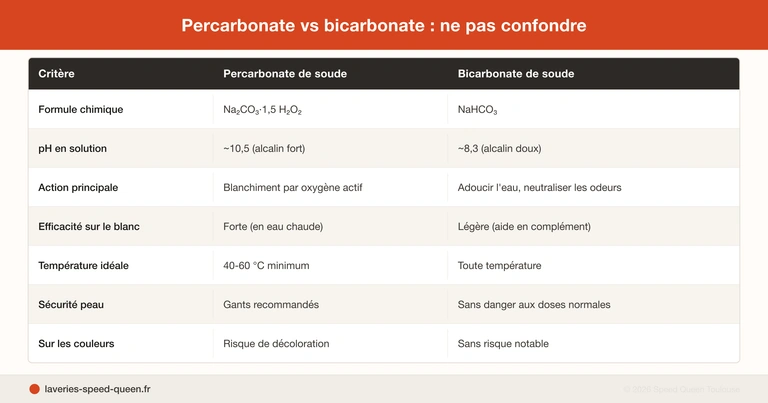
Percarbonate vs baking soda: do not confuse them
This is the most common mix-up. The two names sound similar, but their properties, pH and uses are very different. Mixing them in the same recipe or substituting one for the other is a common mistake in “natural cleaning” blogs.
| Criterion | Sodium percarbonate | Baking soda |
|---|---|---|
| Chemical formula | Na2CO3 1.5 H2O2 | NaHCO3 |
| pH in solution | ~10.5 (strongly alkaline) | ~8.3 (mildly alkaline) |
| Main action | Bleaching by active oxygen | Soften water, neutralise odours |
| Effectiveness on whites | Strong (in hot water) | Slight (as a complement) |
| Ideal temperature | 40-60 °C minimum | Any temperature |
| Skin safety | Gloves recommended | Safe at normal doses |
| On colours | Risk of fading | No notable risk |
| Indicative price | 5-8 EUR/kg | 3-5 EUR/kg |
In short: baking soda is a gentle everyday ally (softening water, deodorising). Percarbonate is a more powerful tool, reserved for oxygen-based whitening and stain removal, with handling precautions.
What changes everything: temperature, time and chemistry
Most competing articles talk about percarbonate as if it worked the same at 30 °C, 40 °C and 60 °C. In practice, that is wrong. Its effectiveness grows when you give it temperature and time.
| Temperature | What you can expect | Honest reading |
|---|---|---|
| 30 °C | Variable and often disappointing results | Not the right ground for promising serious whitening |
| 40 °C | Usable depending on the fabric and duration | Can help, without guaranteeing a major effect on very dull whites |
| 60 °C and above | Most convincing use on compatible whites | This is where active oxygen becomes truly credible for daily use |
Uses that genuinely make sense
Brighten whites
Its most logical territory: white sheets, white towels, household linen compatible with active oxygen.
Support certain stain removals
Especially on organic or oxidisable stains, provided you give it enough time and temperature.
Pre-treatment before machine washing
A soak or preparation just before washing makes sense. A full cycle afterwards remains important for a clean rinse.
Gentler alternative to chlorine
When you want to avoid the bleach approach on a fabric compatible with oxygen bleaching.
Detailed instructions for percarbonate
Percarbonate is a simple product, but its effectiveness depends on respecting three parameters: temperature, contact time and dosage. Here are the three main methods.
Method 1: soaking (the most effective use)
Soaking is the technique that gives the best results for brightening dull whites or treating set-in organic stains.
- Fill a basin or tub with hot water (50-60 °C). Temperature is the determining factor.
- Add 1 to 2 tablespoons of percarbonate per litre of water. Stir well to dissolve the powder completely.
- Submerge the white laundry and soak for 2 to 6 hours depending on the severity of yellowing. For very dull whites, an overnight soak is possible.
- Rinse, then wash in the machine with your usual detergent to remove residue.
Method 2: adding to the machine
For regular maintenance of white laundry, you can add percarbonate directly to the machine.
- Pour 1 to 2 tablespoons of percarbonate into the drum (not into the detergent drawer) with the white laundry.
- Set the machine to 40 °C minimum — 60 °C for a better result.
- Add your normal detergent in the designated compartment.
- Start the cycle. The percarbonate will work during the wash provided the water is hot enough.
Percarbonate does NOT work cold
This is the key point many guides omit. Below 40 °C, the release of active oxygen is too slow and too weak to produce visible whitening. If your machine is set to 30 °C, the percarbonate will do virtually nothing. It is a waste of product.
Method 3: paste for localised pre-treatment
For a specific stain on a white fabric, the paste allows you to concentrate the action.
- Mix 2 tablespoons of percarbonate with just enough hot water to form a thick paste.
- Apply to the stain, leave for 30 minutes to 1 hour.
- Rinse with hot water, then wash in the machine. For stubborn stains, see our tough stains guide.
Dosage summary table
| Use | Dosage | Temperature | Time |
|---|---|---|---|
| Soaking dull whites | 1-2 tbsp / litre | 50-60 °C | 2-6 hours |
| Adding to machine | 1-2 tbsp in the drum | 40-60 °C | Cycle duration |
| Stain removal paste | 2 tbsp + hot water | Hot water | 30 min - 1h |
| Machine maintenance | 2-3 tbsp in the drum | 60 °C (empty cycle) | Full cycle |
Minimum temperature: the critical factor
This point deserves its own section because it is the most widespread mistake on this topic. Percarbonate is a temperature-sensitive product: its effectiveness is directly linked to water temperature.
The chemical reaction that releases active oxygen (decomposition of hydrogen peroxide) is an endothermic reaction — it needs heat to proceed at a useful rate. At 30 °C, the release is so slow that whitening is virtually imperceptible over a standard machine cycle (45-60 minutes).
In practice:
- Below 30 °C: no visible effect. The percarbonate is wasted.
- At 40 °C: activation begins. The effect is detectable but modest on a short soak.
- At 50-60 °C: full activation. This is the ideal ground for whitening cotton and white linen.
- Above 60 °C: active oxygen is released very quickly, which can be useful on resistant whites, but should not be used on fragile fibres.
That is why percarbonate is a good ally for washing at 60 °C, but not for cold or 30 °C cycles.
Uses where percarbonate often disappoints
The problem with percarbonate is not that it is useless. It is that people attribute performance to it that it does not have under all conditions.
- Whitening cold — a claim often exaggerated in mainstream content.
- Preparing a spray for later — the solution loses its effectiveness over time.
- Believing it is universal on colours — some dyes do not tolerate oxidants well.
- Treating it as a primary degreaser — on grease stains, it is not always the best tool.
What percarbonate does not do well
- It is not credible as a cold miracle on very dull or yellowed laundry.
- It is not universal on colours — sensitive dyes require caution.
- It is not a product to prepare in advance once dissolved.
- It does not replace by itself all detergent or targeted stain-removal logic.
Percarbonate, baking soda, bleach: not the same family of use
| Product | Main role | Good use | Main limitation |
|---|---|---|---|
| Percarbonate | Oxygen bleaching | Compatible whites, organic stains, hot water | Less convincing cold, caution on sensitive colours |
| Baking soda | Deodorising / support | Odours, light support, gentle uses | Not a serious whitener on its own |
| Bleach | Chlorine bleaching | Explicitly compatible fabrics | More aggressive, dangerous mixing mistakes |
Safety: what to do properly
Percarbonate does not require a lab protocol, but it deserves better than a hastily opened bag tipped over the drum.
Wear gloves — simple practice, but safer for the skin.
Avoid splashes — especially when preparing a solution or soak.
Store dry — moisture degrades its stability.
Prepare just before use — a stored solution quickly loses its effectiveness.
Do not improvise mixtures — keep acidic or chlorinated products for separate protocols.
Storage and detailed precautions
Sodium percarbonate requires proper storage or it will lose its effectiveness before you even use it.
Storage
- Airtight container essential: as soon as the bag is opened, transfer to a glass jar or plastic box with a sealed lid. Air moisture is enough to trigger gradual decomposition of the product.
- Dry and cool: never store percarbonate in the bathroom (too humid) or near a heat source. A kitchen cupboard or utility room works well.
- Shelf life: properly stored, percarbonate retains its properties for 1 to 2 years. A product that no longer fizzes when dissolved has lost most of its active oxygen.
Handling precautions
- Wear gloves: the high pH (~10.5) can irritate skin with prolonged or repeated contact.
- Avoid eye splashes: in case of eye contact, rinse thoroughly with clean water for 15 minutes.
- Do not mix with: bleach (dangerous reaction between oxidants), white vinegar↗ (neutralises the alkaline effect), nor acids in general.
- Keep out of reach of children: the white powder looks like sugar or salt. Clearly label the container.
- Not on fragile colours: active oxygen can fade unstable dyes. Always test on a hidden area for coloured textiles. For coloured laundry, prefer baking soda (gentler, no oxidant).
When to prefer a different guide
Percarbonate is not the right entry point for every intent.
- if your real need is
re-whiten yellowed laundry-> read whitening yellowed laundry; - if your real need is
a specific stain-> read tough stains: solutions; - if your real need is
homemade detergent recipe-> read homemade detergent: recipes, limits and real risks.
Here, the goal is more precise: to understand when percarbonate makes sense, at what temperature it becomes credible, and what limits to set before using it on laundry.
Methodology and sources
This article deliberately avoids simply redoing a whitening guide. It relies on uses that hold up in light of the product’s chemistry, bleaching results actually observed on white laundry, and the most common mistakes seen in French SERPs: overly optimistic cold-use claims, confusion with baking soda, and barely mentioned safety.
- AISE, technical resources on oxygen bleaching agents and detergency, accessed 15 March 2026
- UFC-Que Choisir, Powder, liquid or capsule detergent?, accessed 15 March 2026
- Internal references: whitening yellowed laundry, tough stains: solutions, homemade detergent: recipes, limits and real risks
- Baking soda and laundry: real uses
- White vinegar and laundry: uses and limits
- Washing at 60 °C: which clothes?
- Washing at 30 or 40 degrees: how to choose
- Washing temperatures: the complete guide
As an Amazon Partner, we earn a small commission on purchases made through the affiliate links in this article — at no extra cost to you. This helps us maintain this site and produce free guides.
If you are looking for a ready-to-use protocol for yellowed whites, head to whitening yellowed laundry. If you are still deciding between powder, liquid or capsule detergent, read which detergent to choose. And if you already use a homemade recipe, also see
our honest guide to homemade detergent
to avoid confusing baking soda, washing soda↗ and percarbonate. For large volumes of white laundry to treat, find our laundromats with suitable machines.