In a nutshell: Sportswear made from synthetic fibres traps bacteria in its porous structure, forming a biofilm that is difficult to dislodge without a thorough rinse. Wash items inside out, at cold or 30 °C. Fabric softener is not recommended on technical fibres (it clogs pores). Commercial machines (50-60 L of water per cycle) deliver an especially effective rinse for this type of textile.
At a glance
30 °C, synthetics programme — heat damages technical fibres without cleaning any better.
No fabric softener — softener deposits a greasy film on microfibres, trapping bacteria and blocking breathability.
Intensive rinse — commercial machines use more water, which removes residues (detergent, softener) that trap bacteria in the fibres.
Immediate drying — delicate tumble-dry programme to prevent bacteria from recolonising.
Commercial machine — intensive tumbling and deep rinse dislodge embedded bacteria.
Why sport smells worse than everyday life
The odour problem on gym clothes is not just about sweat — it is the combination of three factors that creates an ideal breeding ground for bacteria.
1. Sweat volume
During moderate exercise (jogging, cycling), the body produces 0.5 to 1 litre of sweat per hour. During intense exercise (HIIT, spinning, fast running), this can reach 1.5 to 2 litres per hour. Compare that with a normal office day (0.3 to 0.5 litres over the entire day): the volume of liquid the garment has to handle is 5 to 10 times higher.
2. Synthetic fibres = bacteria traps
Sweat itself is virtually odourless. It is skin bacteria (mainly Staphylococcus hominis and Corynebacterium) that convert sweat compounds into volatile, smelly fatty acids. Polyester, with its microscopically porous surface, traps these bacteria in micro-cavities where they form a biofilm — a protective layer that resists standard washing.
3. Prolonged dampness
After a session, the garment stays damp for hours (in the gym bag, in the laundry basket). This warm moisture is a paradise for bacteria: they double in number roughly every 20 minutes. A sports t-shirt left for 4 hours in a sealed bag contains thousands of times more bacteria than when you took it off.
The golden rule: don't let it ferment
If you cannot wash your sportswear immediately, take it out of the bag and hang it in the open air. Even unwashed, it will dry and bacterial growth will slow down considerably. That is the difference between a garment that a normal wash can rescue and one whose odour is permanently embedded.
White vinegar pre-soak: the full protocol
White vinegar is the most effective ally against odours embedded in synthetic fibres. Its acetic acid dissolves bacterial biofilm and accumulated softener residues.
The 3-step protocol
Prepare the bath: fill a basin or sink with 5 litres of cold water. Add 1 glass (200 ml) of white vinegar↗ at 8 %. Cold water is important — hot water would set the odours.
Soak for 30 minutes: submerge the sportswear, making sure items are unfolded and fully covered. Leave for 30 minutes — no more than 2 hours (beyond that, the acid could affect delicate colours).
Rinse and wash: wring out lightly, then run a normal machine cycle (30 °C, synthetics). The vinegar will have loosened the biofilm, and the machine wash will finish the job.
Frequency: this pre-soak is not needed every wash. Reserve it for garments whose odour persists despite a normal wash, or do it once a month as preventive maintenance if you sweat heavily.
Why synthetics smell bad (and cotton doesn’t)
Technical fibres retain more odours because they accumulate bacteria and residues in their micro-cavities, especially after insufficiently rinsed washes.
Cotton absorbs water and bacteria at the surface: a normal wash removes them. Synthetic fibres work differently.
Porous structure
Polyester has an uneven surface with micro-cavities where bacteria embed. These synthetic fibres also release [microplastics with every wash](/blog/microplastiques-lavage-synthetiques/). They form a biofilm — a protective layer — that resists low-water-volume washes. The odour returns as soon as sweat reactivates these bacteria.
Softener makes everything worse
Fabric softener deposits a greasy film (cationic agents) on the fibres. This film prevents water from properly penetrating the fibre during washing, and creates a layer where bacteria thrive. It is the number one cause of persistent odours on sportswear.
The vicious cycle of under-rinsing
Too little water → insufficient rinse → bacteria not removed → odour returns → more detergent is added → residues in the fibres → bacteria cling even better. The solution is not more detergent, but more agitation and rinsing.
The laundromat protocol that works
The most reliable protocol is 30 °C synthetics, thorough rinse, then immediate transfer to the dryer on delicate.
Prepare the laundry
Turn each garment inside out (bacteria are on the inside, against the skin). Close zips and Velcro. Separate sportswear from the rest: rough fabrics (jeans, towels) abrade technical fibres.
Wash at 30 °C, synthetics programme
No need for heat: it is the mechanical action (tumbling + rinsing) that dislodges bacteria. Commercial machines rinse more deeply than modern domestic machines.
Dry immediately, delicate programme
Transfer to the dryer as soon as the cycle ends. Rapid drying deprives surviving bacteria of the moisture they need. Delicate or low-temperature programme: elastane cannot handle high heat.
Tip: run 2 machines
If you accumulate a week’s sportswear, run one machine for sport (30 °C synthetics) and one for everyday laundry (40 °C cotton). Everything is done in 1 hour instead of 2 cycles at home.
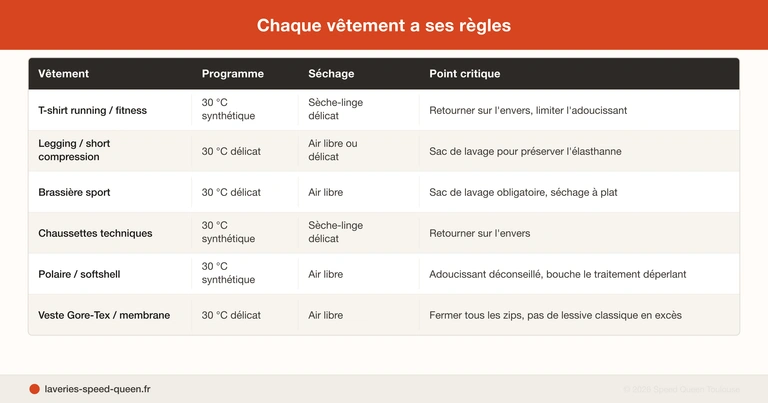
Each garment has its rules
The core rule is to match the cycle to the material: 30 °C for most technical fabrics, with extra protection for compression garments and sports bras.
| Garment | Programme | Drying | Key precaution |
|---|---|---|---|
| Running / fitness t-shirt | 30 °C synthetics | Tumble-dry delicate | Turn inside out, limit softener |
| Leggings / compression shorts | 30 °C delicate | Air dry or delicate | Mesh bag to protect elastane |
| Sports bra | 30 °C delicate | Air dry | Mesh bag essential, dry flat |
| Technical socks | 30 °C synthetics | Tumble-dry delicate | Turn inside out |
| Fleece / softshell | 30 °C synthetics | Air dry | No softener — clogs the water-repellent finish |
| Gore-Tex / membrane jacket | 30 °C delicate | Air dry | Close all zips, avoid excess regular detergent |
By fibre type: the tailored protocol
Every technical fibre has its own quirks. Tailoring the wash to the material extends garment life and improves odour removal.
Polyester (the majority of sportswear)
Polyester makes up 70-90 % of the composition of most sports t-shirts, shorts and leggings. It is the most problematic fibre for odours.
- Washing: 30 °C, synthetics programme. Turn inside out.
- Detergent: normal dose, no softener. Sodium percarbonate (1 tablespoon in the dispenser) can help with stubborn odours.
- Drying: tumble-dry delicate or air dry. Polyester dries quickly on its own.
- Key point: never leave wet polyester in a sealed bag — that is the ideal scenario for biofilm growth.
Elastane (lycra, spandex) — leggings, sports bras, compression wear
Elastane is a fragile elastic fibre, often blended with polyester (typical composition: 80 % polyester / 20 % elastane). It provides the compression and fit.
- Washing: 30 °C maximum, delicate programme. Essential: mesh bag to prevent abrasion and snagging.
- Detergent: reduced dose, no softener (softener destroys elastane’s elasticity).
- Drying: air drying strongly recommended. The tumble dryer, even on delicate, shortens elastane’s lifespan. If you use the dryer, low temperature only and remove as soon as dry.
- Lifespan: elastane loses its elasticity after 50-80 washes. To assess wear, stretch the fabric: if it does not fully bounce back, it is time to replace it.
Gore-Tex and waterproof membranes
Gore-Tex, Dri-FIT Shield and other waterproof/breathable membrane jackets have a durable water repellent (DWR) surface treatment that repels water. This treatment is fragile and requires a specific protocol.
- Washing: 30 °C, delicate programme. Close ALL zips, flaps and Velcro. Use a mild liquid detergent, ideally a specialist membrane wash (Nikwax Tech Wash, Grangers).
- Prohibited: no softener (destroys DWR), no bleach, no powder detergent.
- Drying: air dry. After drying, a 20-minute low-temperature tumble-dry reactivates the DWR treatment (heat redeploys the DWR molecules).
- Re-treatment: if water no longer beads on the surface after washing and drying, apply a DWR product (Nikwax TX.Direct spray or wash-in). This is needed roughly every 5-10 washes.
Compression garments (sleeves, socks, shorts)
Compression garments apply graduated pressure to the muscles. Their effectiveness depends directly on the fabric’s elasticity.
- Washing: 30 °C, delicate programme, mesh bag essential. Wash with lightweight garments — never with jeans or towels whose fibres abrade the fabric.
- Drying: air dry only. The tumble dryer is the enemy of compression — heat relaxes elastic fibres.
- Frequency: after every use. Sweat and salt deteriorate elastane between washes.
- Storage: flat, never hung (the weight of wet fabric stretches the fibres).
Frequency: after EVERY session (no debate)
The washing frequency question comes up often, and the answer is simple: every garment in direct contact with the skin during a sports session must be washed after each use. There are no shortcuts.
Wearing a sports t-shirt again that “doesn’t smell too bad” is the surest way to permanently embed an odorous biofilm in the fibres. The bacteria from the first session are still there, and the second layer of sweat gives them an ideal growth medium. After 2-3 sessions without washing, the odour is often embedded and requires a vinegar pre-soak to remove.
Exceptions: jackets and windbreakers worn over other layers (no direct skin contact) can wait 3-5 sessions. Sports caps can handle 2-3 outings in winter but should be washed after each summer outing.
Rescuing an already-impregnated garment
When the odour persists, a 30-minute vinegar pre-treatment followed by a commercial wash at 30 °C is often enough to break the established biofilm.
If the odour has been embedded for several washes, a single cycle will not suffice. Here is the recovery protocol:
Step 1: white vinegar soak
Soak the garment for 30 minutes in a mixture of cold water and white vinegar (1 glass per 5 litres). The vinegar dissolves bacterial biofilm and accumulated softener residues. Then rinse with clean water.
Step 2: commercial machine wash
Wash in a 9 kg machine, synthetics programme at 30 °C. The higher water volume of the commercial machine (50-60 L) finishes removing residues and biofilm. If the odour persists, run another cycle.
Step 3: immediate full drying
Tumble-dry on delicate, remove as soon as dry. A garment freed of its biofilm and dried quickly should no longer smell.
What destroys your technical garments
- Fabric softener — clogs microfibres, traps bacteria, eliminates breathability
- Hot water (> 40 °C) — deforms elastane, destroys the DWR treatment on membranes
- High-heat tumble drying — permanently destroys elastic fibres
- Delayed drying — leaving laundry damp in the machine for 1 h after the cycle = bacteria recolonise
- Mixing with rough cotton — jeans, bath towels abrade technical fibres during tumbling
The advantage of water volume and immediate drying
The difference comes down to two points: a deeper rinse (more water, better agitation) and protocol continuity (immediate drying, with no damp intermediate phase).
Higher water volume
Commercial machines use significantly more water per cycle than a domestic machine. More water = better rinse = bacteria removed in depth.
Powerful mechanical agitation
The drum of commercial machines tumbles more effectively. Mechanical action is what dislodges bacterial biofilm from synthetic fibres — not temperature or the amount of detergent.
Immediate on-site drying
No need to carry damp laundry home: the dryer is 2 metres away. Immediate transfer is the key to preventing bacterial recontamination.
En tant que Partenaire Amazon, nous percevons une petite commission sur les achats effectués via les liens partenaires de cet article — sans surcoût pour vous. Cela nous aide à maintenir ce site et à produire des guides gratuits.
Sportswear that still smells despite washing? The thorough rinse (50-60 L) and immediate drying of our commercial machines eliminate bacteria embedded in synthetic fibres. Laundromats in Blagnac and Croix-Daurade, open 7j/7 de 7h à 22h, detergent included in the price. 9 kg machine from 4.90 €. You can also take the opportunity to wash your sports shoes. Check our prices.
Washing frequency by type of sportswear
The optimal frequency depends on the intensity of the activity and the garment material:
| Garment | Washing frequency | Why |
|---|---|---|
| Synthetic t-shirt | After every session | Direct skin contact, maximum sweat |
| Shorts / leggings | After every session | Concentrated moisture zone |
| Windbreaker jacket | Every 3-5 sessions | Little skin contact, mainly dust |
| Sports socks | After every session | Maximum sweat and friction zone |
| Sports bra | After every session | Skin contact, elastane under tension |
| Sports towel | After every use | Moisture = rapid bacterial growth |
For sports shoes, a machine wash every 3-4 weeks is enough if you air them after each outing. See our shoe washing guide for the full protocol.
The fabric softener trap
Fabric softener is the number one enemy of sportswear. It deposits a greasy film on synthetic fibres that:
- Clogs micropores — breathability (moisture wicking) decreases after a few washes with softener
- Traps bacteria — the greasy film creates a favourable environment for bacterial growth, which worsens odours
- Reduces elasticity — elastane (spandex) loses its recovery ability after prolonged contact with softener
For technical fibres, wash without fabric softener or use white vinegar as a rinse aid as a gentle alternative.
| Odour type | Likely cause | Priority treatment |
|---|---|---|
| Musty / cellar | Mould (damp towels) | 60 °C wash + full drying |
| Stuffy / stale | Long storage / moisture | Full re-wash + ventilation |
| Forgotten laundry | Moraxella proliferation | Immediate re-wash + commercial drying |
The bacterial mechanism: Moraxella osloensis
Science explains why “forgotten” laundry smells bad. The bacterium Moraxella osloensis multiplies in damp fibres and produces 4-methyl-3-hexenoic acid, responsible for the characteristic “wet rag” odour. The longer laundry stays damp (beyond 4 hours in the drum), the more this bacterium proliferates.
Smoke and cooking odours
Tobacco and cooking grease cling particularly well to natural fibres like cotton.
- Double rinse: odour-causing particles are often greasy; an extra rinse helps flush them out completely.
- Immediate drying: the heat of the tumble dryer helps volatilise the last odour residues.
Long-stored garments (musty odour)
Clothes stored in poorly ventilated wardrobes or boxes can develop an earthy smell.
- Full re-wash: a quick cycle is not enough to dislodge embedded dust and moisture particles.
- Ventilation: never put away laundry that is still slightly damp — this guarantees a musty odour within a few weeks.
Beyond sport: all laundry odours
While sport is a major cause of odours, other sources can make your laundry unpleasant in daily life. Here is how to treat the most common cases to get fresh-smelling laundry again.
Persistent odours on everyday laundry
The advice on this page also applies to towels, sweatshirts and sheets that smell bad after washing. The main cause remains the same: bacteria favoured by stagnant moisture and temperatures that are too low.
Towels that smell musty
The thickness of terry cloth retains moisture for a long time, encouraging mould growth (such as Aspergillus). If your towels smell like a “cellar”:
- 60 °C wash: this is the threshold needed to destroy mould spores.
- Thorough drying: use a commercial dryer to ensure no moisture remains in the loops of the fabric.
- White vinegar: a glass of vinegar in the softener compartment helps dissolve limescale and soap residues that trap odours.
When to replace sportswear
Even with optimal care, technical fibres have a limited lifespan. A running t-shirt loses its moisture-wicking ability after 50 to 80 washes (roughly 1 to 2 years of regular use). Leggings whose elastane is slack (the fabric no longer returns to its shape when you stretch it) should be replaced: they no longer provide proper support and compression is no longer effective. Technical socks that have lost their ankle elasticity or whose reinforced zones have thinned have also reached the end of their life.
Sources and references
- Washing temperature guide
- Drying guide (technical fibres)
- White vinegar and laundry: uses and limits
- [Sodium percarbonate for laundry](/blog/percarbonate↗-de-soude-linge/)
- Washing a sports cap
- Is fabric softener really useful?
- Microplastics and synthetic washing
- Textile care symbols (GINETEX / ISO 3758) (lien externe)
- Washing a swimsuit without damage
- Washing a gym bag
- Callewaert C. et al., Microbial Odor Profile of Polyester and Cotton Clothes after a Fitness Session, Applied and Environmental Microbiology, 2014