In short: the tumble dryer forbidden symbol is a square containing a circle crossed out. It means no tumble drying is allowed. The most commonly affected textiles are wool, silk, delicate knits, items with elastane, and garments that deform with heat. The right alternative is air drying — flat or hanging, as shown on the label.
At a Glance
Square + circle crossed out — tumble drying forbidden, no exceptions.
1 dot ≠ forbidden — a single dot allows tumble drying at low temperature.
Read the entire square — the label often specifies whether the garment should dry flat or hanging.
Direct heat is risky — radiator, drum, or direct sunlight can deform delicate fibres.
What Exactly Does the Tumble Dryer Forbidden Symbol Mean?
The symbol to recognise is simple: a square with a circle inside, crossed out by an X. Visually, picture a circle inscribed in a square, with a cross striking through the whole thing. The square represents the “drying” category in the GINETEX standard (ISO 3758). The circle inside specifically designates the mechanical drum (tumble dryer). The cross means the operation is prohibited. This pictogram forbids tumble drying regardless of the machine’s heat setting.
The symbol not to confuse
 The crossed-out circle completely prohibits the drum. By contrast, a circle with a dot allows tumble drying at low temperature. This is the most common misreading on care labels.
The logic works as follows:
- square = drying instruction family;
- circle inside the square = mechanical drum;
- cross = operation prohibited.
The 5 Drying Symbols Explained
The crossed-out square is just one symbol in the “drying” family. To fully understand what the label is telling you, here are the five square pictograms and their precise meanings according to the GINETEX / ISO 3758 standard.
1. Square with circle and two dots: tumble dry normal temperature
This is the full green light. The garment can withstand tumble drying at normal temperature (up to 80 °C exhaust air). This applies to sturdy cotton textiles: sheets, towels, tea towels, and some thick t-shirts. If you see this symbol, a standard tumble dryer is perfectly fine.
2. Square with circle and one dot: tumble dry low temperature
Tumble drying is allowed, but only at low temperature (maximum 60 °C exhaust air). This is the most common symbol on everyday clothing: fine knits, cotton-synthetic blends, and some jeans. It is the one you must not confuse with the crossed-out symbol. One dot = allowed gently. A cross = forbidden.
3. Square with crossed-out circle: tumble dryer forbidden
This is the main topic of this article. Tumble drying is completely forbidden regardless of temperature. No “delicate” or “cool air” programme makes the tumble dryer acceptable when this symbol is present.
4. Square with horizontal line: flat drying
This symbol requires laying the garment on a flat surface to dry. It is the standard instruction for wool, cashmere, heavy knits, and all textiles that deform under their own wet weight. A wool jumper hung on a hanger stretches irreversibly — flat drying prevents this.
5. Square with vertical line: line drying
The garment can be hung to dry on a hanger or a line. This is the most common symbol after the drum symbols. It suits shirts, dresses, trousers, and structured items that hold their shape better when hung.
Combined symbols
Drying symbols can be combined with other indicators: diagonal lines in the corner mean “in the shade” (no direct sunlight). So you may see a square with a horizontal line AND diagonals = flat drying, in the shade. For the full breakdown, see our complete care label guide.
Why Some Garments Forbid Tumble Drying
Heat shrinks certain fibres
Wool, cashmere, and other knits can felt, shrink, or lose their shape.
The drum adds mechanical stress
Even at low temperature, tumbling can pull, twist, or break the structure of a delicate fabric.
Some finishes cannot withstand the drum
Glues, thermal bonding, prints, elastic, and foam can degrade faster in a tumble dryer.
Colour can age faster
Repeated heat fades certain dark dyes or dulls sensitive prints.
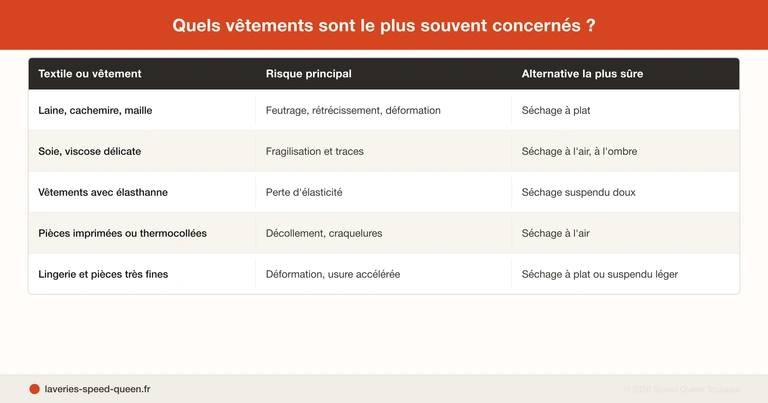
Which Garments Are Most Often Affected?
| Textile or garment | Main risk | Safest alternative |
|---|---|---|
| Wool, cashmere, knits | Felting, shrinkage, deformation | Flat drying |
| Silk, delicate viscose | Weakening and marks | Air drying, in the shade |
| Garments with elastane | Loss of elasticity | Gentle line drying |
| Printed or thermally bonded items | Peeling, cracking | Air drying |
| Lingerie and very fine items | Deformation, accelerated wear | Flat or gentle line drying |
Textiles Most Often Forbidden From Tumble Drying
Certain textiles almost always bear the crossed-out symbol. Knowing this list saves you checking the label every time — though checking is always recommended.
Wool and cashmere
Wool is the fibre most sensitive to tumble drying. The combination of heat and mechanical agitation causes felting: the fibre scales lock together irreversibly, and the garment shrinks and becomes stiff. Cashmere reacts the same way. Recommended drying: flat, on a clean towel, away from any direct heat source. For more details, see our delicate textiles guide.
Silk
Silk is a protein fibre that loses its sheen and suppleness when exposed to heat and mechanical friction. A silk scarf put through the tumble dryer can come out dull, creased, and weakened. Recommended drying: hung in the shade, or rolled in a towel and then dried flat.
Garments with elastane (Lycra, Spandex)
Elastane is found in a large number of modern garments: leggings, underwear, swimwear, sportswear, stretch jeans. Heat degrades the fibre’s elasticity, causing the garment to lose its hold and support. After a few tumble dryer cycles, leggings sag and swimwear loses its shape. Recommended drying: hung in the air, in the shade. See our anti-shrinkage guide to protect these fibres.
Leather and faux leather
Leather can tolerate neither excess water nor the heat of a tumble dryer. A leather or faux leather garment that goes through the drum cracks, stiffens, and loses its patina. Faux leather (polyurethane) may even peel or delaminate. Recommended drying: in the open air, away from sunlight and radiators, on a padded hanger.
Printed and thermally bonded items
Screen prints, heat transfers, and glued appliques react poorly to the repeated heat of a tumble dryer. The design can crack, peel, or transfer onto other garments. Recommended drying: in the air, turned inside out.
Fine lingerie and lace
Lace, fine embroidery, and the metal underwires in bras do not tolerate the tumbling action of the drum. The mesh deforms, threads break, and underwires can pierce the fabric or catch on other garments. Recommended drying: flat or hung carefully, with no pegs on fragile areas.
How to Dry Without a Tumble Dryer Without Damaging the Garment
The safest approach is to follow not only the drum prohibition but also the form of the square that remains on the label. A horizontal line means flat drying; a vertical line means line drying; a shaded corner or diagonal lines usually indicate drying in the shade.
| Symbol | What to do | Typical case |
|---|---|---|
| Lay the garment on a flat surface or a net | Wool, cashmere, heavy knits |
| Dry on a line or hanger | Shirts, dresses, structured items |
| Let it drip then dry without vigorous handling | Very wet delicate items |
| Avoid direct sunlight and UV | Silk, black garments, sportswear, elastane |
| Do not twist the garment to extract water | Knits, viscose, silk |
 Flat
Flat Hanging
 Drip dry
 In the shade
 Do not wring
10-Second Decision: What to Do After the Crossed-Out Symbol?
| If you see… | Then do… | Mistake to avoid |
|---|---|---|
| Crossed-out circle only | No drum, natural drying | ”Just 10 minutes” in the tumble dryer |
| Crossed-out circle + horizontal line | Flat drying | Hanging a heavy wet jumper |
| Crossed-out circle + vertical line | Line drying | Piling it on a radiator in a heap |
| Crossed-out circle + shade | Dry in the shade | Direct sunlight on silk, black, or sportswear |
| Delicate textile + do not wring | Towel + gentle pressing | Wringing the garment to speed things up |
Spin without force — if the wash symbol does not prohibit spinning, use a moderate setting to avoid stretching the fibre.
Lay knits flat — jumpers, wool, cashmere, and heavy knits deform if they hang.
Hang structured items — shirts, dresses, and light jackets dry better on a hanger or line.
Ventilate the room well — especially if you are drying indoors.
What to Do When the Tumble Dryer Symbol Is Forbidden?
When the label bears the square with a crossed-out circle, tumble drying is out. But several alternatives allow efficient drying without damaging the textile.
Flat drying is the safest method for knits, wool, and cashmere. Lay the garment on a clean terry towel, a flat drying rack, or a drying net. The garment keeps its shape without the tension caused by gravity. Turn it over halfway through for even evaporation.
A standard drying rack suits structured items like shirts, dresses, and light trousers. Use padded hangers for fragile shoulders. Avoid pegs on visible areas — they leave marks on damp fabrics.
Drying in the sun is free and effective, but watch out for colours. UV rays gradually bleach dark dyes and silk. If the label shows the “shade” symbol (square with diagonal lines), dry indoors or outdoors under a canopy.
Indoors, ventilation is key. Open a window or place a fan nearby. Drying in a closed, humid room slows evaporation and can cause a musty smell on the laundry.
Pro Tip: The Towel Technique
When tumble drying is forbidden, the right shortcut is not to cheat with the drum — it is to remove excess water before the drying rack.
The safest method to speed up drying
Spread a large clean towel, place the garment on it, roll the whole thing up without wringing the fibre, then press gently with your hands. The towel absorbs some of the residual moisture without subjecting the fabric to the heat or torsion that damages knits and delicate textiles.
This method is especially useful for:
- wool jumpers;
- leggings and garments with elastane;
- items that then need to dry flat;
- garments washed in winter and dried indoors.
The Most Common Mistakes
- Confusing crossed-out circle with 1 dot — a dot allows tumble drying, the cross forbids it.
- Placing on a very hot radiator — that is not 'no tumble dryer', it is often another form of overheating.
- Hanging a wet jumper — the weight of the water stretches the knit.
- Ignoring the other square symbols — the drum prohibition does not yet tell you whether to dry flat or on a line.
Methodology and Sources
The symbol interpretation is based on the international textile care coding and on detailed guidance from appliance manufacturers. This article deliberately distinguishes between drum prohibition and natural drying method, as the two are often mixed up in competing content.
- GINETEX, Publication of the ISO 3758:2023 standard, published 6 December 2023, accessed 15 March 2026
- Haier France, Tumble dryer symbols: a practical guide to understanding them, published 8 January 2026, accessed 15 March 2026
- Internal reference: complete care label symbols guide, updated 8 March 2026
As an Amazon Partner, we earn a small commission on purchases made through the affiliate links in this article — at no extra cost to you. This helps us maintain this website and produce free guides.
If you want to read all care pictograms correctly, start with our complete laundry symbols guide . For a clean alternative to the drum, also see our drying guide, our article on drying clothes indoors and, for the most delicate fibres, the delicate textiles guide. If you need space to dry your delicate textiles, visit our laundromats with suitable drying areas.