In short: Wash a double duvet in an 18 kg machine so it can tumble freely inside the drum. Synthetic duvet: 40 °C, normal cycle. Down/feather duvet: 30 °C, delicate cycle, spin 600 rpm max. Drying: 40 to 90 minutes depending on filling, in 15-to-20-minute sessions. Total cost at a laundromat: around €16 to €19.
At a Glance
Right machine — large capacity so the duvet tumbles freely.
Right cycle — 40 °C for synthetic, 30 °C delicate for down. Check the care label to confirm.
Thorough drying — check internal moisture regularly.
Choosing the Right Machine
For a double duvet (200x200 cm to 240x260 cm), use an 18 kg machine at minimum so the filling can move freely during the 35-minute cycle.
Choosing the right machine is crucial. A duvet crammed into a drum that’s too small won’t be washed properly, and the filling may clump together. See our guide to choosing your machine for more details.
Most domestic machines have a capacity of 7 to 8 kg — enough for a thin single duvet, but too tight for a double duvet (200×200 cm or larger) that weighs 2 to 3 kg dry and takes up a lot of volume once wet. Use a gentle liquid detergent↗ rather than powder: it rinses out more easily from thick filling. For a duvet to be washed properly, it must be able to tumble freely in the drum — you need at least 12 to 18 kg of capacity depending on size and thickness. Our laundromats in Toulouse and Blagnac are equipped with 18 kg Speed Queen machines, perfect for double duvets. The wash cycle takes about 35 minutes in an 18 kg machine.
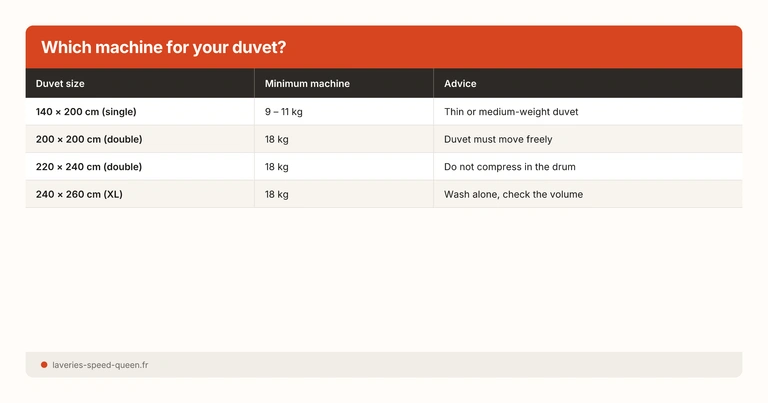
| Duvet Size | Recommended Capacity | Advice |
|---|---|---|
| 140x200 cm (single) | 9 to 11 kg | Thin or medium-thickness duvet. |
| 200x200 cm (double) | 18 kg | Effective wash if the duvet tumbles freely. |
| 220x240 cm (double) | 18 kg | Standard size — do not compress. |
| 240x260 cm (XL) | 18 kg | Wash alone; check it isn’t packed in. |
Single Duvet
9 kg or 11 kg machine. Sufficient for a thin or medium-thickness 140x200 cm duvet.
Double Duvet
18 kg machine required. The only option for a 200x200 or 220x240 cm duvet.
King-Size Duvet
18 kg machine as well. Plan on multiple drying sessions until completely dry.
Simple Rule
The duvet must be able to tumble freely in the drum. If it looks compressed when you close the door, the machine is too small.
The Real Issue: Volume, Not Weight
A double duvet often weighs only 2 to 3 kg, but it takes up 50 to 75 litres — it’s this volume that demands a large drum. With 180 litres, an 18 kg machine avoids compression and washes more effectively than a 52-to-58-litre domestic drum.
A double duvet weighs 2 to 3 kg — well under the capacity of a 7-8 kg machine. But it takes up 50 to 75 litres once inside the drum, depending on filling and thickness. It’s the volume that determines the machine size you need, not the weight.
| Machine | Drum Volume | Double Duvet? |
|---|---|---|
| Domestic 7-8 kg | ~52-58 litres | Too tight — duvet compressed, wash ineffective |
| Speed Queen SC40 (18 kg) | 180 litres | Duvet free, water and detergent circulate |
The Speed Queen SC40 drum is 180 litres — more than 3 times the volume of a domestic machine. This difference is what guarantees an effective wash: the duvet tumbles freely, and water and detergent reach every fibre of the filling. For more on laundry weight, see our per-item weight chart or use our laundry weight calculator to estimate your exact load.
Can You Wash a Duvet in an 8 kg Machine?
In theory, an 8 kg machine can handle a thin single duvet (140×200 cm, thin synthetic filling). In practice, for a double duvet (200×200 cm or larger), the answer is no — the drum is too small for the duvet to tumble freely.
A domestic 8 kg machine has a drum of about 52 to 58 litres. But a double duvet takes up between 50 and 75 litres when wet. That leaves no room for water circulation and detergent penetration.
What happens if you force the wash:
- Ineffective wash: the duvet stays compressed, water doesn’t reach the core of the fibres.
- Incomplete rinsing: detergent residue remains trapped in the filling, causing irritation and bad odours.
- Damaged filling: fibres or feathers clump together in lumps that are hard to separate.
- Mechanical risk: a significant imbalance during the spin cycle can damage your domestic machine.
The ideal solution is the 18 kg machine at a laundromat. Its 180-litre drum (3 times the volume of an 8 kg machine) allows the duvet to tumble freely.
| Machine | Drum Volume | Thin Single Duvet | Double Duvet |
|---|---|---|---|
| Domestic 7-8 kg | 52-58 L | ✅ Possible (tight fit) | ❌ Too compressed |
| Speed Queen 18 kg | 180 L | ✅ Plenty of room | ✅ Free and effective |
If you only have an 8 kg machine at home, save it for thin single duvets. If your duvet is delicate, place it inside a large mesh laundry bag↗ to reduce friction inside the drum. For double duvets, the laundromat is the only option that guarantees a proper wash — and at €16-19, it’s cheaper than the dry cleaner (€27-35 in Toulouse).
Temperature and Cycle
Set a synthetic duvet to 40 °C on a normal cycle, and a down/feather duvet to 30 °C on a delicate cycle with a gentle spin at 600 rpm max.
Synthetic Duvet
40 °C on a normal cycle for most synthetic duvets. If the label allows 60 °C, you can go higher for a deeper clean (useful after illness or for stubborn stains). Spin: normal (800-1000 rpm).
Down or Feather Duvet
30 °C on a delicate cycle. Down is sensitive to heat and agitation: too aggressive a cycle breaks the feathers and flattens the filling. Gentle spin: 600 rpm max. Use a liquid detergent (powder is harder to rinse out of down).
Check the care label to confirm these settings. Some older or high-end duvets require professional dry cleaning ( circle symbol on the label).
Spin Speed: The Simple Rule
Synthetic: normal spin (800-1000 rpm). Feather/down: gentle spin (600 rpm max). Too high a spin speed packs the down into clumps that are hard to redistribute.
Drying: The Critical Step
Drying a duvet typically takes 40 to 60 minutes for synthetic and 60 to 90 minutes for down/feather, in 15-to-20-minute sessions.
Incomplete drying is the leading cause of failure: mould, bad odours, and filling that clumps together. See our complete drying guide for details.
Synthetic Duvet: 40-60 min
Dry in 2-3 sessions of 15-20 minutes. Between each session, take the duvet out, shake it vigorously to separate the filling, then restart. Medium heat.
Down/Feather Duvet: 60-90 min
Dry in 3-4 sessions of 15-20 minutes, low to medium heat. Add 2-3 clean tennis balls to the drum: they hit the duvet and prevent the down from clumping. Shake well between sessions.
Drying Test
Press different parts of the duvet, especially the centre and corners. If you feel a cold or damp spot, continue drying. Never store a duvet that’s still damp: 24 hours is enough for mould to develop inside the filling. If you don’t have a dryer, see our tips to manage humidity from indoor drying. And if odours return after several heavy washes, also follow our guide to cleaning your washing machine.
Preparation Before Washing
Before washing, check the care label and always remove the duvet cover to wash it separately on the appropriate cycle.
Two sub-questions keep coming up
If you’re first looking for how to wash a duvet cover, we’ve covered that topic separately with its own frequency and temperature recommendations. And if you’re still unsure whether your inner duvet can actually go in the machine, start with
how to check if a duvet is machine-washable
before starting the cycle.
Check the label — some duvets are not machine-washable.
Repair any holes — a small tear can become a big problem in the drum.
Remove the cover — wash it separately for a better clean.
Pre-treat stains — use a suitable product and follow the manufacturer's instructions.
Shake the duvet — spread the filling evenly before putting it in the machine.
Pre-Treating Common Stains
Always treat stains BEFORE machine washing: the hot water in the cycle permanently sets most organic soiling.
Coffee / Tea
Dab with cold water and Marseille soap before washing. Avoid hot water, which permanently sets the tannin into the fibres.
Blood
Use cold water only (hot water coagulates the proteins). Apply sodium percarbonate or hydrogen peroxide to the stain.
Yellowing
For sweat marks, apply a paste of baking soda and warm water. Leave for 30 minutes before starting the cycle.
Pet Hair
Run a lint roller or a damp washcloth over the shell before washing to prevent hair from getting stuck in the drum.
Urine
Rinse with cold water and dab with diluted white vinegar. Then wash at 60 °C if the duvet label allows it.
Mistakes to Avoid
- Machine too small — ineffective wash, filling clumps together
- Temperature too high for down — damages natural filling
- Incomplete drying — mould and bad odours
- Forgetting to shake — the filling stays in lumps
- Ignoring the label — some duvets require dry cleaning
After Drying: Airing and Storage
Once dry, shake the duvet to restore its loft, then let it air out for a few minutes. Store it in a breathable cover and avoid plastic bags, which trap moisture.
Recommended Frequency
Wash your duvet at least 1 to 2 times a year: twice a year for a synthetic duvet and 1 to 2 times for a down/feather duvet.
Synthetic Duvet
Twice a year: once in spring, once in autumn. Synthetic retains more moisture and dust mites than down.
Down/Feather Duvet
1 to 2 times a year. Down gets dirty more slowly than synthetic, but at least one wash a year is necessary for hygiene.
Duvet Cover
Every 2 weeks. The cover protects the duvet daily: by washing it regularly, you can space out the duvet washes themselves.
Between washes, air out the duvet for a few minutes in the morning (window open, duvet unfolded) to release overnight moisture.
For a complete seasonal washing programme (duvet, pillows, curtains, throws), consider grouping your bulky textiles into a single laundromat session — it’s more cost-effective and efficient.
Laundromat, Dry Cleaner, or Buying New: The Real Comparison
When a duvet needs a good clean, you have three options. And the price gap is wider than most people think.
| Option | Cost | Result |
|---|---|---|
| Speed Queen Laundromat | €16 to €19 | Professional 18 kg wash + full drying. Detergent included. |
| Traditional dry cleaner | €25 to €45 | Dry cleaning or wet cleaning. Lead time 3-7 days. |
| Buying a new duvet | €80 to €200 | New duvet of equivalent quality (synthetic or down). |
At the laundromat, the cost breaks down as follows: €9.80 for the wash in an 18 kg machine (at Blagnac) or €10 (at Croix-Daurade), plus €6 to €9 for drying depending on thickness (4 to 6 sessions of 10 minutes at €1.50). Detergent and fabric softener are included — nothing to bring. With the loyalty card at -20 %, the wash drops to €7.84 — bringing the total to €14 to €17.
The dry cleaner charges between €25 and €45 for a duvet depending on the city. In Toulouse, expect €27 to €35 at a local dry cleaner. The result isn’t necessarily better: professional laundromat machines use 50 to 60 litres of water per cycle (versus a chemical solvent at the dry cleaner), which rinses the filling more thoroughly.
As for buying new — it’s tempting. But a quality duvet costs €80 to €200. And a new duvet is only justified if the old one is truly at end of life: permanently flat filling, multiple tears, irreversible stains.
Washing Rather Than Throwing Away: The Smart Maths
A well-maintained synthetic duvet lasts 5 to 7 years. A down or feather duvet, 8 to 10 years. By washing it twice a year at the laundromat, you invest about €35 per year to extend its lifespan — instead of spending €80 to €200 on a new duvet every 2-3 years.
Over 10 years, the difference is clear:
- By washing regularly: ~€350 in washes for a single duvet that lasts the entire decade
- By replacing it when it seems dirty: €300 to €600 for 3 to 5 duvets discarded and replaced
Beyond the budget, it’s also a matter of waste. A duvet weighs 2 to 3 kg — and usually ends up incinerated since the filling (synthetic or down) can’t be recycled through standard textile channels. Washing rather than throwing away keeps that volume out of the bin.
The Sustainable Habit
Before buying new, ask yourself: is my duvet truly at end of life, or just dirty? If the filling still has loft and the stitching is intact, a run through an 18 kg machine is enough to give it a second life.
Our laundromats in Blagnac, Croix-Daurade and Montaudran have 18 kg machines ideal for duvets. Detergent and fabric softener included in the price, payment CB sans contact ou espèces. See our detailed prices. Got a question about washing your duvet? Contact us for personalised advice.
As an Amazon Associate, we earn a small commission on purchases made through the affiliate links in this article — at no extra cost to you. This helps us maintain this site and produce free guides.
Lifespan and Replacement
A properly maintained duvet (regular washing, complete drying, protective cover) lasts on average:
- Synthetic duvet: 5-8 years. The filling gradually loses its loft and insulating power.
- Down/feather duvet: 10-15 years. Down retains its properties longer than synthetic, but requires thorough drying after each wash to prevent clumping.
- Signs it’s time to replace: the duvet no longer regains its volume after airing, flat spots appear, or the insulation is uneven (cold in places).
Seasonal storage: store the duvet clean and perfectly dry in a breathable fabric cover (cotton, linen). Avoid prolonged vacuum-sealed storage — compression can break feather shafts and permanently reduce the down’s loft. A fabric bag with a little lavender keeps moths away.
Methodology and Sources
- Machine capacity data (180-litre drum volume, 90 G extraction) comes from Speed Queen SC40 manufacturer specifications (lien externe).
- Dust mite elimination data comes from Park et al. (2007) (lien externe) and McDonald & Tovey (1992) (lien externe).
Sources and References
- 18 kg machine guide for bulky items
- Drying guide (timing and checks)
- Textile care symbols (GINETEX / ISO 3758) (lien externe)
- Speed Queen SC40 — manufacturer specifications (lien externe) — 180-litre drum, 90 G extraction
- Park et al. (2007), American Thoracic Society (lien externe) — 60 °C kills 100 % of dust mites vs 6.5 % at 40 °C
- McDonald & Tovey (1992), J Allergy Clin Immunol (lien externe) — dust mites destroyed at ≥55 °C
- Complete dust mite protocol — frequencies and temperatures by bedding type