In a nutshell: Most pillows (synthetic and feather) can be machine washed at 40-60 °C. Wash them in pairs to balance the drum. Complete drying is critical: a poorly dried pillow develops mold inside. In a professional tumble dryer, allow 40-60 minutes with tennis balls to maintain fluffiness. Recommended frequency: every 3-4 months.
At a glance
Check the care label — some pillows cannot be machine washed (memory foam, latex).
Appropriate temperature — 40 °C for synthetic, 30 °C delicate for feather. Check the care label to confirm.
Complete drying — a damp pillow retains odors and can become lumpy.
Frequency — synthetic pillows 2-4x/year, feather 1-2x/year. Pillowcases: every week.
Which pillows can be machine washed?
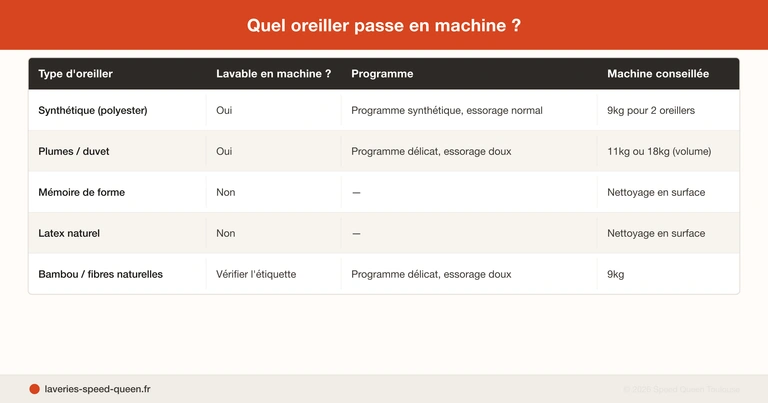
Synthetic and feather/down pillows can be machine washed, while memory foam and latex pillows must not be put in the drum.
Not all pillows are machine washable. The filling determines the cleaning method.
| Pillow type | Machine washable? | Program | Recommended machine |
|---|---|---|---|
| Synthetic (polyester) | Yes | Synthetic program, normal spin | 9 kg for 2 pillows |
| Feather / down | Yes | Delicate program, gentle spin | 11 kg or 18 kg (volume) |
| Memory foam | No | — | Surface cleaning |
| Natural latex | No | — | Surface cleaning |
| Bamboo / natural fibers | Check the label | Delicate program, gentle spin | 9 kg |
Always check your pillow’s care label before washing.
Memory foam and latex: never in the machine
These fillings cannot withstand machine washing. Clean the surface and let air dry.
Preparation before washing
Remove the pillowcase and protector — wash them separately with your sheets.
Check the condition — a torn or unstitched pillow will lose its filling in the drum.
Identify stains — pre-treat with a suitable product, following the manufacturer's instructions.
Check the care label — it indicates the maximum temperature and whether machine drying is allowed.
Yellow stains on pillows
Pre-treat locally if needed before washing. More details in our tough stain guide.
Washing by pillow type
Set a synthetic pillow to 40 °C on a normal cycle, and a feather/down pillow to 30 °C on a delicate program (600 rpm max), ideally in pairs to balance the drum.
Synthetic pillow
The easiest to maintain. Polyester handles machine washing and drying well.
Temperature
40 °C on a normal cycle. Polyester handles this temperature well. If the label allows 60 °C, it's useful after illness or to kill dust mites. See our temperature guide.
Program and spin
Synthetic or normal program, standard spin (800-1000 rpm). Synthetic is tough and rinses easily.
Quantity
2 pillows per 9 kg machine. Leave enough space for the pillows to move freely in the drum: a compressed pillow won't rinse properly.
Feather or down pillow
More delicate. Down is sensitive to heat and agitation.
30 °C, delicate program
Gentle spin (600 rpm max). Use liquid detergent: powder is harder to rinse out of down and can leave residue. A larger machine (11 or 18 kg) helps the filling distribute evenly during the cycle.
Always wash in pairs
A single pillow in a large drum can become unbalanced during the spin cycle. Put two pillows in to balance the load, or add a clean towel.
Drying: the decisive step
Allow 30 to 60 minutes of drying depending on the filling, in several sessions, with 2 tennis balls for feather/down pillows to prevent clumping.
A poorly dried pillow retains moisture in the center of the filling, which causes mold and odors within a few days. Drying is more important than the washing itself. Find our complete tips in the drying guide.
Synthetic: 30-45 min
Dry in 2-3 sessions of 10-15 minutes, medium heat. Shake the pillow between each session to redistribute the filling. Fold it in half and press the center: if it feels cool, run another session.
Feather/down: 45-60 min
Dry in 3-4 sessions of 15 minutes, low to medium heat. Add 2 clean tennis balls in the drum to prevent the down from clumping. Shake vigorously between each session.
Never store a still-damp pillow
After tumble drying, let the pillow air out for a few minutes before putting the pillowcase back on. If you air dry, be careful: the moisture released by indoor drying actually promotes the mold you’re trying to avoid.
Mistakes to avoid
- Temperature too high for down — feathers become brittle
- Incomplete drying — mold and odors within days
- Memory foam pillow in the machine — it will be destroyed
- Overloading the machine — pillows need space for a proper rinse
- Forgetting to check the seams — a torn pillow releases its filling in the drum
Cleaning non-washable pillows
For memory foam and latex pillows:
Surface clean — damp cloth, without soaking the filling.
Spot clean stains — damp sponge with a little Marseille soap, without soaking.
Air out — let air dry before putting the pillowcase back on.
Use a pillow protector — it protects the pillow and is easily machine washed.
Washing frequency
The recommended frequency is 2 to 4 washes per year for a synthetic pillow, and 1 to 2 washes per year for a feather/down pillow.
Synthetic pillows
2 to 4 times per year. Polyester retains more sweat and dust mites than down.
Feather/down pillows
1 to 2 times per year. Down gets dirty less quickly, but a biannual wash maintains hygiene.
Pillow protector
Once a month. It absorbs nighttime sweat and protects the pillow: it's the protector that should be washed often, not the pillow.
Pillowcases
Every week, at the same time as the sheets. The pillowcase is in direct contact with your face.
If the pillow stays flat after washing and won’t fluff up again, it’s time to replace it (average lifespan: 2-3 years for synthetic, 5-6 years for quality down).
Maintenance between washes
A pillow is only washed 2-4 times a year, but it absorbs sweat, saliva and dead skin every night. A few steps between washes extend its freshness and delay the onset of bad odors.
Air out your pillow outdoors once a month for 2-3 hours. The sun’s UV rays have a natural bactericidal effect that reduces the microbial load accumulated in the filling. If you don’t have outdoor space, place the pillow near an open window.
Always use a pillowcase doubled with a pillow protector. The protector absorbs most of the sweat and can be washed weekly with the sheets. Without a protector, sweat and sebum penetrate directly into the filling and accelerate yellowing.
For allergy sufferers, vacuum the pillow surface every 2 weeks with the upholstery attachment to remove surface dust mites. And replace your pillow every 2-3 years — even well-maintained, a pillow loses 30-40% of its support after 2 years of daily use.
En tant que Partenaire Amazon, nous percevons une petite commission sur les achats effectués via les liens partenaires de cet article — sans surcoût pour vous. Cela nous aide à maintenir ce site et à produire des guides gratuits.
Your pillows need a good wash? Our laundromats in Blagnac, Croix-Daurade and Montaudran have machines 9-18 kg suited to all pillow sizes. Detergent included, payment CB sans contact ou espèces. Check our detailed prices.
How to tell if a pillow needs replacing
A pillow that doesn’t regain its fluffiness after a full wash and dry has reached the end of its life. Two simple tests:
The fold test — fold the pillow in half and release. If it unfolds and springs back into shape, it’s still good. If it stays folded, the filling is dead and no longer supports your head properly.
The hand test — lay the pillow flat and press the center with your palm. If it springs back slowly but firmly, it’s fine. If it stays depressed or you feel lumps, it’s time to replace it.
Average lifespan: 2-3 years for a synthetic pillow, 5-6 years for a quality down pillow, 3-4 years for a memory foam pillow (which cannot be machine washed). Pillow protectors washed regularly at 60 °C extend this lifespan by 6 to 12 months.
Hygiene and dust mites: why regular washing matters
A pillow used for 2 years without washing can contain up to 10% of its weight in dead dust mites, mold spores and skin cells. This isn’t just a problem for allergy sufferers: these residues promote skin irritation, breakouts and nighttime respiratory issues.
Washing at 60 °C kills 99% of dust mites and their allergenic droppings. For people with dust mite allergies, monthly washing is recommended. For others, a quarterly wash is the minimum for proper hygiene.
Cost of washing pillows at a laundromat
For a pair of synthetic pillows, a 9 kg machine is sufficient: expect €4.90 to €5.50 for the wash, then €3 to €4.50 for drying. A feather or down pillow requires a larger machine (11 or 18 kg) so the filling distributes properly during the cycle. With a wash every 3 months, the annual budget is between €30 and €40, detergent included.
Laundromat, dry cleaner or at home: the price comparison
Three options exist for washing your pillows: the home washing machine, the self-service laundromat and the dry cleaner. Here’s the real comparison.
| Option | Cost (2 pillows) | Drying | Total time |
|---|---|---|---|
| Home machine (7-8 kg) | €1-2 (water + energy) | Air dry: 24-48h | 24-48h |
| Self-service laundromat (9 kg) | €8-10 (wash + dry, detergent included) | Professional dryer: 30-45 min | ~1h15 |
| Dry cleaner | €20-40 (€10-20/pillow) | Included | 48-72h |
The home machine is the cheapest, but air drying takes 24 to 48 hours — and a poorly dried pillow develops mold at its core. The laundromat offers the best speed-to-price ratio: wash and complete drying in 1h15, with a professional tumble dryer that ensures even drying all the way to the center of the filling. At the dry cleaner, the price is 2 to 4 times higher, with a 48 to 72 hour turnaround.
Choosing your pillow based on ease of care
The filling determines both comfort and ease of care. If you wash regularly (allergies, perspiration), the choice of filling directly impacts your budget and time.
Synthetic: the most practical
€15-40 to buy, washable at 40-60 °C, dries in 30-45 min. Lifespan: 2-3 years. This is the easiest filling to maintain at a laundromat. Ideal if you wash your pillows every 2-3 months.
Feather/down: superior comfort, delicate care
€40-100 to buy, washable at 30 °C delicate, dries in 45-60 min. Lifespan: 5-6 years. More durable but requires more careful washing (gentle spin, tennis balls for drying). Cost-effective over time if you take care of it.
Memory foam: no machine
€50-150 to buy, not machine washable. Lifespan: 3-4 years. Surface cleaning only. Always protect it with a washable pillow protector to extend its lifespan.
In terms of total cost over 5 years (purchase + washes), a synthetic pillow comes to around €100-160 (2 pillows bought + ~20 laundromat washes). A feather/down pillow comes to €80-140 (1 pillow + ~10 washes). Memory foam costs €100-300 (1-2 pillows, no washing costs but more frequent replacement).