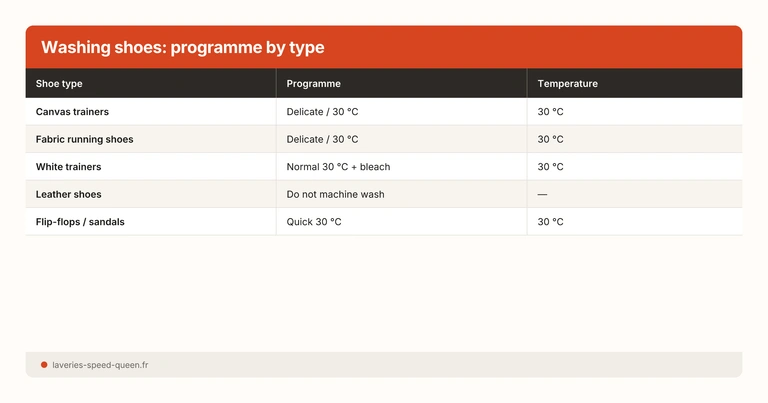
In a nutshell: Canvas and synthetic shoes can be machine washed at 30 °C on a delicate program. Remove laces and insoles, place the shoes in a mesh bag or pillowcase. Leather, suede and nubuck should never go in a machine. Air dry only — the dryer warps shoes and peels the soles off.
At a Glance
Check the label — if there's no machine-wash indication, hand clean instead.
Prepare — remove laces/insoles, brush off mud, protect with a bag.
Gentle program, 30 °C max — delicate or wool cycle, reduced spin.
Which Shoes Can Be Machine Washed?
Only canvas or synthetic shoes, explicitly approved by the care label, should go in the machine at 30 °C maximum.
Not all shoes can handle machine washing. Before putting them in the drum, place each pair in a fine mesh laundry bag↗ to cushion impacts and protect the machine. For caked-on stains on the soles, pre-treating with Marseille soap↗ and an old toothbrush makes all the difference. Here’s how to sort them. For technical sports shoes, check our sportswear care guide which also covers running sneakers:
Best: Canvas and cotton
Acceptable: Mesh and synthetic
Forbidden: Leather and suede
Forbidden: Fragile soles
| Shoe Type | Machine? | Max Temp. | Program | Spin |
|---|---|---|---|---|
| Canvas / canvas sneakers | Yes | 30 °C | Delicate | 400–600 rpm |
| Synthetic sneakers | Yes | 30 °C | Delicate | 400–600 rpm |
| Running shoes | With care | 30 °C | Wool / delicate | 400 rpm |
| Espadrilles / summer shoes | Yes | 30 °C | Delicate | 400 rpm |
| Plastic flip-flops | Yes | 30 °C | Delicate | — |
| Genuine leather | No | — | — | — |
| Suede / nubuck | No | — | — | — |
| Re-glued shoes | No | — | — | — |
| Gore-Tex / membrane | Check label | 30 °C if allowed | Delicate | 400 rpm |
Check the label
If it says “hand wash only” or shows a crossed-out wash symbol, don’t put them in the machine. When in doubt, it’s better to play it safe.
Pre-Wash Preparation
Remove laces and insoles, then brush off dried mud before the cycle: this preparation reduces impacts and improves wash results.
Good preparation is the difference between clean shoes and ruined shoes.
Remove the laces — Wash them separately or in a small bag
Remove the insoles — They dry better separately
Remove dried mud — Brush or tap the soles before washing
Use a protective bag — It protects both the machine and the shoes
Handy tip
No laundry bag? A pillowcase works. Tie it shut so the shoes don’t come out during the cycle.
Machine Settings
Use a delicate cycle at 30 °C with 2 to 3 towels in the drum to cushion impacts during tumbling.
Temperature: 30 °C maximum
Always cold water for shoes. Above 30 °C, glues soften and reinforcements peel off. No exceptions.
Program: delicate or wool
If your machine offers a wool program, that's the best fit: slow rotation, minimal agitation. Otherwise, choose the delicate program. Avoid any intensive cycle.
Never wash shoes alone
Add 2-3 terry towels to the drum. They cushion impacts, protect the drum and improve tumbling. Without towels, shoes bang against the stainless steel throughout the cycle.
Laces and insoles: separately
Laces go in a laundry bag or a tied pillowcase (otherwise they wrap around the drum). Insoles are hand washed with a brush and soap, then air dried.
Spin Cycle: Reduce to Minimum
The spin cycle is the riskiest step for shoes. Choose the lowest setting possible (400-600 rpm). It’s better to retrieve damper shoes and let them dry naturally than to risk deformation.
The laundry bag protects the machine
During the spin cycle, the bag prevents shoes from banging against the drum. Without a bag, repeated impacts damage the shoes AND the machine (scratches on the stainless steel, drum imbalance).
Special Cases
Technical or white models are also washed on a gentle program, with local stain pre-treatment and no aggressive heat.
White Sneakers
Pre-treat heavily soiled areas before washing. Avoid products prohibited by the label ( crossed-out triangle = no bleaching). To restore whiteness after washing, check our guide to whitening yellowed laundry which also works on sneakers.
White Sneakers: Cleaning Protocol
White sneakers are the most searched-for shoes when it comes to machine washing — and the most prone to yellowing. Here’s the complete protocol for machine washing your white sneakers without damaging them.
Stain Pre-Treatment
Before putting your white sneakers in the machine, treat each visible stain individually. Apply a paste of baking soda and water (2 tablespoons for 1 tablespoon of water) on gray or stained areas — sole, heel counter, toe-cap canvas. Let it sit for 15 minutes, then scrub with an old toothbrush. For tougher stains (grass, dried mud), sodium percarbonate is more effective: same method, 30 minutes of sitting time.
Specific Settings
Wash your white sneakers alone or with white laundry only — never with colored clothes that might bleed. Delicate program at 30 °C, spin at 400 rpm maximum. Add 2 white towels to the drum to cushion impacts. Use a liquid detergent without harsh bleaching agents: liquid bleach causes synthetic materials to yellow over repeated washes.
Drying and Yellowing Prevention
Drying is the critical step for white sneakers. Avoid direct sunlight: UV rays accelerate yellowing of plastics and exposed glues. Stuff the shoes with white paper (not printed newspaper, the ink can stain). Dry in the shade, in a ventilated area. If your sneakers have already yellowed despite precautions, see the whitening white sneakers section further below in this article.
Frequency and Routine Care
Don’t machine wash your white sneakers more than once a month. Between washes, clean stains as they appear with a damp sponge and a little Marseille soap↗. A waterproofing spray↗ applied after each wash creates a barrier that slows stain build-up and makes spot cleaning easier.
Technical Running Shoes
These shoes often have breathable membranes and reinforcements that don’t tolerate heat. Just like your technical sportswear, the gentle setting is crucial.
Gentle program mandatory
Wool or delicate program, low setting. At higher temperatures, reinforcements can come unglued and membranes can lose their properties.
When to Avoid Machine Washing
Avoid the machine entirely after a recent re-gluing, in the presence of fragile decorative elements, or on already very worn pairs.
- Putting shoes bare in the drum: Repeated impacts can damage the machine drum and destroy the shoe. Always use a mesh bag.
- Forgetting to remove the laces: Laces risk getting tangled, stuck in the drum or poorly washed.
- Washing in hot water: Above 30 °C, the glue holding the sole can melt and come apart.
- Using the spin cycle: Spinning compresses and twists the shoe. Always disable it (0 rpm).
Drying: The Important Part
Allow 24 to 48 hours of air drying with absorbent paper inside, without a radiator or dryer.
Drying is just as important as washing. Improper drying can warp your shoes.
Air dry
Let them dry at room temperature, never in the dryer or near a radiator
Stuff with paper
Newspaper absorbs moisture and helps maintain the shape. Change it when it gets wet
Patience
Let them dry completely before wearing them again. Never wear still-damp shoes — that's the fastest way to develop odors and mold.
What damages your shoes during drying
Dryer: heat unglues soles and warps synthetic materials. Radiator: concentrated heat cracks synthetic leather and hardens glues. Direct sunlight: yellows whites and degrades plastics. Hair dryer: same problem as a radiator, only worse (localized heat).
Post-Wash Care
After complete drying, re-insert the insoles, re-lace the pair and apply a waterproofing spray on running or trail shoes.
A machine wash cleans well, but a few steps after drying extend the lifespan:
Re-waterproof if needed
Washing removes water-repellent treatments. For running or trail shoes, apply a waterproofing spray after complete drying.
Re-insert the insoles
Wait until the insoles are completely dry. If they're worn or warped, this is a good time to replace them.
Re-lace properly
Take the opportunity to replace worn laces. New laces transform the look of a pair of sneakers.
Preventing Odors Between Washes
Shoe odors come from bacteria that thrive in residual moisture. Prevention is more effective than a remedial wash.
Airing and Rotation
Air out your shoes after each use — don’t put them away while still warm in a closed closet. Leave them in the open air for at least 12 hours. Rotate your pairs to let each pair dry completely between uses (24 hours minimum).
Moisture Absorbers
Slip a sachet of baking soda↗ into each shoe after use. Baking soda absorbs moisture and neutralizes the acids responsible for bad odors. Replace the sachet every 2 weeks. Alternative: activated charcoal sachets or scented cedar inserts, which work on the same absorption principle.
Antibacterial Insoles
If your shoes still smell despite airing, replace the insoles with antibacterial models (activated charcoal or copper). These insoles limit bacterial growth at the source. Expect to pay 8-15 € per pair, replaced every 3-6 months.
For sports shoes, check our sportswear care guide which also covers sneakers.
Whitening White Sneakers
White sneakers yellow over time, even with regular washing. Yellowing comes from oxidation of glues and degradation of UV stabilizers in synthetic materials.
Percarbonate Method (Most Effective)
- Prepare a paste with 2 tablespoons of sodium percarbonate↗ and a little warm water.
- Apply to yellowed areas (soles, canvas, heel counters) with an old toothbrush.
- Let sit for 30 minutes.
- Scrub and rinse before running a delicate cycle at 30 °C.
Percarbonate is an oxygen-based whitening agent — it doesn’t bleach like chlorine bleach and respects the fibers. For more details, check our guide on whitening yellowed laundry.
What Doesn’t Work
Avoid liquid bleach on sneakers: it yellows synthetics and weakens glues. White toothpaste (no colored gel) can work as a quick fix on white soles, but its effectiveness is limited on canvas.
Recommended Wash Frequency
Washing too often damages shoes just as much as not washing them at all. Here are the guidelines by use:
| Use | Machine Frequency | Between Washes |
|---|---|---|
| Running / intense sport | Every 3-4 weeks | Air after each session, brush off mud |
| Daily sneakers | Once a month | Wipe stains, rotate pairs |
| Summer shoes / espadrilles | 2-3 times per season | Brush off sand, air in indirect sunlight |
| Going-out sneakers (light use) | When visibly dirty | Spot clean with a damp sponge |
Beyond these guidelines, trust two indicators: smell (a sign of bacterial growth) and appearance (caked-in stains that a sponge can no longer remove).
Laundromat vs Home Machine
For shoes, the laundromat offers a specific advantage: drum space. Professional 9 or 18 kg machines give shoes more room to tumble without constantly banging against the same wall. In a 7 kg home machine, shoes are more cramped, which increases impacts and the risk of deformation. The same principle applies to washing a weighted blanket or washing a backpack — machine capacity matters.
The other advantage is the program. Speed Queen machines have precise, stable spin settings — you can select exactly 400 or 600 rpm. On some home machines, the “delicate” program still spins at 800 rpm, which is too aggressive for shoes.
How to Do It at a Laundromat
- Arrive with your shoes in a laundry bag (or a pillowcase).
- Add 2-3 towels to the drum of the 9 kg machine.
- Select the delicate program at 30 °C.
- Set the spin to the lowest available setting.
- Retrieve the shoes, stuff them with newspaper.
- Air dry — don’t put them in the laundromat dryer.
Material Questions: Mesh, Knit and Flyknit
Modern running shoes use mesh (open-weave) or knit (one-piece knitted) uppers. These materials are lighter and more breathable, but also more fragile when washed.
Classic mesh — handles machine washing well at 30 °C, delicate program. Mesh is an open weave that cleans easily and dries quickly. It’s the easiest material to care for.
Knit and flyknit — more delicate. The knit is a single piece that can deform if agitation is too strong. Always use a laundry bag, minimum spin (400 rpm), and never put in the dryer. Knit dries naturally in 12-24 hours.
Synthetic leather (faux leather) — handles a quick 30 °C wash if the label allows, but be careful: heat cracks the coating. Avoid any contact with the dryer or a radiator.
If you’re unsure about the material type, check the label inside the tongue. It shows the composition and care instructions.
Need to give your shoes a good clean? Our laundromats in Blagnac and Croix-Daurade offer delicate programs suited for shoes. Detergent included, payment CB sans contact ou espèces. Check our prices.
As an Amazon Associate, we earn a small commission on purchases made through affiliate links in this article — at no extra cost to you. This helps us maintain this site and produce free guides.