In short: 60 °C is mainly for sturdy cotton textiles when hygiene becomes a real constraint: sheets, towels, tea towels, some cotton underwear and some heavily soiled baby laundry. It is not the “washes everything better” setting, but a targeted tool. For colours, synthetics, wool, silk, denim and most everyday clothing, it is often unnecessary or too aggressive.
At a glance
Yes to 60 °C — sheets, pillowcases, towels, tea towels, some sturdy cottons.
Only if the care label allows it — the wash-tub number remains the limit to follow.
No for much of the wardrobe — jeans, vivid colours, wool, silk, elastane, many technical garments.
60 °C serves a targeted hygiene purpose — not a general habit.
Quick answer: which clothes to wash at 60 °C?
Wash at 60 °C the sturdy textiles that meet two conditions: the care label allows it, and the situation requires hygiene beyond everyday laundry. This mainly applies to bedding, towels, tea towels, some cotton underwear and some genuinely soiled baby laundry.
Most competing pages answer with a simple list of items. That is not enough. The real filter is the intent behind the wash.
- If you just want to freshen an everyday garment, 30 or 40 °C is often sufficient.
- If you are treating bedding in prolonged body contact, allergy-sensitive textiles or more heavily soiled household linen, 60 °C becomes more appropriate.
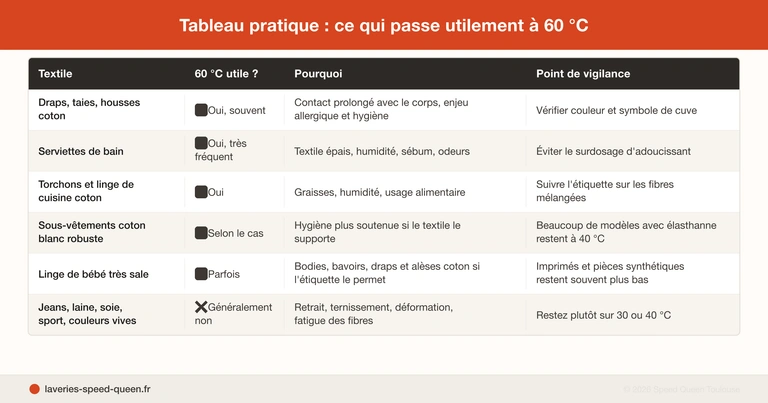
Practical chart: what genuinely benefits from 60 °C
| Textile | 60 °C useful? | Why | Point to watch |
|---|---|---|---|
| Sheets, pillowcases, cotton covers | ✅ Yes, often | Prolonged body contact, allergy and hygiene concerns | Check colour and wash-tub symbol |
| Bath towels | ✅ Yes, very common | Thick textile, moisture, sebum, odours | Avoid overdosing fabric softener |
| Tea towels and cotton kitchen linen | ✅ Yes | Grease, moisture, food contact | Follow the label for blended fibres |
| Sturdy white cotton underwear | ✅ Depending on the case | Enhanced hygiene if the textile can handle it | Many models with elastane stay at 40 °C |
| Heavily soiled baby laundry | ✅ Sometimes | Bodysuits, bibs, cotton sheets and mattress protectors if the label allows | Printed and synthetic items often stay lower |
| Jeans, wool, silk, sportswear, vivid colours | ❌ Generally no | Shrinkage, fading, deformation, fibre fatigue | Stick to 30 or 40 °C |
Comprehensive chart: what can and cannot go at 60 °C
Beyond the summary, here is an extended chart classifying over 20 common items by their real compatibility with 60 °C.
| Item | 60 °C? | Detail |
|---|---|---|
| White cotton sheets | ✅ Yes | Ideal use case for 60 °C in bedding |
| Cotton pillowcases | ✅ Yes | Face contact, sebum, hygiene |
| White cotton duvet covers | ✅ Yes | Check colour and label |
| White bath towels | ✅ Yes | Thick textiles, moisture, sebum |
| Coloured bath towels | ⚠️ Depends on label | Risk of fading on some dyes |
| Cotton kitchen tea towels | ✅ Yes | Food grease, kitchen hygiene |
| Cleaning cloths and rags | ✅ Yes | Often made of durable cotton |
| White cotton baby bodysuits | ✅ If label OK | Heavily soiled laundry only |
| Terry cotton bibs | ✅ If label OK | Baby food hygiene |
| Cotton mattress protectors | ✅ Yes | Bedding protection, prolonged contact |
| White cotton underwear | ✅ Depending on the case | If sturdy and elastane-free |
| Cotton sport socks | ⚠️ Depends on label | Often a cotton-synthetic blend |
| Thick white cotton T-shirts | ⚠️ Rarely necessary | 40 °C is sufficient for routine care |
| Coloured T-shirts | ❌ No | Fading and shrinkage |
| Jeans and denim | ❌ No | Shrinkage, fading, fibre fatigue |
| Wool jumpers | ❌ No | Irreversible felting and shrinkage |
| Silk and viscose | ❌ No | Fibres too delicate for this heat |
| Garments with elastane | ❌ No | Elasticity degrades with heat |
| Leggings and tights | ❌ No | Synthetic + elastane |
| Technical sportswear | ❌ No | Membranes and elastic fibres |
| Easy-iron cotton shirts | ⚠️ Rarely useful | 40 °C is more suitable for daily use |
| Terry bathrobes | ✅ Yes | Thick terry, bathroom hygiene |
| Fabric shower curtains | ⚠️ Depends on label | Check the exact composition |
| Printed baby sleeping bags | ❌ Rarely | Often limited to 40 °C due to print |
When 60 °C is necessary (not just useful)
In some situations, 60 °C is not a luxury but a necessity. Here are the cases where lowering the temperature is not an option.
Dust mites and allergies
The allergology literature is clear: 60 °C is the threshold that effectively destroys dust mites and significantly reduces the allergenic load in bedding. A 40 °C wash removes some soluble allergens but does not kill the mites themselves. For people suffering from allergic rhinitis, asthma or eczema linked to dust mites, washing compatible sheets, pillowcases and covers at 60 °C is part of the basic protocol. See our complete anti-dust-mite guide.
Bed bugs
In the event of a bed-bug infestation, 60 °C is the minimum recommended by health authorities to kill bed bugs and their eggs present in laundry. Infested laundry must be washed at a minimum of 60 °C, then tumble-dried at high temperature if the textile can withstand it.
Bacteria and illness
After gastroenteritis, flu or any contagious illness, bed linen and towels in contact with the sick person benefit from a 60 °C wash if the label permits. The same applies to heavily soiled baby laundry (vomit, faeces). Heat improves the elimination of pathogens compared to a warm cycle.
Mould on textiles
Towels that smell musty or textiles that have developed mould stains after damp storage benefit from a 60 °C cycle. Heat helps eliminate spores alongside the detergent. For stubborn cases, see our anti-mould guide.
When to avoid 60 °C even if it seems logical
Some instincts are misleading. Here are the cases where going up to 60 °C does more harm than good.
Delicate colours and dark garments
Dark dyes (black, navy, burgundy) and vivid colours (red, orange) fade faster under heat. A black pair of jeans washed at 60 °C fades within a few cycles. A red T-shirt loses its vibrancy. If hygiene does not require 60 °C, stick to 30 or 40 °C to preserve colours.
Synthetics and cotton-synthetic blends
Polyester, polyamide and nylon fibres do not handle prolonged heat well. The fabric distorts, the feel changes and wear accelerates. Many modern underwear, pyjamas and everyday T-shirts are actually cotton-synthetic blends: the label often caps at 40 °C.
Garments with elastane (Lycra, Spandex)
Elastane loses its stretch under heat. A pair of leggings, underwear or a swimsuit washed regularly at 60 °C will stretch out and lose its shape within weeks. For this type of laundry, also see our anti-shrinkage guide.
Printed or technical baby clothing
Bodysuits with prints, padded sleeping bags and baby clothes with bonded finishes are not all compatible with 60 °C. Read the label on each item. Prints or heat-bonded elements crack under heat. For baby laundry, sort by label rather than defaulting to “everything at 60 °C”.
Why 60 °C remains a genuine hygiene benchmark
60 °C is not interesting simply because it washes “harder”. It becomes useful when the textile needs to be more thoroughly sanitised, particularly for bedding and certain household linen.
Bedding and dust mites
On compatible sheets, pillowcases and covers, 60 °C remains the most widely used benchmark in anti-dust-mite protocols. This is the logic behind our anti-dust-mite guide.
Towels and damp linen
Thick textiles that stay damp for a long time trap odours, sebum and residues more easily. 60 °C helps reset to a cleaner baseline when the label allows it.
Kitchen and sturdy cotton
Tea towels and some kitchen linen handle 60 °C better and have a greater need for a hotter cycle than lightly worn clothes.
The bedding case
For sheets and pillowcases, the question of 60 °C is far more relevant than for a T-shirt or jeans. If you are looking for a complete protocol by frequency, temperature and season, also see how often to wash your sheets.
When 60 °C is a bad idea
60 °C is too aggressive for many everyday garments, even if they look “dirty”.
- Jeans and dark denim — risk of shrinkage, fading and fibre fatigue.
- Wool, silk, viscose — heat too high for these sensitive fibres.
- Garments with elastane — heat wears out the elasticity and shape.
- Vivid or black colours — heat accelerates fading.
- Technical and sportswear textiles — membranes and elastic fibres gain nothing from 60 °C in most cases.
Mainstream competitors often overlook an important detail: many underwear, leggings, pyjamas or modern T-shirts are actually cotton-elastane blends. Even if the use seems “hygienic”, the label may well cap at 40 °C.
40 °C or 60 °C: the real dividing line
The right trade-off is simple: 40 °C for heavier everyday loads, 60 °C for targeted hygiene on sturdy textiles.
| Question | 40 °C | 60 °C |
|---|---|---|
| Everyday body laundry | ✅ Often sufficient | ⚠️ Reserved for targeted cases |
| Cotton sheets and pillowcases | ⚠️ Intermediate | ✅ Useful benchmark if compatible |
| Towels and tea towels | ⚠️ Possible depending on use | ✅ Very appropriate |
| Delicate colours and denim | ✅ Safer | ❌ Too aggressive in most cases |
If you are still hesitating about the intermediate setting, also read our 30 or 40 °C guide.
The care label decides before habit does
A textile marked 40 °C maximum does not become compatible with 60 °C just because it looks dirtier to you.
The safest reference remains the GINETEX / ISO 3758 wash-tub symbol. The displayed number is a maximum limit, not a vague suggestion. This also applies to underwear, coloured bedding, printed baby clothes and cotton-synthetic blends.
Always check the wash tub
40 °C max = do not exceed 40. 60 °C allowed = only if the need genuinely justifies going that high.
Separate your loads
Do not mix white sheets compatible with 60 °C with dark garments or elastane-rich items.
Baby laundry
Distinguish a heavily soiled cotton bodysuit from a printed sleeping bag or a technical pyjama. They do not have the same temperature ceiling.
Common mistakes
- Washing everything at 60 °C "to be safe" — this wears out clothes without improving everything else.
- Confusing sturdy white cotton with cotton blends — elastane completely changes heat tolerance.
- Washing jeans at 60 °C — very poor habit for colour and shrinkage.
- Forgetting to dry completely — for bedding and towels, a good wash loses its value if the textile stays damp.
- Ignoring the wash-tub symbol — the textile ceiling always overrides domestic habit.
Methodology and sources
This article deliberately addresses the sub-intent “which clothes to wash at 60 °C?” rather than repeating a general temperature guide. The aim is to distinguish genuine targeted-hygiene cases from situations where 30 or 40 °C is more appropriate for preserving fibres.
- ADEME, Laundry care: 10 tips for health and the environment, published 20 November 2025, accessed 15 March 2026
- Clevercare / GINETEX, More eco-temperature tips, published 6 September 2023, accessed 15 March 2026
- McDonald & Tovey, Journal of Allergy and Clinical Immunology, accessed 15 March 2026
Sources and references
- ADEME - Entretien du linge : 10 conseils sante et environnement (lien externe)
- Clevercare - More eco-temperature tips (lien externe)
- GINETEX - Textile care symbols (lien externe)
- McDonald & Tovey (1992), PubMed (lien externe)
- Anti-dust-mite protocol: temperatures and frequencies
As an Amazon Partner, we earn a small commission on purchases made via the affiliate links in this article — at no extra cost to you. This helps us maintain this site and produce free guides.
60 °C is only useful on the right textiles. For the rest of the wardrobe, the real decision often comes down to 30 and 40 °C. And if you want the full chart by fibre, also see
our general washing temperatures guide
. For bedding and large loads, our laundromats offer machines suited to 60 °C washing.