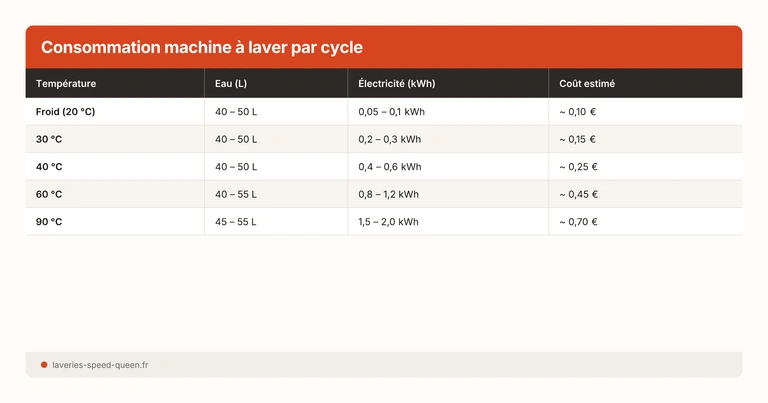
In short: a domestic washing machine uses 40-60 litres of water and 0.5-1.5 kWh of electricity per cycle depending on the temperature. 80% of the energy goes to heating the water — lowering from 60 to 30 °C cuts electricity consumption by 2 to 3 times. Average annual cost (220 cycles): 60-120 EUR (water + electricity, excluding detergent). The eco programme saves 30-50% on electricity. Per kilogram of laundry, professional laundromat machines are more efficient than home machines.
At a glance
40-60 L of water per cycle — a modern washer (class A-B). Older models go up to 80-100 L.
0.5-1.5 kWh per cycle — heating the water accounts for 80% of the cycle's electrical bill.
30 °C = -60% electricity vs 60 °C — the most powerful lever to reduce consumption.
Eco programme = -30 to -50% — washes longer but at a lower temperature.
Full load essential — a half load uses almost as much as a full machine.
60-120 EUR per year — average water + electricity cost for 220 cycles (excluding detergent).
Water consumption: how many litres per cycle?
The water consumption of a washing machine depends on three main factors: the age and class of the machine, the programme chosen and the fill level.
Modern machines (less than 5 years old)
A recent 7-8 kg washer rated A or B on the energy label uses between 40 and 55 litres per full cycle. This water is split between the wash bath (15-20 L), rinses (20-30 L, 2-3 rinse cycles) and residual water in the drum.
The most economical models (premium class A) go down to 36-40 litres thanks to rinse water recycling systems and turbidity sensors that automatically adjust the number of rinses to the actual dirtiness of the laundry.
Older machines (over 10 years old)
An older-generation washer (class C, D or lower on the old labelling) can use 70 to 100 litres per cycle. Automatic dosing technology and load sensors did not exist — the machine used the same amount of water regardless of the fill level.
Impact of the programme
| Programme | Water (litres) | Note |
|---|---|---|
| Normal cotton (40 °C) | 50-55 L | Standard programme, 2-3 rinses |
| Eco cotton (40 °C) | 40-45 L | Fewer rinses, longer time |
| Synthetics (30 °C) | 40-50 L | Higher water level to reduce friction |
| Wool / delicate | 45-55 L | More water to protect fibres, less rotation |
| Quick (15-30 min) | 30-40 L | Short cycle, single rinse, reduced load recommended |
| Pre-wash + wash | 70-90 L | Doubles consumption — avoid unless laundry is very dirty |
The pre-wash is the most water-hungry programme because it adds a full fill-and-drain cycle before the actual wash. Avoid it unless the laundry is very dirty or heavily stained — a manual pre-treatment (soaking, stain remover) is more water-efficient.
Electricity consumption: how many kWh per cycle?
This is where temperature plays a decisive role. Heating the water accounts for about 80% of the electrical consumption of a wash cycle. The motor (drum rotation), drain pump and electronics use only the remaining 20%.
By washing temperature
| Temperature | kWh per cycle | Electricity cost (at 0.25 EUR/kWh) | Relative index |
|---|---|---|---|
| Cold (20 °C) | 0.15-0.20 kWh | 0.04-0.05 EUR | 1x (reference) |
| 30 °C | 0.30-0.50 kWh | 0.08-0.13 EUR | 2x |
| 40 °C | 0.50-0.70 kWh | 0.13-0.18 EUR | 3x |
| 60 °C | 0.90-1.20 kWh | 0.23-0.30 EUR | 5-6x |
| 90 °C | 1.50-2.00 kWh | 0.38-0.50 EUR | 8-10x |
The conclusion is clear: going from 60 to 30 °C cuts electricity consumption by 2 to 3 times. It is the simplest and most impactful action to reduce the energy bill from washing.
Why does 80% of the energy go to heating the water?
Water has a very high specific heat capacity (4.18 J/g·°C). To heat 50 litres from 15 °C (mains water temperature) to 60 °C, you need to supply about 2.6 kWh of thermal energy. The washing machine’s electric heating element has an efficiency of 90-95%, giving 2.7-2.9 kWh of electrical energy. At 30 °C, you only heat from 15 to 30 °C (a 15 °C difference instead of 45 °C), meaning 3 times less energy.
The eco programme: a real lever
The eco programme (also called “eco 40-60 cycle” on recent machines) washes at a lower effective temperature (often 25-35 °C) for a longer duration (2-3 hours instead of 1-1.5 h). The idea: compensate for the lower temperature with extended detergent action time and longer mechanical action.
Real saving: 30 to 50% less electricity per cycle compared to the standard programme at 40-60 °C. Water consumption is also slightly reduced (optimised rinses).
Limitation: the eco programme is not suitable for very dirty laundry, stubborn stains or laundry that requires thermal disinfection (sick person’s sheets, baby linen). For those cases, a 60 °C cycle remains necessary.
Real annual cost: the full calculation
How much does your washing machine really cost in water and electricity each year? Here is the detailed calculation for an average French household in 2026.
Assumptions
- Frequency: 220 cycles per year (slightly above the French average of 200 cycles, source ADEME)
- Breakdown: 60% at 30-40 °C, 30% at 60 °C, 10% cold
- Machine: 7-8 kg washer, class B (mid-range 2024-2026)
- 2026 rates: electricity 0.25 EUR/kWh (EDF regulated rate), water 4.50 EUR/m3 (national average)
Cost breakdown
| Item | Annual consumption | Annual cost |
|---|---|---|
| Water | 10,000-12,000 L (10-12 m3) | 45-54 EUR |
| Electricity | 120-170 kWh | 30-43 EUR |
| Detergent | 220 doses | 33-66 EUR |
| Maintenance (descaling, cleaning) | — | 10-20 EUR |
| Annual total | — | 118-183 EUR |
Adding the depreciation of the machine (450-800 EUR over 10 years, i.e. 45-80 EUR per year), the total cost of ownership of a domestic washing machine sits between 160 and 260 EUR per year.
Washing temperature: the measured impact
The washing temperature is the main driver of electricity consumption. Here is the concrete impact of each level.
30 °C — The standard for everyday laundry
Consumption: 0.30-0.50 kWh per cycle.
Sufficient for lightly to moderately soiled everyday laundry: t-shirts, shirts, jeans, synthetic underwear. Modern detergents are formulated to be effective from 20-30 °C thanks to enzymes (proteases, lipases, amylases) that work at low temperatures.
40 °C — The compromise
Consumption: 0.50-0.70 kWh per cycle.
A good compromise for moderately soiled laundry, colours and synthetics. This is the “default” temperature for many programmes. The extra cost compared to 30 °C is moderate (~+50%), the gain in cleanliness is noticeable for light stains.
60 °C — Disinfection
Consumption: 0.90-1.20 kWh per cycle.
Necessary for bed linen, towels, baby linen, sick person’s linen and very dirty laundry. 60 °C kills the majority of bacteria and dust mites. It is also the recommended temperature for regular descaling of the drum (one empty cycle per month).
90 °C — The exception
Consumption: 1.50-2.00 kWh per cycle.
Reserved for extreme cases: disinfection after contagious illness, elimination of bed bugs, heavily stained laundry resistant to all other treatments. Most households never need this programme. The electricity surcharge is considerable: about 5 times the cost of a 30 °C cycle.
30 °C is enough in 80% of cases
According to ADEME, 80% of domestic laundry can be washed at 30 °C without visible loss of cleanliness, provided you use a quality detergent and do not overload the machine. If every French household dropped from 40 to 30 °C on average, the collective saving would be in the region of 1.5 TWh per year — the equivalent of the annual output of a small power station.
Professional laundromat vs home machine: the ratio per kg
A raw comparison (litres per cycle, kWh per cycle) does not tell the whole story. The relevant criterion is the consumption per kilogram of laundry washed.
| Criterion | Home machine (7 kg) | Prof. laundromat (11 kg) | Prof. laundromat (18 kg) |
|---|---|---|---|
| Water per cycle | 50 L | 60 L | 80 L |
| Water per kg | 7.1 L/kg | 5.5 L/kg | 4.4 L/kg |
| Electricity per cycle (40 °C) | 0.6 kWh | 1.0 kWh | 1.4 kWh |
| Electricity per kg | 0.086 kWh/kg | 0.091 kWh/kg | 0.078 kWh/kg |
| Rinse quality | Adequate | Superior | Superior |
Professional laundromat machines are designed for intensive use and an optimised water/energy ratio per kilogram. Their larger drum allows better tumbling (fewer cycles needed for the same amount of laundry) and more effective rinsing.
The advantage is particularly clear for large items: a double duvet (3-4 kg) in a 7 kg home machine leaves barely any room for tumbling. The same duvet in an 18 kg machine benefits from a far superior water and space ratio — resulting in more effective washing and rinsing in a single cycle.
Energy label: understanding the new system
Since March 2021, washing machines have been labelled on a new scale from A to G (without the old A+, A++, A+++ classes that had made the previous system unreadable).
Class A (dark green)
The most economical. About 50 kWh/100 cycles and 45-50 L/cycle. Very rare in 2026 — only a few high-end models. Purchase premium of 200-400 EUR over class C.
Class B-C (yellow-green)
The best value for money in 2026. About 55-75 kWh/100 cycles and 48-55 L/cycle. The majority of models sold fall in this range. Good energy efficiency at a reasonable price.
Class D-E (orange)
Entry-level or older machines. 80-100 kWh/100 cycles and 55-65 L/cycle. The annual energy surcharge (20-40 EUR) makes replacement worthwhile in 5-7 years if your machine is in this category.
Class F-G (red)
Very old or very low-end machines. 100+ kWh/100 cycles and 70+ L/cycle. Replacement recommended — the annual saving (40-60 EUR) quickly pays off the purchase of a class B-C model.
The energy label also shows the noise level in decibels (during operation and spinning), the eco cycle duration and the exact water consumption per cycle. It is the most reliable source for comparing models.
Environmental impact: beyond the bill
The consumption of a washing machine has an environmental impact that goes beyond the financial cost. Here are the orders of magnitude for a French household.
Carbon footprint
- A 40 °C cycle: about 0.3-0.5 kg of CO2 (low-carbon electricity in France + water + detergent)
- A 60 °C cycle: about 0.6-0.8 kg of CO2
- Over a year (220 cycles): about 80-130 kg of CO2
The French electricity mix being largely decarbonised (nuclear + renewable), the carbon footprint of washing in France is 3 to 4 times lower than in a country with coal-based electricity (Germany, Poland). The main remaining emission item is detergent manufacturing (petrochemistry, surfactants, packaging) and wastewater treatment.
Microplastics
Each wash cycle releases textile microfibres into wastewater — between 700,000 and 12 million microfibres per cycle depending on the fabric type. Synthetic textiles (polyester, nylon, acrylic) are the main emitters. Microplastic filters built into recent machines or washing bags (such as Guppyfriend) reduce this pollution by 80 to 90%.
Water: a resource under pressure
10,000 to 15,000 litres of water per year for washing is the equivalent of 75 to 115 bathtubs. During drought periods (increasingly frequent in southern France), every litre counts. The most effective measures: always wash with a full load, use the eco programme, and replace old models with low water consumption machines.
5 concrete actions to reduce consumption
Lower the temperature — going from 60 to 30 °C reduces electricity consumption by 60%. This is action #1.
Fill the machine — a machine at 80-90% capacity halves the consumption per kg vs a half load.
Use the eco programme — 30-50% electricity savings. Longer, but just as effective for lightly soiled laundry.
Descale regularly — limescale on the heating element increases heating time and consumption. An empty cycle with white vinegar or percarbonate every month.
Dose the detergent correctly — overdosing requires more rinses, which means more water.
Mistakes that increase consumption
- Washing with a half load — the machine uses almost as much water and energy as a full load, but for half the laundry.
- Washing everything at 60 °C — only bed linen, towels and very dirty laundry need 60 °C. Everyday items wash at 30 °C.
- Systematically using the pre-wash — it doubles water consumption. Pre-treat stains by hand before washing.
- Ignoring descaling — a limescaled heating element uses up to 30% more electricity to heat the same amount of water.
- Overdosing the detergent — excess foam requires extra rinses. Follow the recommended dosage based on water hardness.
- Running the machine at peak hours — on an off-peak/peak tariff, a cycle during off-peak hours (night, 23:00-07:00) costs 20-30% less in electricity.
Summary: your machine in numbers
A class B-C domestic washing machine in 2026, used 220 times per year at mixed temperatures (30-60 °C), consumes about 11 m3 of water and 140 kWh of electricity, for an annual cost of 85 EUR (water + electricity, excluding detergent). Detergent adds 30-65 EUR per year, and maintenance 10-20 EUR.
The levers for savings are clear: lower the temperature (the most impactful), fill the machine and use the eco programme. For large items (duvets, curtains, blankets), a professional laundromat offers a better consumption/kg ratio while ensuring more effective washing and rinsing.
As an Amazon Associate, we earn a small commission on purchases made via the affiliate links in this article — at no extra cost to you. This helps us maintain this site and produce free guides.
Our laundromats in Blagnac, Croix-Daurade and Montaudran use professional Speed Queen machines optimised for water and energy, with pre-dosed detergent. For duvets, curtains and large volumes, the consumption/kg ratio is better than at home. Payment CB sans contact ou espèces. See our prices.
Sources and references
- Laundromat vs home machine: the comparison
- Washing temperature guide
- Detergent dosage for your machine
- Descaling your washing machine
- White vinegar and laundry: uses and limits
- Microplastics and synthetic washing
- ADEME — Study on household appliance energy consumption in France
- European Regulation 2019/2014 — new washing machine energy label (A to G scale)
- EDF — Regulated electricity tariffs 2026