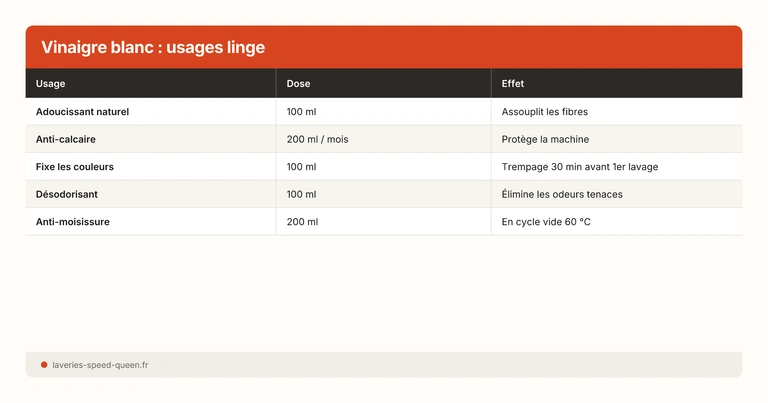
In a nutshell: white vinegar can help laundry mainly at the rinse stage: it limits certain mineral deposits, slightly softens stiff fibres and sometimes helps with odours linked to residue. However, it is neither a miracle stain remover, nor a universal disinfectant, nor a product to pour at random into every wash. Its benefit depends on the context, the fabric and the dosage.
The exact scope of this article
Here, we are talking about white vinegar on laundry and for rinsing. For cleaning the washing machine itself, keep a separate protocol in
how to clean your washing machine
. Mixing the two uses in the same method is the number one source of vague advice on this topic.
At a glance
Yes for rinsing — especially if laundry is stiff or the water is hard.
No to the "it does everything" myth — vinegar does not replace detergent on dirty laundry.
Not with bleach — a prohibited mixture.
Caution on sensitive fabrics — delicate fibres, unstable dyes, elastics.
Keep the wash phase for detergent — vinegar is most logical at the rinse stage.
What white vinegar can actually do for laundry
The right angle is not “miracle vinegar”, but “targeted rinse tool”. Its most defensible use on laundry is to help dislodge certain mineral deposits and residue that leave fibres stiff, dull or poorly rinsed.
The 4 real uses of white vinegar on laundry
1. Natural softener (the best use)
Acetic acid dissolves limescale and detergent residue trapped in the fibres. Laundry comes out softer, without the greasy film of softener. This is particularly useful for sensitive skin that reacts to scented softeners.
2. Anti-limescale rinse aid
In hard water, calcium ions deposit in fibres with every wash and stiffen them. White vinegar dissolves them — the same mechanism as a descaler on a tap, but applied to textile fibres. Result: less stiff laundry, less dull colours.
3. Deodoriser for certain odours
When the odour comes from poor rinsing or mineral deposits, vinegar can help. When the odour comes from an established textile biofilm (sportswear that smells despite washing), it is not always sufficient on its own — a baking soda soak will be more effective.
4. Brighten colours
Limescale dulls colours by depositing a whitish film on fibres. By dissolving this limescale, vinegar brightens the tones. It is not a miracle dyer, but on coloured clothes washed in hard water, the difference is noticeable.
Why vinegar works (the chemistry)
White vinegar↗ is a solution of acetic acid at 8-14% (pH ~2.5). Its action on laundry relies on a simple mechanism: the acid dissolves mineral deposits (calcium and magnesium carbonates) that form in fibres during washing in hard water. These deposits are the main cause of stiffness and dullness in laundry.
Acetic acid reacts with calcium carbonate (CaCO3) to form calcium acetate, CO2 (gas) and water — all soluble or flushed away during rinsing. It is a classic acid-base reaction, harmless to cotton, linen or polyester fibres at recommended doses.
What it does not do chemically: it does not lubricate fibres (unlike the cationic agents in softener), it does not neutralise static charges, and it has no significant antibacterial action at the concentrations used for laundry.
The right dosage for each actual use
The useful dosage is closer to “reasonable” than “half a litre in every load”. Many competing articles overdose because they do not distinguish between occasional maintenance, regular rinsing and recovering heavily soiled laundry.
| Use | Practical dosage | Where to add it | What to expect |
|---|---|---|---|
| Regular rinsing | 100 ml | Softener compartment | Slightly less stiff laundry, cleaner rinse |
| Hard water / stiff laundry | 150 to 200 ml | Softener compartment | More noticeable effect on mineral deposits |
| Towel recovery | 200 to 250 ml | Rinse cycle or dedicated cycle as per protocol | Occasional use, not systematic |
| Pre-treatment for stubborn odour | 1 glass per 5 L of water | Soaking before washing | Can help, especially combined with a proper wash afterwards |
Why the softener compartment is the most logical
If your goal is to aid rinsing, white vinegar should act after the main work of the detergent, not at the same time. During the wash phase, you muddle the chemical balance without necessarily getting a better result on the laundry.
The 3 real limits of white vinegar on laundry
Beyond dosage, it is important to understand what white vinegar cannot do. These limits are rarely mentioned in “natural cleaning” guides.
Limit 1: it does not disinfect laundry
Acetic acid has limited antibacterial action in the lab, but at the concentrations used for laundry (diluted in 50-60 litres of rinse water), its disinfecting effect is negligible. For genuine textile disinfection (after illness, dust mites, bed bugs), a wash at 60 °C minimum or an oxygen-based agent (sodium percarbonate) is needed.
Limit 2: it does not remove stains
UFC-Que Choisir has the merit of being far more honest than most blogs: in bench tests, vinegar produces modest results on most textile stains. Its acetic acid can help with visible limescale deposits (white marks), but it is ineffective on grease (no surfactants), blood (fixed protein), red wine (tannins), ink, and most organic stains. For stain removal, see our tough stains guide.
Limit 3: it is not suitable for silk, wool and delicate fabrics
The acidity of vinegar can damage protein fibres (silk, wool, cashmere) with regular use or excessive dosage. Elastics (elastane, Lycra) can also degrade faster. And some artisan or unfixed dyes are sensitive to acids. For delicate fabrics, prefer a specific pH-neutral detergent.
Dosage and frequency: the benchmarks to follow
The right dosage
Most blogs overdose. Here are the realistic benchmarks:
- Regular rinsing in hard water: 100 to 150 ml in the softener compartment. This is enough to dissolve limescale deposits without overloading the machine.
- Very hard water or very stiff laundry: 150 to 200 ml maximum. Beyond that, the benefit is marginal.
- Pre-treatment soak for odour: 1 glass (200 ml) per 5 litres of water. Soak for 30 minutes to 1 hour, then wash normally.
The right frequency
White vinegar should not be used with every single wash as a matter of course. Repeated acidity can:
- accelerate wear on the rubber seals of the machine (long-term, over months of daily use);
- leave a residual smell if the machine is poorly ventilated;
- become an unnecessary habit in soft water areas (where limescale is not an issue).
Recommended frequency: 1 to 2 times per week in hard water, occasionally in soft water when laundry is stiff or poorly rinsed.
Vinegar + baking soda: the myth to debunk
This is probably the most widespread mixture in “natural cleaning” recipes — and the most pointless from a chemical standpoint.
What actually happens
White vinegar is an acid (acetic acid, pH ~2.5). Baking soda is a base (pH ~8.3). When you mix them, an acid-base reaction occurs:
CH3COOH + NaHCO3 -> CH3COONa + H2O + CO2
The fizzing (CO2 bubbles) is visually impressive. But the chemical result is sodium acetate (a neutral salt) + water + carbon dioxide. In other words: the two active products neutralise each other and you end up with slightly salty water.
When the mixture has a (small) benefit
The mechanical fizzing can help dislodge surface dirt (in a drain, on a raised stain). But for laundry, this mechanical effect is negligible compared to the action of the machine.
The right approach
If you want the benefits of both products, use them in separate steps:
- Baking soda in the wash (in the drum with the detergent) to soften the water and neutralise odours.
- Vinegar in the rinse (in the softener compartment) to dissolve limescale and soften fibres.
This way, each product acts at its optimal pH without cancelling the other.
What white vinegar does not do well
- It does not replace detergent on genuinely dirty laundry.
- It does not remove all stains — many stains resist vinegar alone very well.
- It does not disinfect laundry on its own the way a proper hot cycle or adapted protocol would.
- It is not a universal solution for all fabrics nor for all odour problems.
The 3 most common mistakes with white vinegar and laundry
- Mixing it with bleach — a strictly prohibited combination.
- Presenting it as a universal disinfectant — that is not the right promise for everyday laundry.
- Pouring it everywhere, every time — overdosing and systematic use do not automatically improve results.
ADEME is explicit on one essential point: white vinegar is acidic, should be used sparingly and must never be mixed with other products, particularly bleach.
Fabrics and cases where caution is advisable
White vinegar is not “dangerous” by definition for laundry, but it is not neutral either. A serious approach means distinguishing reasonable use from repeated or poorly targeted use.
| Case | Why be cautious | Recommended approach |
|---|---|---|
| Wool, silk, delicate fibres | Sensitive fibres and fragile finishes | Test on a hidden area or choose a suitable mild detergent |
| Unstable or artisan colours | The issue sometimes comes from the dye, not the product alone | Avoid a long soak and start with a low dose |
| Technical fabrics | Membranes and water-repellent treatments require extra caution | Follow the label and specific textile recommendations |
| Repeated use at high doses | The “more I add, the better” reflex has no serious basis | Reserve high doses for occasional protocols |
The right place for vinegar in a laundry routine
White vinegar is a secondary tool, not the core of the wash. In a clean routine, it can fill 3 useful roles:
- occasional replacement for fabric softener;
- rinse aid for hard water or stiff laundry;
- simple pre-treatment for certain odour or residue cases.
What it does not do well on its own:
- wash instead of detergent;
- treat all stains;
- fix a dirty machine without a dedicated protocol;
- guarantee genuine textile hygiene on its own.
Methodology and sources
This article deliberately separates three uses that many competing articles conflate: textile rinsing, occasional pre-treatment and machine maintenance. The goal is to avoid the “universal vinegar” effect and keep the advice practical, compatible with real textiles and washing routines.
- ADEME, Basic ingredients for more eco-friendly cleaning, published 31 October 2025, accessed 15 March 2026
- UFC-Que Choisir, Textile stain removers: how do vinegar and baking soda perform?, published 26 March 2023, accessed 15 March 2026
- UFC-Que Choisir, Washing machines: dosing your detergent correctly, published 24 June 2019, accessed 15 March 2026
- Internal references: fluffy towels, sportswear care, cleaning your washing machine
- Baking soda and laundry: real uses
- [Sodium percarbonate and laundry](/blog/percarbonate↗-de-soude-linge/)
- Fabric softener: useful or not?
- Detergent residue and sensitive skin
- Delicate fabrics: the guide
- Tough stains: solutions
- Washing at 60 °C: which clothes?
As an Amazon Partner, we earn a small commission on purchases made through the affiliate links in this article — at no extra cost to you. This helps us maintain this site and produce free guides.
If you are looking for a realistic alternative to fabric softener, also read which detergent to choose and our feature on
detergent residue and sensitive skin
. For machine care, keep a separate protocol in
how to clean your washing machine
. And if your towels are already stiff, head to the fluffy towels guide rather than improvising a random dosage. Or discover our 3 laundromats in Toulouse and Blagnac for a professional rinse that limits residue.